
Grylloblattidae
Walker, 1914
ice crawlers, icebugs, rock-crawlers
Genus Guides
1- Grylloblatta(ice crawler)
, commonly known as ice crawlers or icebugs, is a of wingless, cold-adapted insects representing the sole living family of the order Grylloblattodea. These relict insects inhabit extreme cold environments including glacier margins, alpine snowfields, caves, and subalpine forests across disjunct regions of the Holarctic. With approximately 35 extant in six , they exhibit narrow physiological temperature tolerances and are considered endangered due to climate warming and specificity.
Pronunciation
How to pronounce Grylloblattidae: //ˌɡrɪloʊˈblætɪˌdiː//
These audio files are automatically generated. While they are not always 100% accurate, they are a good starting point.
Identification
Wingless insects found exclusively in cold microhabitats. Distinguished from other insects by combination of: long, multi-segmented and ; reduced or absent ; with visible ; and obligate association with near-freezing temperatures. Differ from (rock crawlers) by geographic distribution (Holarctic vs. southern Africa) and details of leg structure. Differ from Dermaptera (earwigs) by absence of forceps-like cerci and presence of long, filamentous cerci. -level identification requires examination of male genitalia and often molecular data.
Images
Appearance
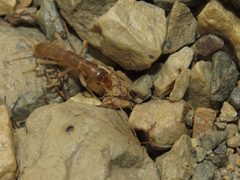
Small, wingless insects typically less than 3 cm in length. Elongated, somewhat flattened body with long, of 23–45 segments. with chewing mouthparts, resembling a in general form. reduced or absent; no ocelli. Long, segmented (5–8 segments) extend from the tip. Legs slender, adapted for crawling on cold substrates; some with tarsal , others without. Body coloration generally pale to dark brown. Male genitalia with IX bearing styli, a diagnostic synapomorphy.
Habitat
Cold, stable microhabitats including glacier margins, alpine snowfields, ice caves, lava tube caves, subalpine forests, and rock crevices near permanent ice or snowpack. In subalpine forests, has been observed in saproxylic within trees killed by bark beetles. Requires temperatures near freezing; many cannot survive above 10°C. Uses snowpack insulation to buffer against temperature extremes.
Distribution
Disjunct Holarctic distribution: western North America (Sierra Nevada, Cascade Range, Coast Range, Rocky Mountains from California to Alberta); northeastern Asia (Japan, Korean Peninsula, Russian Far East, Siberia); Central Asia (China, Kazakhstan, Mongolia). Patchy, localized occurrence with many known from single sites or restricted mountain ranges.
Seasonality
Active year-round in stable cold microhabitats. Seasonal vertical or horizontal movement to maintain optimal temperatures—descending under snowpack during colder periods, moving to surface snowfields during warmer periods. surface activity observed.
Diet
scavenging, primarily on dead arthropods and carrion. In alpine , feeds on wind-blown insects and organic detritus deposited on snowfields (Aeolian deposition). In subalpine forests, gut content analysis reveals feeding on subcortical . Plant material consumed when animal prey is scarce.
Life Cycle
with gradual development. Juveniles resemble in form and use. Specific developmental rates poorly documented due to inaccessibility of habitats; presumably slow development given cold temperatures.
Behavior
foraging on snowfields and in caves. Extremely low vagility with limited ability. Temperature-tracking : moves vertically or horizontally to maintain position within narrow thermal (approximately –4°C to +5°C optimal range). Some exhibit or intraspecific , particularly in cave environments.
Ecological Role
Scavenger in alpine and subalpine Aeolian , processing wind-deposited organic matter and carrion. of subcortical in forest . Serves as for climate change impacts on cold-adapted biota.
Human Relevance
Subject of conservation concern due to climate change vulnerability; warming poses existential threat. Scientific interest as relict lineage illuminating insect evolution and . Some in protected areas (Oregon Caves National Monument, Lava Beds National Monument). Research model for cold physiology and phylogeography.
Similar Taxa
- MantophasmatodeaClosest living relatives (together forming order/suborder Notoptera), but restricted to southern Africa; differ in leg and (rocky outcrops in warm temperate regions rather than cold environments)
- DermapteraBoth have , but earwigs possess forceps-like modified cerci and are not cold-adapted extremophiles
- Grylloptera (fossil)Extinct winged relatives with similar general body plan, but possessed well-developed wings and likely arboreal habits unlike extant wingless ground-dwellers
Misconceptions
Not true crickets or despite and superficial resemblance; represents distinct evolutionary lineage. Not restricted solely to glaciers—some inhabit caves, lava tubes, and subalpine forests without permanent ice.
More Details
Evolutionary history
Fossil evidence from Cretaceous Burmese amber (Zygogrylloblatta longipalpa, ca. 99 Ma) reveals winged, arboreal ancestors with well-developed wings, , and foot pads. Extant wingless, ground-dwelling condition represents derived to cold environments. diverged from winged ancestors prior to mid-Cretaceous.
Conservation status
Multiple listed as endangered or data deficient; extremely narrow distributions and climate warming pose severe threat. Some species known from single cave systems or specific mountain peaks. Korean and Japanese lineages show Miocene divergence associated with geological separation of landmasses.
Phylogenetic significance
Complete mitochondrial sequenced for Asian lineage shows conserved gene arrangement shared with polyneopteran insects. serves as model for investigating macroevolutionary patterns in insects coupled with global geo-climate changes since Mesozoic Era.
Sources and further reading
- BugGuide
- Wikipedia
- GBIF taxonomy match
- iNaturalist taxon
- NCBI Taxonomy
- Catalogue of Life
- Evolutionary diversification of cryophilic Grylloblatta species (Grylloblattodea: Grylloblattidae) in alpine habitats of California
- Three new species of Grylloblatta Walker (Insecta: Grylloblattodea: Grylloblattidae), from southern Oregon and northern California
- Phylogenetic Relationships and Relictualism of Rock-Crawlers (Grylloblattodea: Grylloblattidae) in Cave and Mountain Habitats of Korea
- Descriptions of a new genus and a new species, Grylloprimevala jilina (Grylloblattidae) from China
- New data on Galloisiana sinensis Wang, 1987 (Grylloblattodea: Grylloblattidae) with description of the hitherto unknown female
- Descending from trees: a Cretaceous winged ice-crawler illuminates the ecological shift and origin of Grylloblattidae
- Two new species of Grylloblatta Walker, 1914 (Grylloblattodea: Grylloblattidae) from western North America, and a neotype designation for G. rothi Gurney 1953
- Grylloblatta campodeiformis(Grylloblattodea: Grylloblattidae) uses saproxylic habitats in subalpine forests of western Alberta, Canada: implications for conservation
- Descriptions of Two New Species of Grylloblattidae and of the Adult of Grylloblatta barberi, with an Interpretation of Their Geographical Distribution1
- <I>Galloisiana olgae</I> sp. nov. (Grylloblattodea: Grylloblattidae) and the Paleobiology of a Relict Order of Insects
- Review of extant Grylloblattidae (Insecta: Grylloblattodea) based on morphological and molecular data with a new species in Grylloblattella from China