
Poecilopompilus interruptus
(Say, 1837)
Interrupted Spider Wasp
Species Guides
3- Poecilopompilus interruptus cressoni
- Poecilopompilus interruptus interruptus
- Poecilopompilus interruptus semiflavus(Semiflavate Interrupted Spider Wasp)
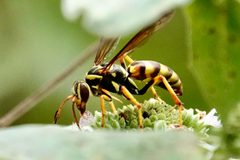
Poecilopompilus interruptus is a New World spider wasp in the Pompilidae. are highly variable in coloration, displaying combinations of -brown, yellow, and black markings. Females are 13 mm in length with curled tips, while males have straight or gently curved antennae. The exhibits Müllerian mimicry of paper wasps (Polistes). It preys exclusively on orb-weaver spiders (Araneidae) and has been documented visiting numerous flowering plants and extrafloral .


Pronunciation
How to pronounce Poecilopompilus interruptus: /ˌpɛsɪloʊˈpɒmpɪləs ˌɪntəˈrʌptəs/
These audio files are automatically generated. While they are not always 100% accurate, they are a good starting point.
Identification
To distinguish from Poecilopompilus algidus, examine two key characters: (1) spines on front of females—P. interruptus has four weak spines versus three strong spines in P. algidus; (2) inner margin of —parallel in P. interruptus versus strongly convergent at top in P. algidus. Color pattern alone is unreliable for separation. Resembles paper wasps (Polistes) due to Müllerian mimicry.
Images
Habitat
Open areas with bare soil suitable for nesting. Associated with vegetation hosting prey spiders and flowering plants for nectar. Documented at extrafloral of agricultural crops including cotton (Gossypium hirsutum) and sunflower (Helianthus annuus).
Distribution
North and Central America. Four recognized with distinct ranges: P. i. interruptus from southern California east and north through Mexico to Chiapas; P. i. cressoni in northeastern United States and southeastern Canada; P. i. dubitatis from eastern Mexico south to Panama; P. i. semiflavus confined to the Central Valley of California.
Diet
feed on nectar from flowers including Chrysothamnus sp., Medicago sativa, Psilostrophe cooperi, Wislizenia refracta, Eriogonum fasciculatum, Eriogonum thomasii, Ribes aureum, Acacia angustissima, and Penstemon rydbergii. Both sexes visit extrafloral . Females have been observed feeding on haemolymph of captured spiders. Larvae provisioned with spiders of Araneidae (orb-weavers).
Host Associations
Life Cycle
Females sting orb-weaver spiders into weak paralysis, transport them backwards overland to nesting sites in bare soil, typically in crotches of grass tussocks or other vegetation. Burrows range 2.5–11 cm deep, angled 45–90 degrees, terminating in a spherical chamber where prey is placed and a single is laid. Burrow entrance is carefully concealed after provisioning.
Behavior
Female transports prey backwards while . Nests in soil, excavating with and kicking soil with front legs. Both sexes visit flowers and extrafloral . Exhibits Müllerian mimicry of paper wasps.
Ecological Role
of orb-weaver spiders. Potential through flower visitation. Participant in Müllerian mimicry complex with other aposematically colored .
Human Relevance
Can deliver painful stings when handled; one documented case from Cincinnati, Ohio. Occasionally encountered in agricultural settings due to attraction to crop extrafloral . Presence indicates healthy spider .
Similar Taxa
- Poecilopompilus algidusOverlapping distribution and similar Müllerian mimicry coloration; distinguished by female front tarsal spine count and margin shape
- Polistes spp.Visual mimic; paper wasps share yellow-brown banded coloration but differ in (Vespidae), nest architecture, and
More Details
Subspecies
Four recognized based on geographic distribution and subtle morphological differences: interruptus, cressoni, dubitatis, and semiflavus.
Mimicry
Member of a Müllerian mimicry complex; the variable coloration appears to mimic paper wasps (Polistes), with both groups being chemically defended.
Sources and further reading
- BugGuide
- Wikipedia
- GBIF taxonomy match
- iNaturalist taxon
- Catalogue of Life
- Bug Eric: June 2012
- Bug Eric: Wasp Wednesday: Poecilopompilus algidus
- Brazil Bugs #4 – Mais dos percevejos | Beetles In The Bush
- Bug Eric: Wasp Wednesday: Neamblyjoppa?
- Bug Eric: Spider Sunday: Labyrinth Spiders
- Bug Eric: Ichneumon Wasp: Ceratogastra ornata