
Poecilopompilus algidus
(Smith, 1855)
Spider Wasp
Species Guides
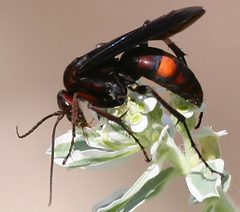
4Poecilopompilus algidus is a spider wasp ( Pompilidae) widespread across the Americas, from southern Canada to Argentina. The exhibits remarkable geographic variation in coloration due to Müllerian mimicry of sympatric —resembling paper wasps (Polistes) in the south and dark spider wasps (Anoplius) in the north. Females hunt orb-weaver spiders (Araneidae) to provision underground nests, paralyzing prey with a sting and dragging it backwards to burrow sites in sandy soils. The species includes five recognized with varying distributions across North and South America.


Pronunciation
How to pronounce Poecilopompilus algidus: /ˌpɛkɪloʊˈpɒmpɪləs ælˈdʒaɪdəs/
These audio files are automatically generated. While they are not always 100% accurate, they are a good starting point.
Identification
Distinguished from the similar Poecilopompilus interruptus by examining two key characters: (1) females of P. algidus have 3 strong spines on the front versus 4 weak spines in P. interruptus; (2) P. algidus has convergent inner margins (eyes angled toward each other at the top) while P. interruptus has parallel inner eye margins. Geographic color variation complicates visual identification, making morphological examination necessary for definitive determination.
Images
Appearance
Medium-sized spider wasp, 13–28 mm in length with females typically larger than males. Coloration varies geographically: southern often black with yellow or reddish markings resembling Polistes paper wasps, while northern populations are predominantly black with red abdominal spots resembling Anoplius spider wasps. Some populations show mainly black coloration with a single red spot on the metasoma. Females possess three strong spines on the front . The shows convergent inner margins (eyes angled toward each other at the top). Wings are typically dark, especially in northern specimens.
Habitat
Prefers sandy areas where it excavates burrows ( habit), but also occurs in well-vegetated including scrub and open woodlands. In Florida, females have been observed hunting in vegetation at heights of 3–20 meters. P. a. fervidus in Brazil nests in sandy banks among Eucalyptus plantations.
Distribution
Widespread in the Americas from Ontario, Canada south through the United States, Mexico, and Central America to Argentina. In the United States, occurs from California to Arizona, Utah, Texas, Florida, and north to South Dakota, Minnesota, Michigan, and Massachusetts. Five recognized: P. a. algidus (eastern North America), P. a. coquilletti (southwestern United States), P. a. fervidus (Neotropical), P. a. marcidus (western North America), and P. a. rubiginosus.
Seasonality
In northern portions of range, with active mid-summer to late autumn. In warmer southern regions, likely multivoltine with extended periods. Adults observed hunting in late afternoon in Florida observations.
Diet
feed on nectar, particularly from flowers of Baccharis spp., Chrysothamnus viscidiflorus, Heracleum lanatum, and Melilotus albus (males and females); females also visit Melilotus. Larvae are provisioned exclusively with spiders of the Araneidae (orb-weavers), including documented prey: Neoscona oaxacensis, Eriophora ravilla, Nephila clavipes, Parawixia sp., Argiope argentata, and Araneus sp.
Host Associations
- Araneidae - prey of orb-weaver spiders; females hunt in understory vegetation and trees, switching seasonally
Life Cycle
Solitary nesting . Females excavate burrows 2.5–11 cm deep in sandy soil, angling 45–90 degrees, with a spherical terminal chamber. The burrow is constructed near the prey deposition site, often in bare sand among vegetation or pine needles. Females sting spiders into weak paralysis, drag them backwards by the hind base to the nest site, temporarily deposit them in vegetation while completing excavation. Nests are provisioned with one spider per ; a single is laid on the final prey item. Burrows are carefully concealed with soil tamped by the and covered with debris such as pine needles. Larvae consume the paralyzed spider and pupate in the nest.
Behavior
Females hunt actively by on vegetation surfaces, intermittently flicking wings, remaining in outer leaf layers rather than deep cover. Prey is transported backwards over ground and under vegetation while grasped by the base of the hind . Burrow excavation involves biting through hard surface soil with , then kicking loosened sand backwards with forelegs; digging speed increases as completion nears. Nest lining with dried plant material such as pine needles has been observed. visit flowers and extrafloral , particularly on sunflower (Helianthus spp.).
Ecological Role
of orb-weaver spiders, potentially influencing spider and structure. Acts as a when visiting flowers for nectar. Serves as a Müllerian mimic in warning coloration complexes with other stinging , reinforcing aposematic signals to predators across multiple .
Human Relevance
Capable of delivering painful stings when handled; the can back up its aposematic advertisement. Generally not aggressive toward humans unless physically molested. May be encountered in gardens, parks, and natural areas with sandy soils. Of interest to entomologists studying mimicry and .
Similar Taxa
- Poecilopompilus interruptusOverlapping distribution and similar size; distinguished by female tarsal spine count (4 weak spines vs. 3 strong) and parallel inner margins (vs. convergent)
- Polistes spp.Southern of P. algidus are Müllerian mimics of paper wasps, sharing yellow and black coloration; distinguished by body shape, wing venation, and
- Anoplius spp.Northern mimic these dark spider wasps with red abdominal markings; distinguished by tarsal spine characters and margin shape
- Ceratogastra ornataIchneumon suggested to mimic Poecilopompilus; distinguished by many short antennal segments (vs. fewer, longer segments in spider wasps) and different wing venation
More Details
Mimicry and Color Variation
The exhibits extraordinary geographic plasticity in appearance due to Müllerian mimicry. In the southern United States, P. algidus resembles paper wasps (Polistes), while in the northern range it resembles spider wasps of the Anoplius (black with red abdominal bands). This variation led to recognition of multiple and complicates field identification based on coloration alone.
Nesting Observations
Detailed observations in southern Florida documented females hunting in late afternoon at 3–20 m heights in scrub vegetation, capturing Eriophora ravilla. The deposited the spider 8 cm above ground while excavating a burrow 1.2 m away, later lining the nest with dried pine needles before sealing it carefully.
Prey Switching
In São Paulo State, Brazil, females of P. a. fervidus switched from hunting Nephila clavipes in July to Parawixia sp., Argiope argentata, and Araneus sp. later in the season, demonstrating temporal flexibility in prey selection within the Araneidae .
Sources and further reading
- BugGuide
- Wikipedia
- GBIF taxonomy match
- iNaturalist taxon
- NCBI Taxonomy
- Catalogue of Life
- Bug Eric: Wasp Wednesday: Poecilopompilus algidus
- Bug Eric: Wasp Wednesday: Neamblyjoppa?
- Bug Eric: Spider Sunday: Labyrinth Spiders
- Bug Eric: Ichneumon Wasp: Ceratogastra ornata
- Bug Eric: Wasp Wednesday: The Wasp Tree Part II
- Bug Eric: December 2013