
Eriophora ravilla
(C. L. Koch, 1844)
Tropical Orbweaver, tropical orb weaver
Eriophora ravilla, commonly known as the tropical orb weaver, is a strictly spider in the Araneidae. Unlike many orb weavers that are active during the day, this hides in curled leaves during daylight hours and emerges at night to construct large webs up to 1 meter wide, which it consumes by morning. The species is distributed across the circum-Caribbean region from the southern United States through Central America to Brazil.

Pronunciation
How to pronounce Eriophora ravilla: /ˌɛ.rɪˈɒf.ɔː.rə rəˈvɪl.ə/
These audio files are automatically generated. While they are not always 100% accurate, they are a good starting point.
Identification
Distinguished from the similar barn spider Neosona crucifera by dark and yellow abdominal shoulders; the common N. crucifera lacks these features and has a more widespread North American distribution. color pattern provides definitive identification. Strictly also separates it from Argiope .
Images
Appearance
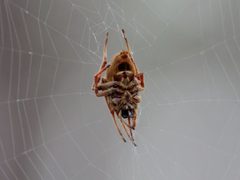
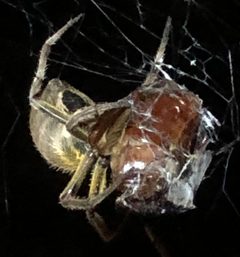
Large-bodied orb weaver with distinct coloration: dark and yellow 'shoulders' on the . The side shows a diagnostic color pattern that distinguishes it from similar like Neosona crucifera. Body size substantial among orb weavers, with individuals capable of building webs up to 1 meter in diameter.
Habitat
web-building in open areas; daytime retreat in curled leaves. Observed in intertidal mangrove marshes and similar vegetation-rich . Web construction occurs in same location on successive nights, suggesting site fidelity.
Distribution
Circum-Caribbean distribution from southern United States (Florida documented) through Mexico, Central America (Guatemala, Nicaragua), and South America to Brazil. Records from Cuba and Colombia (Valle del Cauca).
Seasonality
Active year-round in suitable climates; activity pattern consistent regardless of season. In Florida, observed in August.
Life Cycle
Nightly web construction and morning consumption of web; retreats to curled leaf hiding place during day. Site fidelity observed—individuals return to same web-building location on successive nights.
Behavior
Strictly : hides in curled leaf during day, emerges at night to build large orb web up to 1 meter wide, consumes web by morning, and returns to hiding place. This behavioral pattern contrasts with orb weavers like Argiope. Site fidelity demonstrated by repeated web construction in same location.
Ecological Role
; builds large orb webs to capture flying insects at night.
Human Relevance
Subject of macrophotography interest due to habits and aesthetic appeal against dark backgrounds. Observed in residential-adjacent (mangrove marshes behind condominiums).
Similar Taxa
- Neosona cruciferaSimilar overall appearance and web architecture; distinguished by E. ravilla's dark , yellow abdominal shoulders, and diagnostic pattern. N. crucifera is widespread across North America and .
- Argiope argentataBoth large orb weavers in Araneidae; distinguished by A. argentata's strictly activity and silvery coloration versus E. ravilla's habits and different color pattern.
More Details
Nocturnal behavior
The strictly habit of Eriophora ravilla is unusual among Araneidae and represents an ecological partitioning from orb weavers. This makes black-background photography particularly appropriate for depicting the in a manner consistent with human nighttime experience.
Taxonomic history
Originally described as Epeira ravilla by C. L. Koch in 1844; later transferred to Eriophora.