
Eriophora
Simon, 1895
Species Guides
2- Eriophora edax
- Eriophora ravilla(Tropical Orbweaver)
Eriophora is a of orb-weaver spiders in the Araneidae, first described by Eugène Simon in 1895. The genus name derives from Ancient Greek roots meaning "wool bearing." are found in tropical climates across the Americas, Africa, and Asia. Most species construct orb webs for prey capture, with some exhibiting notable variation in web architecture. The genus includes both solitary and colonial species, with E. bistriata demonstrating social organization including communal web construction and feeding. One species, E. transmarina (now reclassified as Hortophora transmarina), was the subject of a NASA space experiment in 2003 to study web-building in microgravity.

Pronunciation
How to pronounce Eriophora: //ˌɛɹiˈɒfərə//
These audio files are automatically generated. While they are not always 100% accurate, they are a good starting point.
Identification
Distinguished from other Araneidae by the combination of: third tarsal claw present; females with elongated epigyne scape; males with enlarged second leg tibia. E. ravilla identifiable by dark and yellow abdominal "shoulders," plus color pattern. E. fuliginea distinguished by unusually large, asymmetrical web architecture. E. nephiloides and E. ravilla sometimes confused with Neoscona crucifera (barn spider) but differ in color pattern and strictly .
Images
Appearance
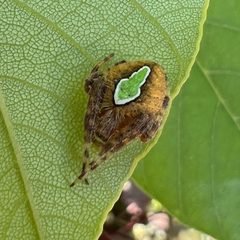
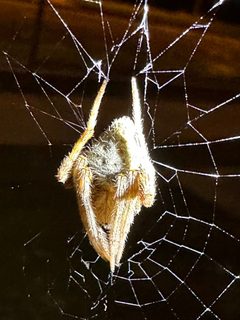
Orb-weaver spiders with variable coloration ranging from bright green (E. nephiloides, occasionally E. ravilla) to reddish-brown to gray. Abdominal dorsum may display white spots or stripes. Females are larger than males and possess a very long epigyne scape. Males have an enlarged tibia on the second leg. All possess a third claw used in web construction. E. fuliginea constructs exceptionally large webs (1.6–3 m diameter) with an open hub in the upper third.
Habitat
Tropical climates; specific microhabitats include intertidal mangrove marshes (E. ravilla in Florida), forests, and agricultural areas. Colonial E. bistriata occupies tropical forest where communal web construction occurs.
Distribution
Tropical regions of the Americas (USA to Brazil, Honduras to Guyana, Guatemala), Africa (Congo, Ethiopia), and Asia (China). Specific records from: USA, Brazil, Honduras, Guatemala, Guyana, China, Congo, Ethiopia. E. ravilla: circum-Caribbean distribution including Florida. E. transmarina: Australasia (subject of 2003 space shuttle experiment).
Seasonality
Activity patterns vary by . E. ravilla and are strictly , hiding in curled leaves during daylight and constructing webs at night, consuming them by morning. Activity year-round in tropical .
Diet
; prey consists of flying insects captured in orb webs. Communal feeding observed in colonial E. bistriata. E. sp. webs in Ecuador documented capturing small vertebrate prey (Thyroptera tricolor bat).
Life Cycle
Developmental stages include , spiderling, and . present: females larger with elongated epigyne scape; males with modified second leg tibia. Colonial E. bistriata exhibits social organization with communal web construction and absence of inter-individual hostility. E. transmarina individuals reached 2nd–3rd instar in laboratory rearing.
Behavior
Primarily web-building ; E. ravilla and strictly nocturnal, constructing large webs (up to 1 m wide) nightly and consuming them by morning. Web architecture varies: most build balanced symmetrical webs of small to medium size; E. fuliginea constructs large (1.6–3 m diameter), asymmetrical webs with open hub in upper third. Colonial species E. bistriata exhibits social organization including common hunting web construction, communal feeding, and absence of aggression between individuals. E. transmarina demonstrated rapid to microgravity, building webs in approximately half the time required by earth-bound controls during 2003 space shuttle experiment.
Ecological Role
of flying insects; contributes to -vertebrate connections through occasional capture of small bats. Colonial may influence local insect structure through communal .
Human Relevance
Subject of scientific research including 2003 NASA space shuttle experiment (STS-107) studying web-building in microgravity. E. transmarina was first spider documented building webs in orbit, though all specimens perished in Columbia disaster. Some photographed as subjects of macrophotography studies.
Similar Taxa
- Neoscona cruciferaSimilar appearance to E. ravilla; distinguished by activity, different abdominal color pattern, and lack of dark with yellow shoulder markings
- ArgiopeBoth Araneidae orb-weavers; Argiope typically with different web architecture ( often present) and lack the elongated epigyne scape and male leg modifications of Eriophora
- Hortophora transmarinaFormerly classified as Eriophora transmarina; reclassified to separate but similar in general orb-weaver and web-building
More Details
Space Flight Research
Eriophora transmarina (now Hortophora transmarina) was selected for the 2003 NASA 'Spiders in Space' experiment due to its consistently symmetrical web architecture, which allowed rapid identification of modifications under microgravity. Eight individuals launched aboard Space Shuttle Columbia on STS-107 (January 16, 2003). Low-resolution images received during the mission indicated successful web construction in microgravity, with lead spider 'Wako' completing her web in roughly half the time of earth-based controls. All specimens were lost in the Columbia re-entry disaster on February 1, 2003.
Taxonomic History
Most now placed in Eriophora were previously classified under Araneus. As of July 2022, the contains seven recognized species: E. conica, E. edax, E. fuliginea, E. nephiloides, E. neufvilleorum, E. ravilla, and E. virgata.
Social Behavior
Eriophora bistriata exhibits colonial social organization rare among orb-weavers, including communal web construction, communal feeding, and absence of inter-individual aggression. This has been compared to other colonial spiders under Shear's (1970) evolutionary framework for sociality in spiders.
Sources and further reading
- BugGuide
- Wikipedia
- GBIF taxonomy match
- iNaturalist taxon
- NCBI Taxonomy
- Catalogue of Life
- A black background is better… sometimes | Beetles In The Bush
- Arachnida | Beetles In The Bush | Page 6
- Araneae | Beetles In The Bush | Page 5
- photography | Beetles In The Bush | Page 6
- First report of Thyroptera tricolor (Chiroptera: Thyropteridae) caught in a web of Eriophora sp. (Araneae: Araneidae) in the Ecuadorian Amazon Primer reporte de Thyroptera tricolor (Chiroptera: Thyropteridae) capturado en una telaraña de Eriophora sp. (Araneae: Araneidae) en la Amazonía de Ecuador
- Seed germination requirements and responses to salinity and water stress of Centaurea eriophora
- General behavioral patterns and life-cycle of the colonial spider, Eriophora bistriata (Araneida: Argiopidae)
- The Spatial Analysis for Bassia eriophora (Schrad.) Asch. Plant Distributed in all IRAQ by Using RS & GIS Techniques