
Tromatobia
Förster, 1869
Species Guides
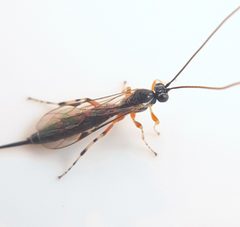
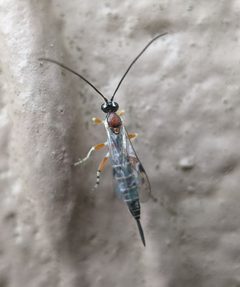
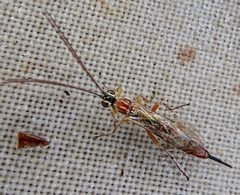
4Tromatobia is a of ichneumonid wasps in the Pimplinae comprising approximately 33 described . These are specialized associates of spider sacs, with females laying eggs inside silken egg sacs constructed by spiders. The larvae develop by consuming spider eggs in , functioning essentially as rather than true . The genus has been documented across Europe, the Near East, and North America, with some species frequently encountered in suburban and human-modified environments.
Pronunciation
How to pronounce Tromatobia: //trəˈmætoʊbiə//
These audio files are automatically generated. While they are not always 100% accurate, they are a good starting point.
Identification
Members of Tromatobia can be distinguished from related pimpline by their association with spider sacs rather than lepidopteran cocoons or other . Tromatobia lineatoria, the best-studied , exhibits distinctive red, cream, and black coloration with a conspicuous yellow orbital stripe that is acutely angled near the hind ocellus. The genus is placed phylogenetically between of cocooned and the polysphinctine that develop on active spiders. Species-level identification requires examination of morphological characters not detailed in available sources.
Images
Habitat
in this have been recorded in varied environments including suburban areas, residential settings, and natural . Tromatobia lineatoria is often found around houses throughout Britain, Ireland, and continental Europe. A Mexican record documents occurrence in suburban Mexico City. Specific microhabitat requirements beyond proximity to spider sacs are not well documented.
Distribution
Europe (including Britain and Ireland, Scandinavia), Near East, and North America (Mexico). GBIF records indicate presence in Denmark, Norway, and Sweden. Distribution records for individual vary; Tromatobia lineatoria occurs across much of Europe and the Near East.
Seasonality
of Tromatobia lineatoria have been recorded from spring through late autumn. The is at least double-brooded, with larvae from late autumn feeding slowly through winter and adults emerging in spring. Seasonal patterns for other species in the are not documented.
Diet
Larvae feed on spider within spider egg sacs. Multiple spider serve as : Araneidae (including Zygiella x-notata, Araneus diadematus, Neoscona oaxacensis), Clubionidae, Philodromidae, Theridiidae, Linyphiidae, and Tetragnathidae. Larvae consume eggs in ; if eggs remain uneaten, spiderlings may emerge.
Host Associations
- Zygiella x-notata - sac Araneidae
- Araneus diadematus - sac Araneidae
- Neoscona oaxacensis - sac Araneidae; first record from Mexico
- Araneidae - sac
- Clubionidae - sac
- Philodromidae - sac
- Theridiidae - sac
- Linyphiidae - sac
- Tetragnathidae - sac
Life Cycle
Females deposit within silken spider egg sacs. Larvae are usually gregarious, with sizes of one to six individuals per egg sac. Developmental timing varies by brood: autumn larvae feed slowly through winter with in spring, while other broods complete development more rapidly. The is at least double-brooded. occurs within the spider egg sac.
Behavior
Larvae exhibit gregarious development with of one to six individuals coexisting within a single spider sac. females do not attack spiders guarding egg sacs, targeting only the eggs. The 's represents an intermediate strategy between true and : though classified in a wasp , the functions essentially as a of spider eggs.
Ecological Role
of spider sacs. The occupies a phylogenetically significant position in the evolution of spider-associated ichneumonids, potentially representing an intermediate between of cocooned Lepidoptera and the polysphinctine that develop on active spiders. By consuming spider eggs, these wasps influence spider , though quantitative impacts are unstudied.
Human Relevance
Tromatobia lineatoria is frequently encountered in suburban and residential environments, making it one of the more commonly observed ichneumonid wasps in human-modified in Europe. No economic importance or pest status has been documented. The has been the subject of genomic research, with a high-quality assembly of 383.6 Mb produced from a UK specimen.
Similar Taxa
- Polysphincta-group wasps (Pimplinae)Also associated with spiders, but develop as ectoparasitoids on active spiders rather than feeding on within egg sacs; represent a more derived strategy
- Other Pimplinae (e.g., Pimpla)Many are of Lepidoptera cocoons rather than spider sacs; association is the primary distinguishing feature
- AcmaeonuraRelated within Pimplinae; distinguished by morphological and association differences, though specific characters not detailed in available sources