
Oedoparena glauca
(Coquillett, 1900)
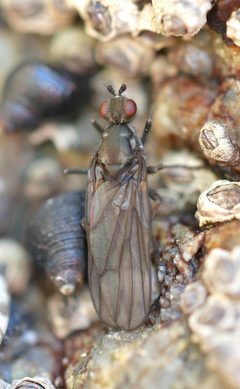
A coastal fly in the Dryomyzidae, Oedoparena glauca is notable as the only known dipteran of barnacles. Its is tightly linked to intertidal barnacle beds, with larvae developing inside and consuming multiple barnacle before pupating in empty shells. emerge during morning low tides, reflecting precise behavioral to tidal cycles.
Pronunciation
How to pronounce Oedoparena glauca: /ˌiːdoʊpəˈriːnə ˈɡlɔːkə/
These audio files are automatically generated. While they are not always 100% accurate, they are a good starting point.
Images
Habitat
Coastal intertidal zones, specifically barnacle beds on rocky shores. Larval development occurs within barnacle shells.
Distribution
Nearctic region, from central California north to Alaska.
Seasonality
occurs during morning low tides. Specific seasonal activity patterns are not documented.
Diet
Larvae are obligate of barnacles, consuming multiple individuals during development. feeding habits are not documented.
Host Associations
- barnacles - Larvae develop as within barnacle shells; deposited on barnacle
Life Cycle
are deposited on the of barnacles. Larvae consume several barnacles during development, then pupariate within an empty barnacle shell. emerge during morning low tide.
Behavior
is synchronized with morning low tides, suggesting tidal-dependent activity patterns. Larval development involves active on multiple barnacle .
Ecological Role
in intertidal , potentially regulating barnacle . The represents a rare case of dipteran on marine .
More Details
Unique feeding strategy
This is the only known dipteran of barnacles, representing an unusual ecological specialization within the order Diptera.
Conservation of congeneric ecology
It has been suggested that other members of the Oedoparena may share a similar barnacle-predating lifestyle, though this remains unconfirmed.