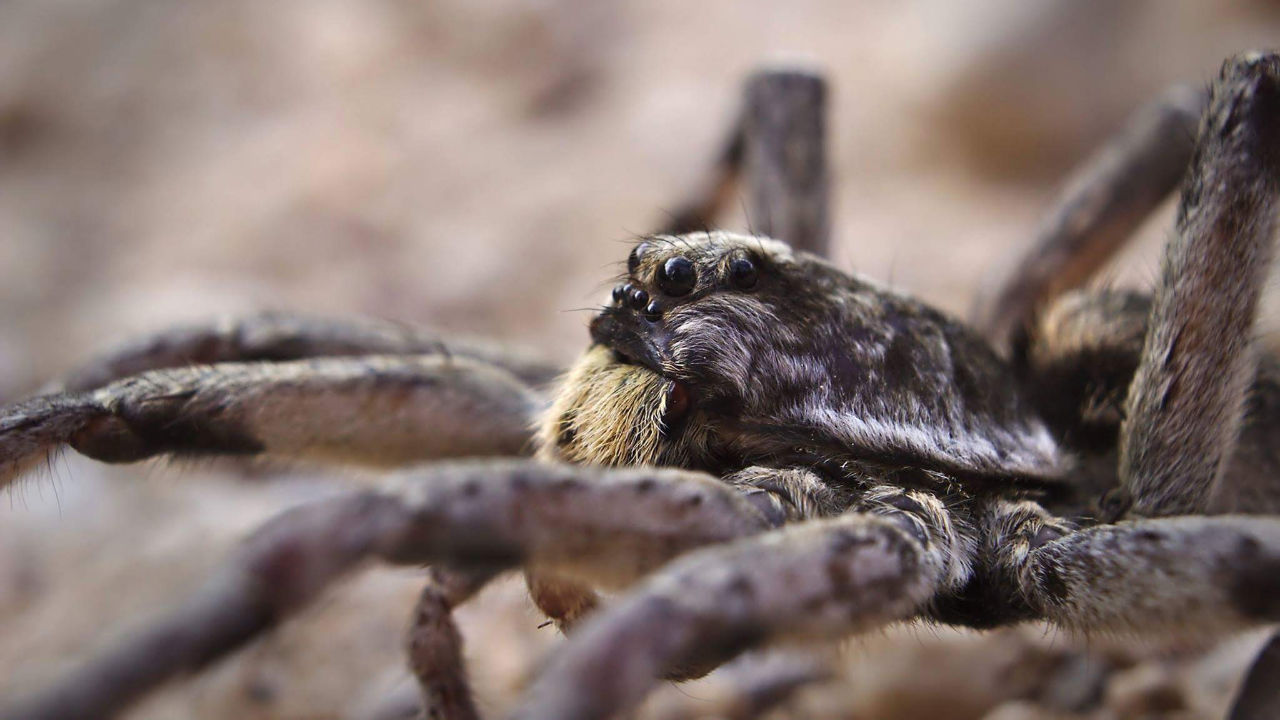
Philoponella arizonica is a species of crevice weaver spider in the family Uloboridae, first described by Gertsch in 1936. The species occurs in the southwestern United States and Mexico. Like other members of the genus Philoponella, it constructs characteristic sprawling, lacy cribellate webs that issue from retreats in crevices and sheltered locations. Females are notably long-lived and continue to molt after reaching sexual maturity, a trait shared only with mygalomorph spiders among arachnids.
Philoponella oweni is a small cribellate orb-weaver spider (4.7–7.1 mm) found in arid regions of the southwestern United States and northwestern Mexico. The species exhibits facultative semi-social behavior, with females living either solitarily or in communal groups of 2–40 individuals depending on web-site availability and prey abundance. Despite communal living, individuals do not cooperate in prey capture, web construction, or brood care. Communal females benefit from higher feeding rates and greater egg production, but suffer increased parasitism by pteromalid wasps, resulting in equivalent net reproductive success between strategies.
Pholcophora americana is a species of cellar spider in the family Pholcidae, first described by Nathan Banks in 1896. It is a small-bodied spider found in the United States and Canada. As a member of the Pholcidae, it shares the characteristic elongated legs and compact body typical of cellar spiders. The species has been documented in 392 iNaturalist observations, indicating it is moderately well-observed but not extensively studied in the scientific literature.
Manuel's Cellar Spider, cellar spider, daddy longlegs
Pholcus manueli is a cellar spider (family Pholcidae) native to temperate Asia, with established introduced populations in the United States. The species is expanding its range in North America and has been documented in anthropogenic habitats. It exhibits leg autotomy as an anti-predator defense, with autotomy rates in natural populations ranging 5–40%. Unlike some related cellar spiders, P. manueli does not regenerate lost legs. The species has been the subject of research on locomotor performance across inclined substrates.
Opilion-like Cellar Spider
Pholcus opilionoides is a cellar spider species in the family Pholcidae, named for its resemblance to harvestmen (Opiliones) due to its exceptionally long, sprawling legs. The species is native to Europe, Egypt, the Caucasus, and possibly Iran, and has been introduced to North America. Adults are small-bodied with a body length of 3-5 mm but appear larger due to their elongated legs. It is frequently confused with the more widespread Pholcus phalangioides and the similar Pholcus manueli, requiring careful examination for accurate identification.
Long-bodied Cellar Spider, Cosmopolitan Cellar Spider, Daddy Long-legs Spider
Pholcus phalangioides is a long-legged cellar spider native to Asia that has become cosmopolitan through human association. Females reach about 7-8 mm body length with legs 5-6 times longer; males are slightly smaller at 6-10 mm. The species is notable for building loose, irregular webs in dark indoor spaces and for its specialized predatory behaviors including web invasion and aggressive mimicry. It preys on other spiders—including dangerous species such as redbacks—and exhibits a distinctive whirling defense against predators. Despite common misconceptions, its bite is harmless to humans.
Leaf-curling Orbweavers
Phonognathidae is a family of orb-weaving spiders resurrected at family rank in 2018 based on phylogenomic analysis. The family was originally described by Simon in 1894 but had been treated as a synonym of Araneidae. It is now classified within the clade Orbipurae alongside Araneidae and Nephilidae. Members are commonly known as leaf-curling orbweavers and are distinguished by their habit of constructing retreats within curled leaves.
Phrurolithus pipensis is a species of true spider in the family Phrurolithidae, first described by Muma in 1945. It is known from the United States. Members of this family are generally small, ground-dwelling spiders.
Phruronellus was a genus of North American araneomorph spiders described by R. V. Chamberlin in 1921. Its taxonomic placement changed over time, moving from Liocranidae to Corinnidae in 2002, then to Phrurolithidae in 2014. As of 2024, Phruronellus is recognized as a junior synonym of Scotinella Banks, 1911, and all species previously assigned to it have been transferred to that genus.
Phrurotimpus alarius is a species of true spider in the family Phrurolithidae, originally described by Hentz in 1847. It occurs in the United States and Canada. The species includes two recognized subspecies: P. a. alarius and P. a. tejanus. It belongs to a genus of small, ground-dwelling spiders often associated with leaf litter and similar habitats.
Phylloneta is a small genus of comb-footed spiders (family Theridiidae) containing three species and two subspecies with a Holarctic distribution. The genus was elevated from subgenus status in 2008, having formerly been considered part of Allotheridion. Species include P. impressa, P. pictipes, and P. sisyphia (with subspecies P. s. foliifera and P. s. torandae). The type species, P. pictipes, was originally described in 1884.
Forest Cobweb Weaver
Phylloneta impressa is a small comb-footed spider (Theridiidae) with a Holarctic distribution. Males measure 2.5–5.5 mm and females 3.5–5.5 mm. The species constructs tangle webs beneath retreats on vegetation and has been documented in agricultural settings including rape fields. It is closely related to and frequently confused with Phylloneta sisyphia.
Phylloneta pictipes is a cobweb spider in the family Theridiidae, native to the United States. This species constructs irregular cobwebs for prey capture. Adults display distinctive coloration with a yellow abdomen bearing patterned black spots, black-banded legs, and a comparatively small cephalothorax. The species has been documented in 1,110 iNaturalist observations, indicating it is moderately well-recorded though not commonly encountered in general natural history.
A cellar spider species in the family Pholcidae, distributed across the southwestern United States and Mexico. Adults are active during fall months, with males wandering in search of mates. The species frequently occurs in human dwellings, where it constructs webs in ceiling corners and other sheltered locations.
short-bodied cellar spider
Physocyclus globosus, commonly known as the short-bodied cellar spider, is a small pholcid spider with a cosmopolitan distribution. It is frequently found in anthropogenic habitats including buildings and caves across tropical and subtropical regions, and has been introduced to numerous temperate areas worldwide. The species is characterized by a compact, globose abdomen and distinctive dark dorsal markings. It belongs to the globosus species group within its genus, which exhibits a biogeographical distribution pattern in the Mesoamerican and Mexican Mountain biotic components.
Piabuna is a genus of small, ground-dwelling spiders in the family Phrurolithidae, endemic to North America. First described in 1933, it has undergone multiple family reassignments, reflecting ongoing revisions in spider systematics. The genus contains six described species distributed primarily in the southwestern United States and Mexico. These spiders are rarely encountered and poorly known in terms of natural history.
large hammockweb spider
Pimoa altioculata is a large hammockweb spider in the family Pimoidae, found in the western United States and Canada. It was formerly classified in the family Linyphiidae but was separated due to distinct morphological differences, particularly its substantially larger body size. The species constructs fine, horizontal, net-like webs and is primarily associated with coniferous forest habitats.
Large Hammockweb Spider
Pimoa haden is a species of large hammockweb spider in the family Pimoidae, found in the western United States. It was described by Chamberlin & Ivie in 1943. The species is notable for its relatively large size compared to other members of the family, with females reaching up to 12 mm in body length. Like other Pimoa species, it constructs fine, net-like horizontal webs that can span considerable distances.
tangled nest spiders
Pimus is a genus of spiders in the family Amaurobiidae, commonly referred to as tangled nest spiders. The genus was established by R. V. Chamberlin in 1947 and is restricted to North America. All ten described species occur exclusively in the United States. These spiders construct irregular, tangled webs and are part of the diverse Amaurobiidae family, which is characterized by this web-building behavior.
Pirata alachuus is a wolf spider species in the family Lycosidae, first described by Gertsch and Wallace in 1935. The species is known only from the United States, with records indicating presence in North America. Like other Pirata species, it belongs to a genus of wolf spiders often associated with moist habitats near water.
Pirata montanoides is a wolf spider species in the family Lycosidae, first described by Nathan Banks in 1892. The species is known from the United States, though specific details about its biology and ecology remain sparse. Like other members of the genus Pirata, it is likely associated with moist or semi-aquatic habitats, as this genus is known for its affinity for wet environments.
Pirata sedentarius is a wolf spider species in the family Lycosidae, first described by Montgomery in 1904. The species is distributed across North America and the Greater Antilles. Like other members of the genus Pirata, it is associated with semi-aquatic and moist habitats. The specific epithet "sedentarius" suggests relatively stationary behavior compared to more nomadic wolf spider species.
Piratula canadensis is a wolf spider in the family Lycosidae, originally described from Canada. The species occurs in boreal and montane regions of North America and has also been recorded from the Russian Far East including Kamchatka. As a member of the genus Piratula, it is associated with moist habitats near water bodies.
Lonely Wolf Spider
Piratula insularis is a wolf spider (family Lycosidae) found across northern regions of North America and Eurasia. First described by Emerton in 1885 under the name Pirata insularis, this species has since been reclassified to the genus Piratula. The species epithet "insularis" (meaning "of islands") likely refers to its occurrence on islands or isolated habitats, though the original description context is not preserved in available sources. It is one of several species in the genus Piratula, which comprises small to medium-sized wolf spiders often associated with wetland and riparian habitats.
Straight-banded Nursery Web Spider
Pisaurina brevipes is a nursery web spider found in the eastern United States and Canada. It closely resembles the more common Pisaurina mira but is distinguished by proportionally shorter legs and straighter edges on the abdominal band. Females measure 11–13 mm in body length, males approximately 10.8 mm. The species favors grasslands, bogs, and swamps, though detailed natural history remains poorly documented.
hammock spider
Pityohyphantes costatus, commonly known as the hammock spider, is a sheetweb weaver in the family Linyphiidae. The species name derives from its distinctive web architecture, which resembles a suspended hammock. It occurs primarily in coniferous forests of North America, though it has also been found in hardwood habitats. The genus name translates from Greek as 'pine weaver,' reflecting its association with coniferous vegetation.
Pityohyphantes minidoka is a sheetweb spider in the family Linyphiidae, described by Chamberlin and Ivie in 1943. The genus name derives from Greek meaning 'pine weaver,' reflecting the typical habitat association of related species. As a member of the hammock spider group, it constructs a distinctive web architecture. The species is known from the United States, with records from Idaho and potentially broader western North American distribution.
Hammock spider
Pityohyphantes rubrofasciatus is a species of sheetweb spider in the family Linyphiidae, commonly known as hammock spiders. The genus name derives from Greek meaning "pine weaver," though species occur in both coniferous and hardwood forests. The species constructs flat or slightly convex sheet webs suspended in foliage, typically well above ground level. It occurs across northern North America in the United States and Canada.
Taiga Sheetweb Weaver
Pityohyphantes subarcticus is a species of sheetweb weaver spider in the family Linyphiidae, commonly known as the Taiga Sheetweb Weaver. It occurs in boreal and subarctic regions of western Canada and Alaska. As a member of the genus Pityohyphantes, it constructs characteristic hammock-shaped webs suspended in vegetation. The species was described by Chamberlin and Ivie in 1943.
Pityohyphantes tacoma is a species of sheetweb spider in the family Linyphiidae. It belongs to the genus Pityohyphantes, commonly known as hammock spiders. The species was described by Chamberlin and Ivie in 1942. Very little specific information is available about this particular species beyond its taxonomic classification and geographic occurrence in the United States.
A comb-footed spider in the family Theridiidae, originally described from a female specimen collected in Saga Prefecture, Kyushu, Japan in 1906. The species was recently reinstated as valid based on distinct body coloration, markings, genital morphology, and molecular data (partial mitochondrial COI gene), having been previously synonymized with Yunohamella lyrica. Molecular analysis revealed that females previously identified as Platnickina mneon are conspecific with males associated with Yunohamella varietas, leading to the latter's synonymization. The species is currently classified under the genus Platnickina, though it was transferred to Yunohamella in the revision that reestablished its validity.
Pocadicnemis is a genus of sheet-weaving spiders (family Linyphiidae) established by Eugène Louis Simon in 1884. The genus contains seven described species distributed across Asia, Europe, and North America. As linyphiids, members construct flat, horizontal sheet webs to capture prey.
dwarf spider
Pocadicnemis pumila is a species of dwarf spider in the family Linyphiidae, first described by John Blackwall in 1841. It has a notably wide distribution spanning multiple continents, including North America, Europe, Turkey, the Caucasus, Russia (from European Russia to the Far East), Iran, and Japan. The species belongs to a family commonly known as sheet-web weavers or money spiders, though specific behavioral details for this species remain poorly documented.
Pocobletus coroniger is a species of sheet-web weaving spider in the family Linyphiidae, described by Eugène Simon in 1894. It belongs to a genus of small-bodied spiders found in the Neotropical region. The species has been recorded from scattered localities across Central America and northern South America, with some records from the southern United States. Like other linyphiids, it constructs flat, horizontal sheet webs with a retreat area. Very little is known of its specific biology or ecology.
Poeciloneta is a genus of sheet web spiders (family Linyphiidae) established by Kulczyński in 1894, with Neriene variegata as the type species. The genus contains approximately 15 species distributed across the Holarctic region, including North America, Europe, Russia, and China. Most species are small-bodied spiders that construct flat sheet webs. The genus has not undergone modern taxonomic revision.
Poeciloneta lyrica is a species of sheetweb spider in the family Linyphiidae, first described by Zorsch in 1937. It belongs to a diverse family of small spiders known for constructing flat, sheet-like webs. The species has been recorded in North America, with confirmed observations in Alberta, Canada. Available information on this species remains limited.
European Paper Wasp
Polistes dominula is a highly successful invasive social wasp native to Eurasia that has established populations across North America, South America, New Zealand, South Africa, and other regions. First detected in North America near Boston in 1978, it has become one of the most abundant wasps on the continent. The species builds small, exposed paper nests in protected locations and preys primarily on live insects, particularly caterpillars. Unlike yellowjackets, it does not scavenge for meat or sugar. Its rapid spread has been attributed to ecological flexibility, superior competitive ability, and tolerance of human-altered environments.
Kulczynski's Dwarf Weaver
Praestigia kulczynskii is a dwarf spider in the family Linyphiidae, described by Eskov in 1979. The species has a transcontinental distribution spanning the Palearctic and Nearctic regions, with records from Russia, Japan, and Canada. As a member of the sheet-web weavers, it belongs to one of the most species-rich spider families, though specific ecological details for this species remain poorly documented.
Prodidomus is a genus of long-spinneret ground spiders in the family Prodidomidae, first described by Nicholas Marcellus Hentz in 1847. The genus comprises 54 species as of September 2025. Members are small spiders, with males measuring 1.9–4.3 mm and females 1.8–5.0 mm in total length. They are distinguished by their elongated anterior lateral spinnerets, which measure 10–20% of abdominal length, and their distinctive eye arrangement with greatly enlarged, canoe-shaped posterior lateral eyes.
Prodidomus rufus is a species of true spider in the family Prodidomidae. It was described by Hentz in 1847 and has a remarkably broad geographic distribution spanning multiple continents. The species appears to be native to the Mediterranean region and Africa, with confirmed established populations across the Americas, Asia, and Pacific islands suggesting human-mediated dispersal. Its wide range and presence on remote islands indicates significant colonization ability.
Promyrmekiaphila is a genus of mygalomorph trapdoor spiders endemic to California. First described by Schenkel in 1950, the genus currently contains three species: P. clathrata, P. winnemem, and P. korematsui. These spiders construct silk-lined burrows with wafer-like trapdoor lids and exhibit strong geographic population structuring with deep genetic divergence, particularly within P. clathrata. The genus is notable for morphological conservation despite considerable genetic differentiation, representing a cryptic species complex.
Psilochorus apicalis is a species of cellar spider in the family Pholcidae, first described by Banks in 1921. It is a small, long-legged spider endemic to the United States. Like other pholcids, it constructs irregular, tangled webs in sheltered locations. The species is part of a genus containing approximately 20 described species, most occurring in the Americas.
cellar spider
Psilochorus imitatus is a cellar spider species in the family Pholcidae, first described by Gertsch and Mulaik in 1940. It is known from the United States and Mexico. As a member of Pholcidae, it likely exhibits the characteristic long, slender legs and small body typical of this family, though specific morphological details for this species remain limited in published sources.
A species of cellar spider in the family Pholcidae, described by Gertsch in 1935. The species belongs to a genus characterized by long, delicate legs and small, elongated bodies typical of pholcid spiders. Very little specific information has been published about this particular species beyond its original description and taxonomic placement.
Rhysodromus alascensis is a species of running crab spider in the family Philodromidae. It has a broad transcontinental distribution spanning northern North America and Eurasia, including Alaska, Siberia, Kazakhstan, and China. The species was originally described as Philodromus alascensis by Keyserling in 1884 and later transferred to the genus Rhysodromus. Like other philodromids, it is an active hunter that does not build webs to capture prey.
Attractive Running Crab Spider
Rhysodromus histrio is a species of running crab spider in the family Philodromidae. It serves as the type species of the genus Rhysodromus. The species has a broad distribution across the Northern Hemisphere, occurring in North America, Europe, and Asia. It is an active hunter that does not build webs to capture prey.
Rhysodromus mysticus is a running crab spider in the family Philodromidae, originally described as Philodromus mysticus in 1975. The species has a transcontinental distribution spanning northern Eurasia and North America. Like other philodromids, it is an active hunter that does not build webs to capture prey.
Robertus is a genus of comb-footed spiders in the family Theridiidae. It was established by Octavius Pickard-Cambridge in 1879 and is recognized as the senior synonym of the former genus Garritus. The genus comprises small spiders that construct tangled, irregular webs. Species within Robertus are found primarily in the Northern Hemisphere, with documented occurrences in Europe and North America.
Robertus pumilus is a species of cobweb spider in the family Theridiidae. It is found in the United States. The species was described by James Henry Emerton in 1909.
Saltonia is a monotypic genus of North American cribellate araneomorph spiders containing the single species Saltonia incerta. The genus was first described in 1942 and has undergone several taxonomic revisions, most recently moved to the family Argyronetidae in 2025. It represents a rare relict lineage restricted to hypersaline desert habitats in southwestern North America.