
Philoponella arizonica
(Gertsch, 1936)
Philoponella arizonica is a of crevice weaver spider in the Uloboridae, first described by Gertsch in 1936. The species occurs in the southwestern United States and Mexico. Like other members of the Philoponella, it constructs characteristic sprawling, lacy cribellate webs that issue from retreats in crevices and sheltered locations. Females are notably long-lived and continue to after reaching sexual maturity, a trait shared only with mygalomorph spiders among arachnids.
Pronunciation
How to pronounce Philoponella arizonica: //ˌfaɪloʊpəˈnɛlə ˌærɪˈzoʊnɪkə//
These audio files are automatically generated. While they are not always 100% accurate, they are a good starting point.
Identification
Distinguished from brown recluse spiders (Loxosceles) by having eight rather than six, with eyes grouped atop the crown rather than in three pairs across the front edge of the . Males are sometimes mistaken for brown recluses due to similar pale coloration and long legs, but the eye arrangement and extremely long, elbowed of Philoponella are diagnostic. Females may be confused with small tarantulas due to their dark, robust build and lumpy eye , but lack the prominent and of true tarantulas. The sprawling, lacy cribellate web issuing from a crevice retreat is characteristic of the and .
Images
Appearance
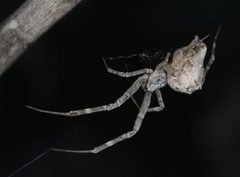
Females are velvety black or dark gray in coloration with a body shape and lumpy arrangement reminiscent of small tarantulas. Males are distinctly different in appearance, being beige or pale brown with small bodies and extremely long legs. Males possess elongated, elbowed . Both sexes have eight eyes grouped atop the crown of the . The are and incapable of independent movement. The legs have a weak joint at the tibia-patella juncture that allows for autospasy (voluntary leg detachment) as an escape mechanism.
Habitat
Found in sheltered, dry locations including under eaves, in window frames, and in other crevices of buildings and structures. Occurs in xeric and semi-arid environments characteristic of the southwestern United States and adjacent Mexico. Webs are constructed in protected microhabitats that provide retreat opportunities.
Distribution
Recorded from the southwestern United States (Arizona and presumably adjacent states) and Mexico. The specific epithet 'arizonica' indicates the type locality in Arizona.
Seasonality
may be observed year-round in suitable . Females are long-lived and continue molting after sexual maturity. Males wander in search of mates, particularly after dark.
Life Cycle
Females are notably long-lived and continue to after reaching adulthood, a phenomenon otherwise known only in mygalomorph spiders. This extended longevity is associated with the extended time required to reach sexual maturity. Females are haplogynes, possessing largely unmodified external genitalia with paired reproductive openings under a slot-like orifice. sacs and early instar details are not documented in available sources.
Behavior
Nocturnally active. Females venture to the lip of their retreat after dark in anticipation of prey. Males wander in search of mates during nighttime hours. Constructs sprawling, lacy cribellate webs using a cribellum and calamistrum; silk is carded by rapid vibration of the fourth leg against the third leg, producing non-sticky but highly entangling threads. Capable of autospasy (voluntary leg detachment) at the weak tibia-patella joint to escape . Prey capture relies on physical entanglement in the irregular web threads rather than adhesive properties.
Ecological Role
of small arthropods that become physically entangled in its cribellate web. Occupies a specific structural in xeric , utilizing human-made structures and natural crevices for retreat sites.
Human Relevance
Frequently encountered in and around human dwellings in its range, where it constructs webs on exterior window frames, under eaves, and in similar sheltered locations. Not dangerously venomous to healthy humans; virtually all spiders are venomous but few pose significant medical risk. Beneficial as a of small household arthropods. The extreme and unusual appearance of females may cause alarm among those unfamiliar with the .
Similar Taxa
- Kukulcania hibernalisCo-occurs in Arizona; also a crevice weaver with similar web architecture and , distinguished by subtle morphological differences and geographic distribution patterns
- Loxosceles spp. (brown recluse spiders)Males frequently misidentified due to similar pale coloration and long legs; distinguished by number and arrangement (8 vs. 6 eyes), and extremely long elbowed in Philoponella males
- Small tarantulas (Theraphosidae)Females may be confused due to dark robust build and lumpy ; distinguished by , lack of prominent , and web architecture
- Other FilistatidaeShare cribellate web architecture and crevice-dwelling habits; require detailed morphological examination for definitive identification
Misconceptions
Frequently misidentified as brown recluse spiders, particularly the pale-colored males. The dramatic has led to males and females being assumed to be different by casual observers. The robust, dark-colored females are sometimes mistaken for small tarantulas due to convergent appearance.
More Details
Cribellate silk production
Produces characteristic lacy, non-sticky webs using a cribellum (additional silk-spinning organ) and calamistrum (comb of curved hairs on the fourth leg ). The carding process involves rapid vibration of the fourth leg against the third leg, faster than the slow rocking motion used by most other cribellate spiders.
Post-maturity molting
One of very few spider lineages known to continue molting after reaching sexual maturity, a trait shared only with mygalomorph spiders. This appears related to extended longevity and the extended developmental period required to reach maturity.