
Philoponella
Mello-Leitão, 1917
Species Guides
2Philoponella is a of uloborid spiders characterized by the absence of venom glands, a trait shared by all members of Uloboridae. These spiders are obligate web-dwellers that capture prey using silk rather than venom. The genus exhibits notable behavioral diversity, including both solitary and social , with some demonstrating cooperative prey capture. Philoponella species are primarily pantropical in distribution.
Pronunciation
How to pronounce Philoponella: /fɪloʊpoʊˈnɛlə/
These audio files are automatically generated. While they are not always 100% accurate, they are a good starting point.
Identification
Distinguished from other uloborid by combination of: longer than wide with pale ground color and broad dusky lateral stripes; small with nearly straight row; with distinct and centrally positioned apex; overall white appearance with faint dusky spotting. Communal web-building in some may aid field identification where multiple individuals occupy connected webs.
Images
Appearance
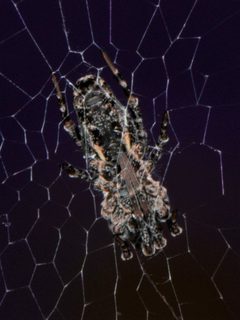
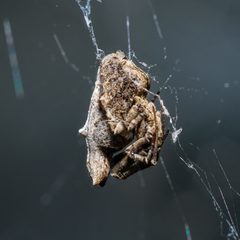
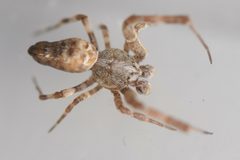
longer than wide, pale with broad dusky side stripes. small with row nearly straight. covered with white setae. with distinct , less distinct posterior tubercles, and apex positioned near middle of length. Specimens appear quite white overall with faint dusky spots on abdominal tubercles.
Habitat
Web-dwelling; specific microhabitat preferences not documented beyond association with vegetation supporting orb-webs. Communal construct colonies of interconnected individual webs.
Distribution
Pantropical: Americas, Africa, southeastern Asia, and Australia. Approximately half of described distributed from southern United States through northern Argentina.
Diet
Prey captured in webs and subdued using silk. P. vicina has been observed using silk to compress and crush prey. Specific prey not documented.
Life Cycle
Females undergo color change post-maturation: in P. raffrayi, females remain orange for at least one week after final , transitioning to black after several weeks. Other developmental stages and longevity not documented.
Behavior
All are web-dwellers. Some species (P. congregabilis, P. oweni) construct communal webs but capture prey individually. P. raffrayi and P. republicana exhibit cooperative prey capture: in P. raffrayi colonies, two females cooperate in wrapping large peripheral prey in approximately 10% of cases, improving success rates fourfold, though only one female feeds. P. republicana may involve more than two individuals in cooperative capture.
Ecological Role
; webs provide for kleptoparasitic Argyrodes and predatory Portia species in P. raffrayi colonies.
Human Relevance
No documented economic or medical significance. Absence of venom eliminates bite risk to humans.
Similar Taxa
- Other Uloboridae generaPhiloponella distinguished by shape (longer than wide), arrangement, and abdominal pattern; many uloborids lack the distinct tubercles and central abdominal apex.
- Araneidae (typical orb-weavers)Philoponella constructs orb-webs but lacks venom glands; Araneidae possess venom and typically have different arrangements and body proportions.
More Details
Social behavior variation
The exhibits a spectrum of social organization: solitary , communal web-builders with individual foraging, and cooperative foragers. This variation makes Philoponella a subject of interest for studies on the evolution of sociality in spiders.
Prey subjugation
Unlike venomous spiders, Philoponella relies entirely on silk for prey capture and subjugation. P. vicina has been documented using silk to physically compress and crush prey, representing an alternative evolutionary solution to prey handling.