
Phylloneta
Archer, 1950
Species Guides
2- Phylloneta impressa(Forest Cobweb Weaver)
- Phylloneta pictipes
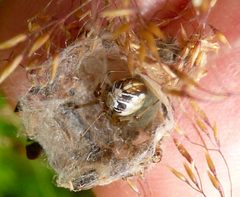
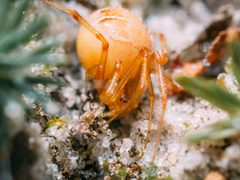
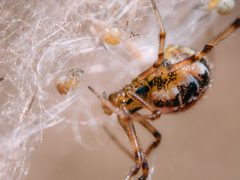
Phylloneta is a small of comb-footed spiders ( Theridiidae) containing three and two with a Holarctic distribution. The genus was elevated from subgenus status in 2008, having formerly been considered part of Allotheridion. Species include P. impressa, P. pictipes, and P. sisyphia (with subspecies P. s. foliifera and P. s. torandae). The type species, P. pictipes, was originally described in 1884.
Pronunciation
How to pronounce Phylloneta: //ˌfɪl.əˈneɪ.tə//
These audio files are automatically generated. While they are not always 100% accurate, they are a good starting point.
Identification
Members of this can be distinguished from related theridiid genera by their comb-footed and specific genitalic characteristics that warranted their elevation to genus status. Separation from the former parent genus Allotheridion and from Theridion requires examination of detailed morphological features.
Images
Habitat
Agricultural landscapes including rape (canola) fields; broader range across Holarctic region inferred from distribution but not explicitly documented.
Distribution
Holarctic distribution. Documented occurrence records from Denmark, Norway, and Sweden.
Seasonality
and cocoons present in agricultural fields before crop harvest in mid-July.
Life Cycle
occurs during crop growing season, with females producing cocoons that persist in the field environment. Cocoons and females co-occur in before harvest.
Behavior
Web-building spiders that construct webs capable of retaining prey remnants. Webs serve as passive sampling devices for environmental contaminants including .
Ecological Role
in agricultural . Serves as a bioindicator for exposure through accumulation in body tissues, cocoons, and web structures.
Human Relevance
Subject of monitoring research due to bioaccumulation of plant protection products in bodies, cocoons, and webs. Potential utility for environmental risk assessment in agricultural landscapes.
Similar Taxa
- TheridionFormerly classified within this ; separated based on distinct morphological characteristics.
- AllotheridionFormerly considered a subgenus of Allotheridion; elevated to status in 2008 based on revised taxonomic assessment.
More Details
Taxonomic History
First described as Theridion pictipes by Eugen von Keyserling in 1884. Transferred to Phylloneta and elevated to status in 2008 following taxonomic revision.