
Pholcus manueli
Gertsch, 1937
Manuel's Cellar Spider, cellar spider, daddy longlegs
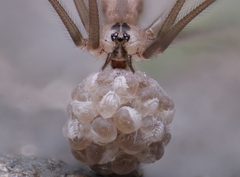
Pholcus manueli is a cellar spider ( Pholcidae) native to temperate Asia, with established introduced in the United States. The is expanding its range in North America and has been documented in anthropogenic . It exhibits leg as an anti- defense, with autotomy rates in natural populations ranging 5–40%. Unlike some related cellar spiders, P. manueli does not regenerate lost legs. The species has been the subject of research on locomotor performance across inclined substrates.
Pronunciation
How to pronounce Pholcus manueli: //ˈfoʊl.kəs ˌmænˈweɪ.li//
These audio files are automatically generated. While they are not always 100% accurate, they are a good starting point.
Identification
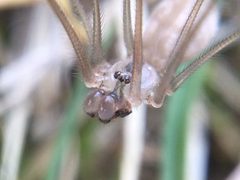
Pholcus manueli can be distinguished from the widespread Pholcus phalangioides by examination of genitalia; specimens cannot be reliably identified to . The Pholcus is characterized by eight (not six) and absence of a pit or groove in the . Species-level identification requires microscopic examination and comparison with reference specimens or keys.
Images
Habitat
Corners of sheltered with three-dimensional microhabitats including caves, basements, outbuildings, and other structures with vertical and overhanging horizontal surfaces. In its introduced North American range, it occupies anthropogenic environments.
Distribution
Native to Russia (Far East), Turkmenistan, Kazakhstan, China, Korea, and Japan. Introduced to the United States, with records from the Midwest and northeastern U.S.A. (including Nebraska). Established present in North America, Europe and Northern Asia (excluding China), and Southern Asia.
Life Cycle
and stages have been documented in field collections. The does not exhibit leg following .
Behavior
Exhibits leg as an anti- strategy, readily self-amputating legs during encounters with predators and aggressive conspecifics. Autotomy rates in natural range from 5–40% of individuals. Locomotor performance is affected by both substrate incline and leg loss: speeds decrease with increasing incline (horizontal to 45° to 90°) and following autotomy. Autotomized spiders show greater speed reduction on horizontal surfaces compared to inclines. Partial kinematic compensation occurs—stride length decreases at 90° inclines but not after autotomy, while stride cycle time and duty factor increase after autotomy but not during uphill movement.
Human Relevance
Has been intercepted in commercial merchandise shipments, prompting identification requests for regulatory compliance. Not considered dangerously venomous to humans or pets. Subject of scientific research on locomotor biomechanics and .
Similar Taxa
- Pholcus phalangioidesLong-bodied Cellar Spider; historically the most abundant and widespread Pholcus in North America, but P. manueli is expanding its range and requires genitalia examination for reliable separation
- Holocnemus plucheiMarbled Cellar Spider; native to Mediterranean Europe, introduced to western North America, distinguished by dome-like web structure and different body patterning
More Details
Research significance
P. manueli has become a model organism for studying the biomechanical consequences of leg in spiders, with experimental studies examining interactive effects of limb loss and substrate angle on locomotor kinematics.
Invasive status
The is documented as in North America, with behavioral variation observed between ; specific behavioral traits and ecological impacts remain under investigation.
Sources and further reading
- BugGuide
- Wikipedia
- GBIF taxonomy match
- iNaturalist taxon
- NCBI Taxonomy
- Catalogue of Life
- Bug Eric: Spider Sunday: Mystery Solved
- Bug Eric: November 2011
- Spiders in corners, part 2: Cellar spider, Pholcus phalangioides — Bug of the Week
- Me and my shadow: Cellar spider, Pholcus phalangioides — Bug of the Week
- Dragonfly meets spider, spider eats dragonfly: Seaside Dragonlet, Erythrodiplax Berenice, and daddy-long-legs, Pholcus spp. — Bug of the Week
- Bug Eric: Spider Sunday: Marbled Cellar Spider
- Behavioural Variation in the Invasive Cellar Spider Pholcus Manueli (Araneae: Pholcidae)
- Behavioural variation in the invasive cellar spider Pholcus manueli (Araneae: Pholcidae)
- Interactive effects of leg autotomy and incline on locomotor performance and kinematics of the cellar spider, Pholcus manueli