
Pholcus opilionoides
(Schrank, 1781)
Opilion-like Cellar Spider
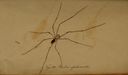
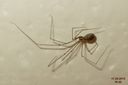
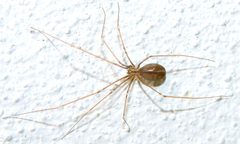
Pholcus opilionoides is a cellar spider in the Pholcidae, named for its resemblance to harvestmen (Opiliones) due to its exceptionally long, sprawling legs. The species is native to Europe, Egypt, the Caucasus, and possibly Iran, and has been introduced to North America. are small-bodied with a body length of 3-5 mm but appear larger due to their elongated legs. It is frequently confused with the more widespread Pholcus phalangioides and the similar Pholcus manueli, requiring careful examination for accurate identification.
Pronunciation
How to pronounce Pholcus opilionoides: //ˈfɔl.kʊs oʊˌpɪl.iˌɒnˈɔɪ.diːz//
These audio files are automatically generated. While they are not always 100% accurate, they are a good starting point.
Identification
Distinguished from true harvestmen (Opiliones) by the clear separation between and ; harvestmen have a body. Separated from Pholcus phalangioides by subtle morphological differences requiring close examination—P. opilionoides typically has a more pronounced cephalothoracic stripe pattern. Most reliably distinguished from Pholcus manueli by sternum pattern and body proportions, though P. manueli has been expanding its range and increasing confusion. specimens are particularly difficult to identify to .
Images
Habitat
Builds loose, irregular webs in sheltered locations. In native range, occupies cool, dark microhabitats including cellars, basements, building overhangs, and shaded corners. In North America, found in similar anthropogenic as well as outdoor locations near buildings.
Distribution
Native to Europe, Egypt, the Caucasus region, and possibly Iran. Introduced and established in North America including Canada and the United States; records exist from France and other parts of its introduced range.
Diet
; preys on small insects and other arthropods captured in irregular webs. Specific prey preferences for this are not documented separately from congeneric species.
Behavior
Constructs irregular, tangled webs in corners and sheltered locations. Web-building and prey capture strategies appear similar to congeneric cellar spiders, though -specific behavioral studies are lacking.
Ecological Role
of small insects and arthropods; may contribute to of indoor and building-associated pests in anthropogenic environments.
Human Relevance
Beneficial in buildings as a of small insect pests. Not considered dangerously venomous to humans or pets. Frequently encountered in cellars, basements, and building corners where it may be mistaken for the more common Pholcus phalangioides or, due to leg proportions, for harvestmen.
Similar Taxa
- Pholcus phalangioidesLong-bodied Cellar Spider; extremely similar in overall appearance and , historically the most commonly encountered cellar spider in many regions. P. opilionoides distinguished by cephalothoracic pattern and body proportions, though reliable separation requires careful examination.
- Pholcus manueliMost similar in terms of dimensions and sternum pattern; expanding range in North America increases identification challenges. Subtle differences in sternal separate the two species.
- Holocnemus plucheiMarbled Cellar Spider; another introduced pholcid with long legs, but builds dome-shaped webs and has distinct marbled patterning on .
- Opiliones (harvestmen)Non-spider arachnids with which P. opilionoides is frequently confused due to convergent leg proportions; distinguished by body structure lacking waist between and .
More Details
Taxonomic history
Originally described as Aranea opilionoides by Schrank in 1781; later transferred to Pholcus. The specific epithet 'opilionoides' directly references its resemblance to harvestmen of the order Opiliones.
Identification challenges
Accurate -level identification within Pholcus often requires specimens and microscopic examination of genitalic structures or detailed pattern analysis. specimens and photographs are frequently insufficient for definitive identification.
Sources and further reading
- BugGuide
- Wikipedia
- GBIF taxonomy match
- iNaturalist taxon
- NCBI Taxonomy
- Catalogue of Life
- Spiders in corners, part 2: Cellar spider, Pholcus phalangioides — Bug of the Week
- Me and my shadow: Cellar spider, Pholcus phalangioides — Bug of the Week
- Dragonfly meets spider, spider eats dragonfly: Seaside Dragonlet, Erythrodiplax Berenice, and daddy-long-legs, Pholcus spp. — Bug of the Week
- Bug Eric: Spider Sunday: Mystery Solved
- Bug Eric: Spider Sunday: Marbled Cellar Spider
- Bug Eric: Housemates