
Holocnemus pluchei
(Scopoli, 1763)
Marbled Cellar Spider
Holocnemus pluchei is a cellar spider native to the Mediterranean region that has been introduced to North America, Australia, and other regions. It is notable for its group-living , with multiple individuals often sharing communal webs. Both sexes possess stridulatory organs, an unusual trait among spiders. The exhibits a unique defensive behavior called 'bouncing' when disturbed. It has been identified as a source of allergenic proteins that can trigger asthma in sensitive individuals.
Pronunciation
How to pronounce Holocnemus pluchei: /hɒˈlɒknɪməs ˈpluːkeɪ/
These audio files are automatically generated. While they are not always 100% accurate, they are a good starting point.
Identification
Distinguished from the similar Pholcus phalangioides (Long-bodied Cellar Spider) by its more dome-shaped web structure and preference for outdoor, sun-shaded locations rather than dark indoor spaces. The black and white banding on leg joints is distinctive. Females can be identified by the projecting sternum and swollen . Both sexes possess stridulatory organs, unlike most spiders where only males have such structures.
Images
Appearance
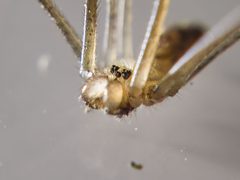
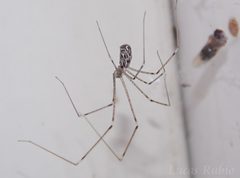
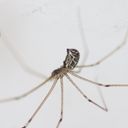
Small-bodied spider with extremely long, fragile legs that make it appear much larger than its actual size. Body length 5–7.5 mm (females slightly larger than males). Legs display distinctive black and white circles around the joints. individuals resemble in general form. Females possess swollen and a projecting sternum, the latter thought to function in mate selection.
Habitat
Builds webs in shaded outdoor locations such as under building overhangs, among dense vegetation, and in the leathery leaves of agave plants. In its native Mediterranean range and introduced North American , it is often found in warmer, sheltered microhabitats. Unlike many cellar spiders, it is more common outdoors than indoors in arid regions like southern Arizona, though it will occupy basements, attics, and eaves of buildings.
Distribution
Native to the Mediterranean region of Europe and North Africa. Introduced to North America with earliest record from Sutter County, California in 1974; now ranges east to central Texas and north to southern Oregon. Also introduced to southern Western Australia, Argentina, and Japan. Present in urban and suburban environments across its introduced range.
Diet
Preys on various insects including fruit flies (Drosophila), house flies (Musca domestica), and . In group webs, the largest individual that detects prey captures it approximately 80% of the time. Food availability directly affects development rate and size.
Life Cycle
Spiderlings emerge from and undergo five during development; females more likely to undergo a sixth molt than males, and poorly fed individuals more likely to undergo additional molts. Spiderlings at 4–5 days old choose whether to join group webs or build solitary webs. Females carry egg sacs in their fangs and guard them until hatching, during which time they do not feed. Each contains approximately 50 spiderlings. Females may produce multiple clutches, sometimes as soon as two months after hatching the first brood. Laboratory-reared individuals may live up to one year.
Behavior
Exhibits two primary web types: curved prey-capture sheets and dome-shaped webs constructed by -carrying females that completely surround the female and eggs. Individuals frequently relocate to new webs throughout their lifespan. When disturbed, performs 'bouncing'—rapid vertical movement while keeping legs on the silk—to dislodge intruders. Both sexes stridulate by rubbing against ; female stridulation appears associated with unreceptivity to male advances. Males aggressively steal food from females' webs rather than exhibiting 'chivalrous' prey-sharing seen in other pholcids. Group-living individuals compete for prey through display and fighting, with conflicts occasionally escalating to death when spiders are similar in size.
Ecological Role
Serves as prey for jumping spiders (Salticidae), particularly Portia fimbriata and Portia labiata, which employ to avoid triggering defensive bouncing. Functions as a insect in urban and suburban . Group living reduces individual silk production costs but increases for food resources.
Human Relevance
Considered a common household spider and urban pest. Not dangerous to humans due to inability to deliver a strong bite, though venom is present. Has been documented as a source of arginine kinase, an allergen that triggered asthma in at least one documented case. Often mistaken for the brown recluse spider, leading to unnecessary killing.
Similar Taxa
- Pholcus phalangioidesSimilar long-legged appearance and web-building ; distinguished by preference for dark indoor spaces and less dome-shaped web structure
- Holocnemus caudatusCongeneric found in Spain and Sicily; geographic separation aids identification
- Holocnemus hispanicusCongeneric found in Spain; geographic separation aids identification
Misconceptions
Often mistaken for the brown recluse spider (Loxosceles reclusa) due to similar use, leading to misidentification and unnecessary killing. Despite 'daddy long-legs,' it is not a harvestman (Opiliones) and does not possess the mythically exaggerated venom potency sometimes attributed to that group.
More Details
Stridulation
Unique among spiders in that both sexes possess stridulatory organs of the -against- type, with no morphological differences between sexes. Female stridulation appears to signal unreceptivity to mating rather than courtship.
Group living dynamics
Up to 15 individuals may share a communal web with membership changing periodically. Group living reduces silk production costs by 50% or more but decreases per-capita food intake. Decision to join groups or live solitarily is made at 4–5 days of age and influenced by recent feeding success.
Sexual selection
Female sternum projection interacts with male during sperm transfer, potentially allowing female control over copulation. Second male to mate with a female fertilizes 65–82% of , suggesting sperm competition and last-male advantage.
Predator defense
Bouncing is effective against web-invading jumping spiders but can be circumvented by tactics of Portia . Artificial induction experiments confirm bouncing effectiveness as an anti- defense.
Sources and further reading
- BugGuide
- Wikipedia
- GBIF taxonomy match
- iNaturalist taxon
- NCBI Taxonomy
- Catalogue of Life
- Bug Eric: Spider Sunday: Marbled Cellar Spider
- Bug Eric: July 2011
- Anti‐predator defences of a web‐building spider, Holocnemus pluchei (Araneae, Pholcidae)
- Food Level and Life History Characteristics in a Pholcid Spider (Holocnemus Pluchei)
- Predator‐prey interactions between web‐invading jumping spiders and a web‐building spider, Holocnemus pluchei (Araneae, Pholcidae)