
Holocnemus
Simon, 1873
cellar spiders
Species Guides
1- Holocnemus pluchei(Marbled Cellar Spider)
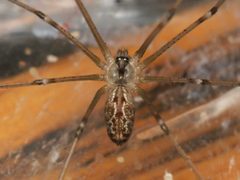
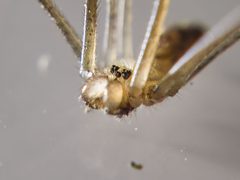
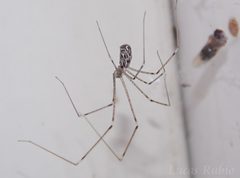
Holocnemus is a of cellar spiders ( Pholcidae) first described by Eugène Louis Simon in 1873. The genus is distinguished by dark marks on the leg and tibiae in both sexes, a trait shared with related genera Crossopriza, Stygopholcus, and Maghreba. As of October 2025, the genus comprises four , with H. pluchei being the most widely distributed due to human-mediated introduction outside its native range.
Pronunciation
How to pronounce Holocnemus: /hɔˈlɔknɛməs/
These audio files are automatically generated. While they are not always 100% accurate, they are a good starting point.
Identification
Members of Holocnemus can be distinguished from other pholcid by the presence of dark marks on the leg and tibiae in both males and females. This characteristic is shared with the related genera Crossopriza, Stygopholcus, and Maghreba. The genus is placed in the Holocneminae based on these and other morphological features.
Images
Habitat
in this occupy varied . Holocnemus pluchei, the best-studied species, is frequently found outdoors in shaded locations such as building overhangs and dense vegetation, including agave plants. Unlike many pholcids that prefer cool, dark interior spaces like basements and wells, H. pluchei shows a strong preference for outdoor environments in at least some parts of its introduced range.
Distribution
The is native to Europe and North Africa. Holocnemus pluchei has been introduced worldwide, with the earliest North American record from Sutter County, California in 1974. In the United States, H. pluchei currently ranges east to at least central Texas and north to southern Oregon.
Behavior
Holocnemus pluchei exhibits communal web-building , with up to fifteen individuals sharing a single web structure. Web membership changes periodically. When prey is captured, individuals compete, though contests are rarely prolonged. The exhibits a distinctive defensive behavior called "bouncing," in which the spider rapidly moves its body up and down while maintaining leg contact with the silk. This behavior is triggered by tactile stimulation and air movement, and has been demonstrated to be effective against web-invading jumping spiders.
Ecological Role
As web-building spiders, members of this function as of small arthropods. Holocnemus pluchei serves as prey for specialized web-invading jumping spiders (Salticidae), including Portia that use to capture them. The species' defensive , particularly bouncing, represent an important anti-predator in these interactions.
Human Relevance
Holocnemus pluchei has been introduced well outside its native range through human activity. The produces arginine kinase, a newly described allergen that can induce asthma in sensitive individuals. This represents a potential health concern in areas where the spider is abundant. The species is not considered dangerously venomous to humans or pets.
Similar Taxa
- Pholcus phalangioidesLong-bodied Cellar Spider; H. pluchei closely resembles this , which may have contributed to delayed recognition of its establishment in North America. Both share the long-legged, fragile appearance typical of pholcids.
- CrossoprizaRelated pholcid sharing the characteristic dark marks on leg and tibiae; distinguished by other morphological features and geographic distribution.
- StygopholcusRelated pholcid sharing the characteristic dark marks on leg and tibiae; primarily found in cave environments.
- MaghrebaRelated pholcid sharing the characteristic dark marks on leg and tibiae; restricted to the Maghreb region of North Africa.
More Details
Taxonomic history
The was first described by Eugène Louis Simon in 1873 and is classified in the Holocneminae. As of October 2025, four are recognized in the genus.
Research significance
Holocnemus pluchei has been intensively studied as a model organism for understanding social in spiders, -prey dynamics with jumping spiders, and the effects of food availability on traits. The ' communal web-building and defensive behaviors have made it particularly valuable for behavioral research.
Sources and further reading
- BugGuide
- Wikipedia
- GBIF taxonomy match
- iNaturalist taxon
- NCBI Taxonomy
- Catalogue of Life
- Bug Eric: Spider Sunday: Marbled Cellar Spider
- Bug Eric: July 2011
- Anti‐predator defences of a web‐building spider, Holocnemus pluchei (Araneae, Pholcidae)
- Food Level and Life History Characteristics in a Pholcid Spider (Holocnemus Pluchei)
- Predator‐prey interactions between web‐invading jumping spiders and a web‐building spider, Holocnemus pluchei (Araneae, Pholcidae)