
Pityohyphantes rubrofasciatus
(Keyserling, 1886)
Hammock spider
Pityohyphantes rubrofasciatus is a of sheetweb spider in the Linyphiidae, commonly known as hammock spiders. The name derives from Greek meaning "pine weaver," though species occur in both coniferous and hardwood forests. The species constructs flat or slightly convex sheet webs suspended in foliage, typically well above ground level. It occurs across northern North America in the United States and Canada.
Pronunciation
How to pronounce Pityohyphantes rubrofasciatus: /ˌpɪti.oʊˈhaɪfəntiːz ˌruːbroʊˌfæsɪˈeɪtəs/
These audio files are automatically generated. While they are not always 100% accurate, they are a good starting point.
Identification
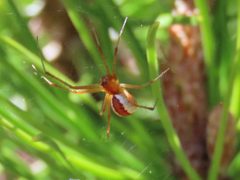
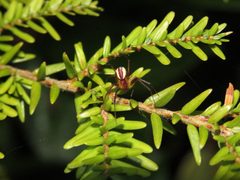
-level identification of Pityohyphantes requires examination of external genitalia. Members of the are recognized by a consistent abdominal pattern: a brown or reddish jagged-edged longitudinal band on an ivory background. Sheetweb weavers in this genus can be distinguished from cobweb weavers (Theridiidae) by the presence of prominent setae on the legs, whereas cobweb weavers have spineless legs. The web structure also differs: hammock spiders construct sheet-like platforms with a maze of supporting threads above, rather than the irregular three-dimensional tangles typical of cobweb weavers.
Images
Habitat
Found in coniferous and hardwood forests, typically in foliage well above ground level. Webs may also be constructed on fences, building exteriors, and other manmade structures.
Distribution
United States and Canada. GBIF records confirm distribution across both countries.
Behavior
Constructs flat to slightly convex sheet webs (described as "hammocks") suspended by a maze of threads above the platform. The spider hangs upside down beneath the sheet and responds to entangled prey at any time of day. Usually conceals itself on the underside of foliage at the web periphery rather than occupying the web center. Mature males cease web-building and wander in search of mates, during which time they do not feed.
Ecological Role
of small insects; webs capture prey that fall from branches above.
Similar Taxa
- Steatoda spp.Both construct sheet-like webs, but Steatoda (Theridiidae) has spineless legs and builds more irregular three-dimensional webs rather than the flat suspended platforms of Pityohyphantes.
- Bowl and Doily Spider (Frontinella pyramitela)Another linyphiid sheetweb weaver, but constructs a distinct bowl-shaped web with a doily-like platform below, unlike the simple hammock structure of Pityohyphantes.