
Frontinella pyramitela
(Walckenaer, 1841)
Bowl-and-doily Spider, Bowl and Doily Spider
Frontinella pyramitela, commonly known as the bowl-and-doily spider, is a small sheet-weaving spider found across North and Central America. It is distinguished by its highly characteristic web architecture: an inverted dome-shaped 'bowl' suspended above a horizontal sheet 'doily.' The is one of the most common and widespread linyphiid spiders in North America, frequently encountered at forest edges, in pine woodlands, and in human-modified environments. Earlier taxonomic references treated this species as Frontinella communis, a name now synonymized with F. pyramitela.
Pronunciation
How to pronounce Frontinella pyramitela: /frɒnˈtɪnɛlə ˌpaɪræmɪˈtiːlə/
These audio files are automatically generated. While they are not always 100% accurate, they are a good starting point.
Identification
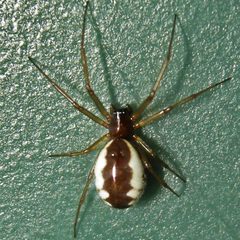
The is most readily identified by its unique web structure—an inverted dome 'bowl' suspended by tangled silk above a horizontal sheet 'doily'—rather than by body characteristics alone. The bowl-and-doily architecture is considered the most recognizable non-orb web in North America. For visual confirmation of the spider itself, the bold black and white abdominal striping on a minute spider distinguishes it from other small linyphiids, though magnification is typically required.
Images
Appearance
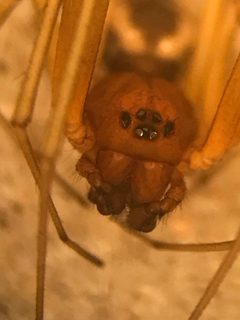
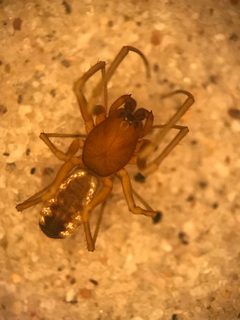
Small-bodied spider with mature females measuring 3-4 mm in body length and males slightly smaller. bears bold black and white stripes. is brown. Legs are brownish in coloration.
Habitat
Forest edges and pine woodlands are primary , but the is equally common in yards, gardens, and orchards. Webs are constructed well above ground level, typically stretched between twigs, suspended from fences, or attached to other elevated structures.
Distribution
North and Central America; widespread across North America with records from Vermont and across the continent. The is considered one of the most common and widespread spiders in North America.
Seasonality
Males share female webs in late summer and fall, suggesting peak reproductive activity during this period. Web-building and foraging activity presumably occurs throughout the warmer months.
Diet
Small flies, gnats, and other small insects are captured when they strike the supporting scaffold threads and fall onto the upturned sheet below.
Life Cycle
sac production timing not documented in available sources. Spiderlings presumably disperse by ballooning, typical of Linyphiidae.
Behavior
The spider hangs inverted on the underside of the 'bowl' portion of the web, awaiting prey. Insects striking the tangled scaffold lines fall onto the sheet below. At least one source asserts that the spider pulls prey through the bottom of the bowl and retreats to the 'doily' to feed. The exhibits local abundance with of dozens of webs in close proximity, which may facilitate mating encounters. Males are observed sharing female webs during late summer and fall.
Ecological Role
of small flying insects. Local abundance suggests potentially significant collective impact on of small dipterans in suitable .
Human Relevance
Not dangerous to humans. Frequently encountered in gardens, orchards, and around buildings due to its preference for elevated web sites. The distinctive web is often noticed before the spider itself is seen.
Similar Taxa
- Frontinella huachucaCongeneric known from Arizona; potentially distinguishable by geographic range and subtle morphological differences, though positive identification requires expert examination
- Other LinyphiidaeNumerous small sheet-weaving spiders construct flat or dome-shaped webs, but none combine the specific bowl-above-doily architecture with this ' bold abdominal pattern
Misconceptions
The was long known as Frontinella communis in earlier literature, leading to potential confusion with modern sources using F. pyramitela. The two names are now synonymized, with F. pyramitela taking priority.
More Details
Taxonomic Note
Frontinella pyramitela (Walckenaer, 1841) has priority over F. communis (Hentz, 1850), which is now treated as a junior synonym. Older references may use either name.
Web Architecture
The bowl-and-doily structure is among the most complex sheet webs known, with the three-dimensional bowl suspended above a two-dimensional sheet by an intricate tangle of supporting threads.