
Frontinella
F. O. Pickard-Cambridge, 1902
Bowl and Doily Spiders
Species Guides
2- Frontinella huachuca
- Frontinella pyramitela(Bowl-and-doily Spider)
Frontinella is a of dwarf spiders in the Linyphiidae, first described by F. O. Pickard-Cambridge in 1902. The genus contains nine described distributed across China, El Salvador, Mexico, and the United States. The best-known member, F. communis (formerly F. pyramitela), is recognized by its distinctive bowl-and-doily web architecture. These spiders are small-bodied, with mature females measuring 3–4 mm. Some species exhibit behavioral through solar orientation and cohabitation between males and females.
Pronunciation
How to pronounce Frontinella: /fron.tiˈnɛl.la/
These audio files are automatically generated. While they are not always 100% accurate, they are a good starting point.
Identification
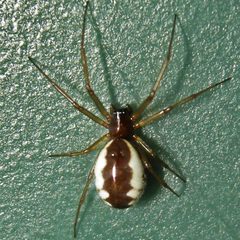
in this are distinguished by their distinctive web architecture: a concave "bowl" suspended above a flat "doily" or sheet platform. The spider hangs inverted beneath the bowl. F. communis has bold black and white abdominal stripes, brown , and brownish legs. Body length is small (3–4 mm for females, slightly smaller for males). Web size is only a few inches across. F. huachuca occurs in Arizona and may be distinguished by geographic range. F. pyramitela and F. communis have been confused historically; F. communis is the currently accepted name for the widespread North American bowl and doily spider.
Images
Habitat
Webs are constructed well above ground, stretched between twigs, suspended from fences, and other elevated objects. Found at forest edges and in pine woodlands. Also occurs in yards, gardens, and orchards.
Distribution
China, El Salvador, Mexico, and the United States. F. communis is widespread across North America. F. huachuca occurs in Arizona and Mexico. F. pyramitela is recorded from North and Central America. F. laeta is the type from Mexico. F. omega occurs in El Salvador. F. hubeiensis and F. zhui are known from China. F. bella is recorded from Hispaniola.
Seasonality
Males share female webs in late summer and fall.
Behavior
Constructs distinctive bowl-and-doily webs: a concave bowl suspended by tangled scaffolding above a flat sheet. The spider hangs inverted on the underside of the bowl. Prey likely hits scaffolding threads and falls onto the upturned sheet. F. communis has been observed to pull prey through the bowl bottom and retire to the doily to feed. Exhibits behavioral : when insolation and ambient temperature are high, aligns oral-anal axis with sun rays, reducing body temperature by at least 0.5°C compared to perpendicular orientation. This solar orientation is not visually mediated. Males and females cohabitate in webs; multiple webs are often found in close proximity, which may facilitate mating.
Human Relevance
Not dangerous to humans. Common and widespread in North America, frequently encountered in residential settings.
Similar Taxa
- NerieneRelated in Linyphiidae; also constructs sheet webs but lacks the distinctive bowl-and-doily architecture of Frontinella
More Details
Nomenclature history
Earlier references treated the widespread North American bowl and doily spider as Frontinella pyramitela; this is now recognized as F. communis. F. pyramitela remains a valid species recorded from North and Central America.
Sources and further reading
- BugGuide
- Wikipedia
- GBIF taxonomy match
- iNaturalist taxon
- NCBI Taxonomy
- Catalogue of Life
- Bug Eric: Spider Sunday: Bowl & Doily Spider
- Behavioral thermoregulation: Solar orientation in Frontinella communis (Linyphiidae), a 6-mg spider
- Enigmatic cohabitation in bowl and doily spiders, Frontinella pyramitela (Araneae, Linyphiidae)