
Pityohyphantes
Simon, 1929
hammock spiders, pine weavers
Species Guides
6- Pityohyphantes costatus(hammock spider)
- Pityohyphantes cristatus
- Pityohyphantes minidoka
- Pityohyphantes rubrofasciatus(Hammock spider)
- Pityohyphantes subarcticus(Taiga Sheetweb Weaver)
- Pityohyphantes tacoma
Pityohyphantes is a of sheetweb weavers ( Linyphiidae) commonly known as hammock spiders, named for their slightly convex sheet-like webs suspended by a maze of threads above. The genus name derives from Greek 'pitys' (pine) and 'hyphantes' (weaver), reflecting their frequent association with coniferous forests. Mature females measure approximately 5–7 mm in body length, with males slightly smaller. The genus contains at least 16 distributed across Europe and North America, with most North American species occurring in western and northern coniferous forests.
Pronunciation
How to pronounce Pityohyphantes: //ˌpɪti.oʊˈhaɪfæntiːz//
These audio files are automatically generated. While they are not always 100% accurate, they are a good starting point.
Identification
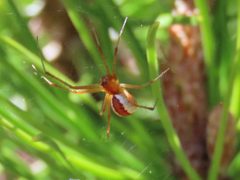
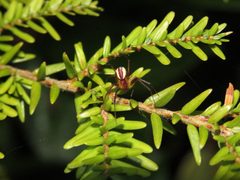
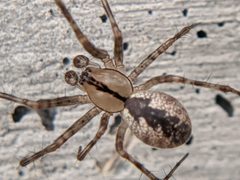
Hammock spiders are recognized by a consistent abdominal pattern: a brown or reddish jagged-edged band running down the midline on an ivory background. They can be distinguished from cobweb weavers (Theridiidae) by their prominent leg setae—cobweb weavers have spineless legs. Their webs are slightly convex sheets suspended by numerous threads above, rather than the irregular tangles typical of cobweb weavers. Reliable identification requires examination of external genitalia.
Images
Habitat
Primarily arboreal, occurring in of coniferous trees and hardwood foliage. Webs are constructed well above ground level, typically suspended in vegetation. Some also build webs on fences, building exteriors, and other artificial structures.
Distribution
Europe and North America. European records include Central and Eastern Europe, Russia to Kazakhstan, and Japan. North American distribution centers on western and northern coniferous forests, with ranging across the United States and Canada including Alaska.
Seasonality
Mating occurs in spring in at least some (e.g., P. costatus). and immatures may overwinter under bark or stones on the ground.
Life Cycle
Females attach sacs to twigs or other objects at the web periphery. occurs as or immatures under bark or ground stones.
Behavior
Spiders hang upside down beneath the sheet web to capture prey. They typically conceal themselves on the underside of peripheral foliage, though some individuals occupy the web center. Mature males cease web-building and wander in search of mates, not feeding during this period.
Ecological Role
Bird has been demonstrated as a significant mortality factor, with exclusion experiments showing 2.1–10.6 times higher spider abundance on protected branches. Predation affects both sexes but may impose additional winter mortality risk on males due to higher activity levels.
Similar Taxa
- Bowl and Doily Spider (Frontinella pyramitela)Both are linyphiid sheetweb weavers, but Bowl and Doily Spiders construct a characteristic two-tiered web with a bowl-shaped sheet above a flat doily, whereas hammock spiders build a single slightly convex sheet.
- Cobweb weavers (Theridiidae: Steatoda and relatives)Some cobweb weavers like Steatoda build sheet-like webs with tangled threads, but they lack the prominent leg setae of hammock spiders and typically have more irregular, three-dimensional webs rather than the suspended planar sheets of Pityohyphantes.
More Details
Sex ratio biology
Pityohyphantes phrygianus exhibits a skewed sex ratio and possesses complex female genital including two distinct spermathecae with different gland structures, suggesting female-mediated mechanisms of sex ratio control.
Sources and further reading
- BugGuide
- Wikipedia
- GBIF taxonomy match
- iNaturalist taxon
- NCBI Taxonomy
- Catalogue of Life
- Bug Eric: Spider Sunday: Hammock Spiders
- Bug Eric: City Nature Challenge 2023 Recap
- Bug Eric: One Night, One House, Seventeen Spider Species
- Female genitalia in Pityohyphantes phrygianus, a spider with a skewed sex ratio
- Bird predation as a sex‐ and size‐selective agent of the arboreal spider Pityohyphantes phrygianus