
Philoponella oweni
(Chamberlin, 1924)
Philoponella oweni is a small cribellate orb-weaver spider (4.7–7.1 mm) found in arid regions of the southwestern United States and northwestern Mexico. The exhibits facultative semi-social , with females living either solitarily or in communal groups of 2–40 individuals depending on web-site availability and prey abundance. Despite communal living, individuals do not cooperate in prey capture, web construction, or care. Communal females benefit from higher feeding rates and greater production, but suffer increased by pteromalid , resulting in equivalent net reproductive success between strategies.
Pronunciation
How to pronounce Philoponella oweni: /ˌfɪləˌpoʊˈnɛlə ˈoʊəni/
These audio files are automatically generated. While they are not always 100% accurate, they are a good starting point.
Identification
Distinguished from other Philoponella by its specific geographic range in the southwestern United States and northwestern Mexico. The combination of small size, cribellate orb web construction, and facultative communal is characteristic. Communal webs are found in protected microhabitats such as hollow trees or rock clefts, with multiple individual orbs sharing support lines and connected to common retreat areas. Solitary individuals construct single orbs with irregular threads above and below.
Images
Appearance
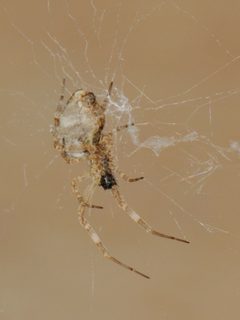
Small spider measuring 4.7–7.1 mm in body length. As a cribellate orb-weaver, produces webs with characteristic hackled band silk. bear distinctive color markings that allow maternal identification within communal groups.
Habitat
Arid and semi-arid environments. Communal webs occupy protected sites including hollowed trees and rock clefts that allow long-term web persistence. Solitary webs occur in locations with more abundant attachment sites. Web-site availability is a primary determinant of social strategy: scarce sites favor communal living, abundant sites favor solitary living.
Distribution
Southwestern United States (Arizona, Colorado) and northwestern Mexico (Sonora).
Seasonality
Subadults emerge from sites in spring (early April to early June in Arizona, timing varies with elevation). Mating occurs in late spring through early summer. Males die by early July. Females begin oviposition in late June to early July, with some continuing into September. Spiderlings emerge as second instars approximately 20 days after -case construction.
Diet
Feeds on insects captured in orb webs. Communal females have significantly higher feeding rates (56% feeding per hour) compared to solitary females (22% feeding per hour). Food intake directly affects production: well-fed females produce approximately 23 eggs per versus 10 eggs on poor diets. Communal groups occupy sites with higher insect abundance than solitary webs, though individuals within groups compete for prey.
Life Cycle
breeding cycle. Spiderlings hatch as second instars after molting within the , leaving behind empty eggshells and first . Hatchlings initially remain in maternal webs, spinning their own orbs within web meshwork. Some immatures disperse; others remain in natal location, emerging the following spring to occupy the same sites. In some cases, immatures bud off from parental webs by clustering and building interconnected webs progressively farther from the maternal web until connection is severed.
Behavior
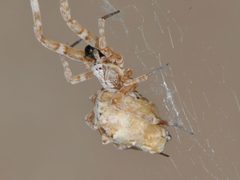
Facultatively communal: females may live solitarily or in groups of 2–40 plus males and immatures. Communal living is not cooperative—individuals do not share prey, collaborate on web construction, or provide alloparental care. Females guard by retreating to safe areas with attached to and held by fourth pair of legs for approximately 20 days until hatching. Webs are maintained for multiple days through repair rather than daily replacement. Males are mobile and traverse between female webs; females are sedentary.
Ecological Role
Similar Taxa
- Other Philoponella speciesDistinguished by specific geographic distribution in southwestern North America and documented facultative semi-social ; most lack detailed behavioral studies confirming this specific social system.
- Other UloboridaeCribellate silk production is -level trait; identification to requires geographic and behavioral data.
More Details
Parasitism pressure
Communal webs experience 28% by Arachnopteromalus dasys versus 10% for solitary webs, offsetting the reproductive advantage of higher production in communal females.
Kleptoparasitism
Argyrodes baboquivari occupies P. oweni webs, with 50% of observations in communal webs despite communal webs comprising only 28% of study webs. on P. oweni and has been documented.