
Pimoa haden
Chamberlin & Ivie, 1943
Large Hammockweb Spider
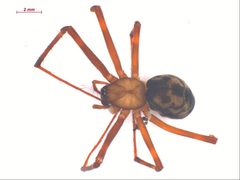
Pimoa haden is a of large hammockweb spider in the Pimoidae, found in the western United States. It was described by Chamberlin & Ivie in 1943. The species is notable for its relatively large size compared to other members of the family, with females reaching up to 12 mm in body length. Like other Pimoa species, it constructs fine, net-like horizontal webs that can span considerable distances.
Pronunciation
How to pronounce Pimoa haden: /ˈpaɪmoʊə ˈheɪdən/
These audio files are automatically generated. While they are not always 100% accurate, they are a good starting point.
Identification
Distinguished from other Pimoa by subtle morphological characters requiring expert examination, including details of genitalia. The combination of relatively large body size (for Pimoidae), long legs, and fine net-like horizontal webs distinguishes it from the much smaller Linyphiidae (sheetweb weavers) to which Pimoidae were formerly assigned. Within the Pimoa, identification to species level requires examination of microscopic characters.
Images
Appearance
Medium-sized spider with long legs that increase its apparent size. Females measure 5-12 mm in body length, while males are smaller at approximately 5 mm. The body is relatively robust compared to the closely related sheetweb weavers (Linyphiidae). Coloration and detailed patterning are not specifically documented for this .
Habitat
Coniferous forests in rain shadow regions. Webs are constructed in crevices of logs, fences, and retaining walls. The appears to favor shaded, moist microhabitats where dew helps make the nearly invisible webs detectable.
Distribution
Western United States, specifically along the Pacific coast region. The has been recorded from California and Oregon based on available distribution data.
Seasonality
can be found hanging beneath webs at night or on overcast days. Specific seasonal activity patterns are not well documented, but the is active during warmer months when prey availability supports web-building.
Life Cycle
Females construct nearly spherical sacs covered with debris for camouflage, containing approximately 80-100 eggs. Juveniles emerge and presumably disperse to construct their own webs. Developmental stages and timing are not specifically documented for this .
Behavior
Constructs fine, net-like horizontal webs that may span up to one yard (approximately 0.9 meters) though most webs are smaller, typically under six inches across. The spider hides in a crevice or retreat during daylight hours and hangs from the underside of the web at night or during overcast conditions. Like related Linyphiidae, individuals may autotomize legs below the patellar segment to escape , with minimal impact on mobility.
Ecological Role
on small flying insects captured in the hammockweb. Serves as prey for larger and possibly small vertebrates. Contributes to diversity in coniferous forest understory .
Human Relevance
Not a of economic importance. Occasionally encountered by naturalists and arachnologists in western North America. No known medical significance or pest status.
Similar Taxa
- Pimoa rupicolaAnother large Pimoa in western North America; distinguished by geographic distribution and subtle morphological differences
- Linyphiidae (sheetweb weavers)Formerly classified together; distinguished by much smaller body size (typically under 5 mm) and different web architecture
- Nesticidae (cave cobweb spiders)May share crevice-dwelling habits; distinguished by different web structure (tangled cobwebs vs. fine sheet webs) and arrangement
More Details
Taxonomic History
The Pimoidae was established to accommodate Pimoa and related , separated from Linyphiidae based on morphological and phylogenetic evidence. Pimoa haden was among the earlier described in the genus, with the specific epithet possibly referencing the Hadeninae (a of ), though the etymology is not explicitly documented.
Conservation Status
Not evaluated by IUCN. The appears to have a restricted range along the Pacific coast, potentially making it vulnerable to alteration in coniferous forest .