
Pimoa
Chamberlin & Ivie, 1943
large hammockweb spiders
Species Guides
2- Pimoa altioculata(large hammockweb spider)
- Pimoa haden(Large Hammockweb Spider)
Pimoa is a of large hammockweb spiders in the Pimoidae, comprising approximately 86 as of 2026. The genus name derives from the Gosiute language meaning "big legs," referring to the notably long legs of these spiders. Pimoa species are distinguished from their close relatives in Linyphiidae by their substantially larger body size, with females reaching 12 mm in body length. The genus exhibits a disjunct distribution across the Pacific coast of North America, the Cantabrian Mountains of Spain, the Alps, and the Himalayas, with the majority of concentrated in Asia.
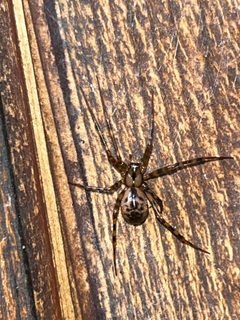
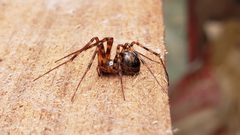
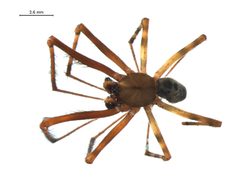
Pronunciation
How to pronounce Pimoa: /ˈpɪmoʊə/
These audio files are automatically generated. While they are not always 100% accurate, they are a good starting point.
Identification
Pimoa spiders can be distinguished from the related sheetweb weaver Linyphiidae by their significantly larger body size—males measure 5 mm and females up to 12 mm in body length, with proportionally long legs that make them appear even larger. The webs are fine, net-like, and horizontal, often spanning up to one yard though typically smaller. identification relies primarily on genitalic characters and barcodes.
Images
Habitat
Coniferous forests in rain shadow regions; subterranean including caves in alpine regions; webs constructed in crevices of logs, fences, and retaining walls. Some show minor to hypogean (subterranean) life while retaining higher ability than more specialized cave-dwelling spiders.
Distribution
Pacific coast of North America; Cantabrian Mountains, Spain; Alps; Himalayas; Qinghai-Tibet Plateau; Southwest China. Approximately 15 occur in North America north of Mexico, while 67 species are distributed across Asia.
Life Cycle
Females construct nearly spherical sacs covered with debris for camouflage, containing approximately 80–100 eggs. Developmental stages include egg, , and .
Behavior
Constructs fine, net-like horizontal webs; retreats to crevices during daylight hours; hangs from underside of web at night or on overcast days. has been observed: individuals may break legs off below the patellar (knee) segment to escape without compromising agility.
Similar Taxa
- LinyphiidaeFormerly classified within this ; distinguished by substantially smaller body size and different web architecture
- NanoaSister within Pimoidae; and morphologically distinct
Sources and further reading
- BugGuide
- Wikipedia
- GBIF taxonomy match
- iNaturalist taxon
- NCBI Taxonomy
- Catalogue of Life
- Bug Eric: Large Hammockweb Spiders: Pimoa
- Figure 6: Current and past distribution of Pimoa lineages.
- Unexpected diversity in the relictual European spiders of the genus Pimoa (Araneae : Pimoidae)
- Notes on three closely related species of the genus Pimoa (Araneae, Pimoidae) from Southwest China
- Species conservation profile of the stenoendemic cave spider Pimoa delphinica (Araneae, Pimoidae) from the Varaita valley (NW-Italy)
- Three new species of the spider genus Pimoa Chamberlin & Ivie, 1943 (Araneae, Pimoidae) from Qinghai-Tibet Plateau of China
- An annotated chromosome-level genome of a troglophilic spider (Pimoa clavata).