
Physocyclus globosus
(Taczanowski, 1874)
short-bodied cellar spider
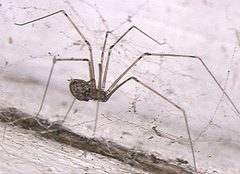
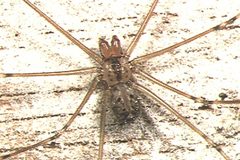
Physocyclus globosus, commonly known as the short-bodied cellar spider, is a small pholcid spider with a distribution. It is frequently found in anthropogenic including buildings and caves across tropical and subtropical regions, and has been introduced to numerous temperate areas worldwide. The is characterized by a compact, globose and distinctive dark markings. It belongs to the globosus species group within its , which exhibits a biogeographical distribution pattern in the Mesoamerican and Mexican Mountain biotic components.
Pronunciation
How to pronounce Physocyclus globosus: /ˈfaɪsoʊsɪˌkləs ɡloʊˈboʊsəs/
These audio files are automatically generated. While they are not always 100% accurate, they are a good starting point.
Identification
Distinguished from the more common long-bodied cellar spider (Pholcus phalangioides) by its short, broad, globose versus the elongated, cylindrical abdomen of P. phalangioides. The compact body shape and prominent black stripe are diagnostic. Within its , assigned to the globosus group based on morphological phylogenetic analysis. In the southwestern United States, it appears to replace P. phalangioides as the typical indoor cellar spider.
Images
Appearance
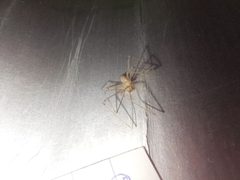
Small spider with body length approximately 6 mm. and short and broad, giving a compact, globose overall appearance. A prominent black line runs longitudinally along the surface of the carapace, continuing along most of the abdomen. Eight grouped closely together on a raised hump on the . Coloration generally brown.
Habitat
Primarily associated with anthropogenic environments including buildings, cellars, and caves. Occupies dark, sheltered corners of ceilings and walls. In natural settings, occurs in caves. Shows preference for warmer climates but has established in temperate regions through human-mediated introduction.
Distribution
distribution throughout warmer parts of the world. Native range includes Mesoamerican and Mexican Mountain biotic components. Introduced established in Africa (Congo), Europe (Czechia), Asia (Iran, Sri Lanka, China, Japan, Philippines, Indonesia), Australia, Pacific islands, Galápagos Islands, and South America (Brazil, Venezuela). Present in North America.
Seasonality
Active year-round in suitable indoor environments. Observed in autumn in temperate regions when males wander in search of mates. Ballooning for reported in fall for related , though not specifically documented for this species.
Life Cycle
Development includes early stages that construct webs lacking gumfoot threads, unlike females. sacs produced by females, with spiderlings developing within silk insulation. Intraindividual numerical variation has been documented.
Behavior
Constructs irregular, tangled webs in corners of ceilings and walls. males and early juveniles build webs that lack gumfoot threads—sticky trapping lines typical of pholcid webs—despite possessing the morphological structures (spigots) to produce them. This behavioral difference is not explained by spigot . Males wander in search of females in autumn. Females remain in webs, which may contain multiple individuals including males.
Human Relevance
Common household spider in tropical and subtropical regions, and increasingly in temperate areas. Considered beneficial as it preys on other arthropods including flies and insects. Frequently encountered in cellars, hence the . Non-aggressive and harmless to humans.
Similar Taxa
- Pholcus phalangioidesLong-bodied cellar spider with elongated, cylindrical versus the short, globose abdomen of P. globosus; P. globosus replaces P. phalangioides as the typical indoor pholcid in the southwestern United States
More Details
Chromosomal characteristics
Exhibits intraindividual numerical variation. NOR (nucleolar organizer region) distribution patterns have been studied in this within the Haplogynae suborder context.
Phylogenetic position
Member of the globosus group within Physocyclus, one of two major clades in the (the other being the dugesi group). The globosus group contains 11 species with a biogeographical distribution pattern in the Mesoamerican and Mexican Mountain biotic components.
Web architecture
The absence of gumfoot threads in male and webs represents a behavioral plasticity not linked to morphological constraints, suggesting developmental or sex-specific regulation of silk use rather than structural limitations.
Sources and further reading
- BugGuide
- Wikipedia
- GBIF taxonomy match
- iNaturalist taxon
- NCBI Taxonomy
- Catalogue of Life
- Bug Eric: ArachNovember?
- CHROMOSOMES OF CROSSOPRIZA LYONI (BLACKWALL 1867), INTRAINDIVIDUAL NUMERICAL CHROMOSOME VARIATION IN PHYSOCYCLUS GLOBOSUS (TACZANOWSKI 1874), AND THE DISTRIBUTION PATTERN OF NORs (ARANEOMORPHAE, HAPLOGYNAE, PHOLCIDAE)
- The Absence of Gumfoot Threads in Webs of Early Juveniles and Adult Males ofPhysocyclus globosus(Pholcidae) is not Associated with Spigot Morphology
- A reanalysis of the morphological phylogeny of the spider genus Physocyclus Simon (Araneae: Pholcidae) with the description of a new species and description of the female of Physocyclus paredesi Valdez-Mondragón from Mexico