
Physocyclus
Simon, 1893
cellar spiders
Species Guides
3- Physocyclus californicus
- Physocyclus enaulus(cellar spider)
- Physocyclus globosus(short-bodied cellar spider)
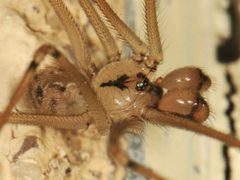
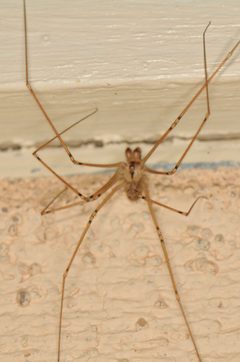
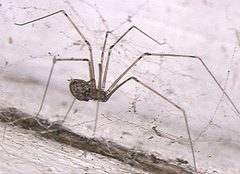
Physocyclus is a of cellar spiders ( Pholcidae) established by Eugène Louis Simon in 1893. The genus comprises 38 recognized distributed across multiple continents, with the highest diversity in Mexico. Two distinct species groups are recognized: the globosus group (11 species) and the dugesi group (21 species), distinguished by morphological and biogeographic patterns. The type species, P. globosus, has been widely introduced globally through human activity.
Pronunciation
How to pronounce Physocyclus: /ˌfaɪsoʊˈsaɪkləs/
These audio files are automatically generated. While they are not always 100% accurate, they are a good starting point.
Identification
Members of Physocyclus can be distinguished from the more commonly encountered Pholcus phalangioides (Long-bodied Cellar Spider) by their occurrence patterns; Physocyclus appears to replace Pholcus as the typical indoor cellar spider in the southwestern United States. The is characterized by morphological features used in phylogenetic analysis, including 54 discrete character states across binary and multistate traits. -level identification requires examination of male structures and other genitalic characters.
Images
Habitat
occupy diverse environments including indoor spaces, with P. globosus noted as a common indoor spider in the southwestern United States. The globosus group is associated with Mesoamerican and Mexican Mountain biotic components, while the dugesi group occurs in Mesoamerican and Continental Nearctic regions.
Distribution
Native range includes South America, Asia, Central America, North America, Africa, Australia, Czechia, and Pacific Islands. Mexico harbors the greatest with numerous . P. globosus has been introduced to Africa, Czechia, Iran, Sri Lanka, China, Japan, Philippines, Indonesia, Australia, and Pacific islands.
Seasonality
Observations indicate males may wander in search of mates during fall, as documented in New Mexico. Activity likely extends into unseasonably warm late autumn periods in temperate regions.
Life Cycle
Web construction differs between life stages and sexes. Early juveniles and males construct webs primarily for shelter and lack gumfoot threads. Adult females build prey-capture webs with gumfoot threads that serve as defensive retreats when disturbed. All instars possess piriform spigots capable of producing gumfoot threads, indicating the behavioral difference is not morphologically constrained. sacs are produced by mated females, with spiderlings potentially within protective silk enclosures.
Behavior
females construct specialized webs with gumfoot threads used as defensive retreats when disturbed. Early juveniles and adult males exhibit different web architecture suited to shelter rather than prey capture. Adult males have been observed wandering in search of females, sometimes congregating near female webs.
Ecological Role
Indoor contribute to pest control, as noted in human dwellings. The occupies similar to Pholcus in building interiors.
Human Relevance
P. globosus serves as a common indoor spider in the southwestern United States, replacing Pholcus phalangioides in this ecological role. Observations suggest these spiders are tolerated or encouraged indoors for pest control of flies and other insects. The has been subject to taxonomic research including phylogenetic reanalysis and chromosomal studies.
Similar Taxa
- Pholcus phalangioidesLong-bodied Cellar Spider; Physocyclus replaces this as the typical indoor cellar spider in the southwestern United States, though both occupy similar in buildings.
More Details
Phylogenetic structure
The is divided into two monophyletic clades: the globosus group (11 ) distributed in Mesoamerican and Mexican Mountain biotic components, and the dugesi group (21 species) in Mesoamerican and Continental Nearctic components. This structure was corroborated through cladistic analysis of 54 morphological characters.
Chromosomal characteristics
P. globosus exhibits intraindividual numerical variation, with documented variation in nucleolar organizer region (NOR) distribution patterns. This cytogenetic diversity contributes to understanding of pholcid evolution.
Sources and further reading
- BugGuide
- Wikipedia
- GBIF taxonomy match
- iNaturalist taxon
- NCBI Taxonomy
- Catalogue of Life
- Bug Eric: ArachNovember?
- A reanalysis of the morphological phylogeny of the spider genus Physocyclus Simon (Araneae: Pholcidae) with the description of a new species and description of the female of Physocyclus paredesi Valdez-Mondragón from Mexico
- The Absence of Gumfoot Threads in Webs of Early Juveniles and Adult Males ofPhysocyclus globosus(Pholcidae) is not Associated with Spigot Morphology
- CHROMOSOMES OF CROSSOPRIZA LYONI (BLACKWALL 1867), INTRAINDIVIDUAL NUMERICAL CHROMOSOME VARIATION IN PHYSOCYCLUS GLOBOSUS (TACZANOWSKI 1874), AND THE DISTRIBUTION PATTERN OF NORs (ARANEOMORPHAE, HAPLOGYNAE, PHOLCIDAE)