
Phylloneta impressa
(L. Koch, 1881)
Forest Cobweb Weaver
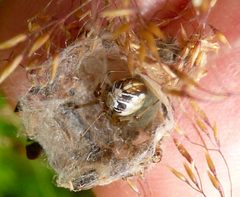
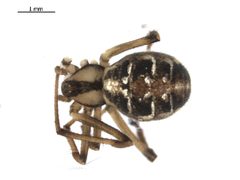
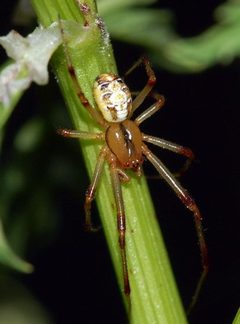
Phylloneta impressa is a small comb-footed spider (Theridiidae) with a Holarctic distribution. Males measure 2.5–5.5 mm and females 3.5–5.5 mm. The constructs tangle webs beneath retreats on vegetation and has been documented in agricultural settings including rape fields. It is closely related to and frequently confused with Phylloneta sisyphia.
Pronunciation
How to pronounce Phylloneta impressa: /ˌfɪloʊˈniːtə ɪmˈprɛsə/
These audio files are automatically generated. While they are not always 100% accurate, they are a good starting point.
Identification
Distinguished from the very similar Phylloneta sisyphia by : males peak in June–July and females in July–August, occurring slightly later than P. sisyphia. sac production in August–September also occurs later than in P. sisyphia. Both may co-occur on gorse, heather, and thorny bushes.
Images
Habitat
Vegetated including gorse, heather, and thorny bushes. Also recorded from rush florets in upper saltmarsh zones and from agricultural landscapes including rape (canola) fields. Constructs retreats on vegetation with associated tangle webs below.
Distribution
Holarctic distribution: widespread in western Europe (absent from Iceland), common in south and central England becoming scarcer north and west. Recorded across North America, Europe, Turkey, Caucasus, Russia (European to Far East), Kazakhstan, Iran, Central Asia, China, India, Romania, and Alaska (USA).
Seasonality
males recorded May–August, peaking June–July. Adult females recorded June–October, with one exceptional December record, peaking July–August. Juveniles emerge from sacs and are orally fed by females.
Life Cycle
Females produce a single spherical blue-green sac in August–September, retained within the retreat. Juveniles emerge and are fed orally by the female. males have been observed mate-guarding females in retreats.
Behavior
Constructs a retreat on vegetation with a characteristic tangle web suspended below, typical of Theridiidae. males engage in mate-guarding of females within retreats. Juveniles receive oral feeding from females after from sacs.
Human Relevance
Documented as accumulating residues in agricultural landscapes; 23 pesticide compounds detected in field-collected specimens from rape fields, including neonicotinoids (clothianidin, thiamethoxam, acetamiprid, thiacloprid, imidacloprid) and chlormequat. Serves as an indicator of pesticide exposure in agroecosystems.
Similar Taxa
- Phylloneta sisyphiaVery similar in appearance and use; distinguished by earlier ( and sacs peak earlier in the season) and minor pattern differences
More Details
Pesticide bioaccumulation
Study detected 23 compounds in P. impressa females, cocoons, and webs from rape fields, with differential distribution: clothianidin only in females, thiamethoxam predominant in webs with prey remnants, and acetamiprid/thiacloprid/imidacloprid present in all three matrices. Chlormequat was among the most abundant compounds detected.
Taxonomic history
Originally described as Theridion impressum by L. Koch in 1881; later transferred to Phylloneta.
Sources and further reading
- BugGuide
- Wikipedia
- GBIF taxonomy match
- iNaturalist taxon
- NCBI Taxonomy
- Catalogue of Life
- Seventy-four cuckoos in the nest: A new key to all North European cuckoo wasp species | Blog
- Not all Florida tiger beetles are rare | Beetles In The Bush
- Finland | Blog
- Why I Roamed the Marsh at Night | Beetles In The Bush
- Florida Metallic Tiger Beetle | Beetles In The Bush
- Pesticide comparison of Phylloneta impressa (Araneae: Theridiidae) females, cocoons and webs with prey remnants collected from a rape field before the harvest