
Pisaurina brevipes
(Emerton, 1911)
Straight-banded Nursery Web Spider
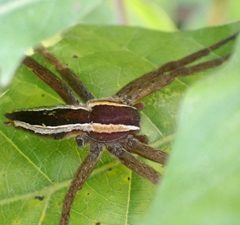
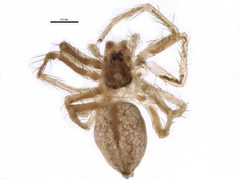
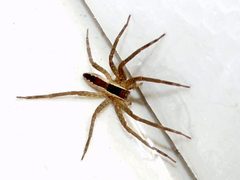
Pisaurina brevipes is a nursery web spider found in the eastern United States and Canada. It closely resembles the more common Pisaurina mira but is distinguished by proportionally shorter legs and straighter edges on the abdominal band. Females measure 11–13 mm in body length, males approximately 10.8 mm. The favors grasslands, bogs, and swamps, though detailed natural history remains poorly documented.
Pronunciation
How to pronounce Pisaurina brevipes: //ˌpaɪ.sɔːˈraɪ.nə ˈbrɛ.vɪˌpiːz//
These audio files are automatically generated. While they are not always 100% accurate, they are a good starting point.
Identification
Best distinguished from Pisaurina mira by measuring the ratio of patella-tibia I length to length: less than 2.0 in males and less than 1.4 in females (versus more than 2.0 and 1.4 respectively in P. mira). The abdominal band has straighter, more defined edges compared to the more undulating band of P. mira. Coloration patterns overlap extensively with P. mira, making visual identification unreliable without measurement or examination of male .
Images
Habitat
Favors grasslands, bogs, and swamps according to available records. Likely occupies low vegetation in moist open , similar to related nursery web spiders.
Distribution
Eastern North America from Ontario and Quebec south to Florida, west to Kansas. Range overlaps broadly with P. mira in the eastern United States.
Life Cycle
Rears young in nursery webs—bell-like sheet webs where the female suspends her sac and guards emerging spiderlings until their next and .
Behavior
Females carry sacs in their jaws before constructing nursery webs. Has been observed at outdoor lights, suggesting foraging activity.
Ecological Role
in grassland, bog, and swamp ; specific prey relationships undocumented.
Human Relevance
Not considered dangerously venomous to humans. May occasionally enter human structures. Benefits humans as a of insect pests in yards and gardens.
Similar Taxa
- Pisaurina miraOverlapping coloration and pattern; distinguished by longer leg proportions (patella-tibia I: ratio >2.0 in males, >1.4 in females) and more undulating abdominal band edges. P. mira is more abundant and widespread, making P. brevipes frequently overlooked or misidentified.
More Details
Taxonomic History
Described by Emerton in 1911. Frequently confused with P. mira due to morphological similarity and overlapping geographic range; reliable identification requires quantitative measurements or examination of male genitalia.
Conservation Status
Not formally assessed; likely underreported due to identification challenges with P. mira.