
Blissus occiduus
Barber, 1918
Western Chinch Bug
, the western chinch bug, is a phloem-feeding true (Hemiptera: Blissidae) that is a significant pest of warm-season turfgrasses, particularly buffalograss and zoysiagrass. The exhibits strong preference hierarchies, with buffalograss being the most preferred host followed by zoysiagrass, though it can survive and reproduce on a broad range of grasses including agronomic crops. Field studies have documented inconsistent control with neonicotinoid , with thiamethoxam showing particularly rapid degradation in buffalograss tissues compared to imidacloprid and clothianidin.
Pronunciation
How to pronounce Blissus occiduus: /ˈblɪsəs ɔkˈsɪdjuːs/
These audio files are automatically generated. While they are not always 100% accurate, they are a good starting point.
Identification
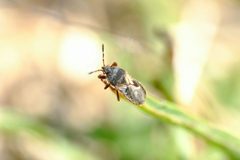
are small, approximately 4-5 mm in length, with the characteristic chinch bug body plan: oval, somewhat flattened, with a dark body and contrasting wing markings. The forewings are primarily white with a distinct black triangular spot at the middle of the outer margin. Nymphs lack wings and progress from yellowish to reddish with a pale band across the , eventually becoming dark with a conspicuous white spot between the wing pads. Distinguished from the hairy chinch bug (Blissus leucopterus hirtus) and common chinch bug () by geographic distribution and associations; B. occiduus is the primary chinch bug pest in western North America and shows particularly strong association with buffalograss, which is not a preferred host of eastern chinch bug .
Images
Habitat
Turfgrass systems, particularly buffalograss and zoysiagrass lawns and research plots; agricultural fields with grass crops; weedy grassland areas. Associated with managed and unmanaged grassland where warm-season grasses predominate. In field studies, concentrated in buffalograss leaf tissues where distribution and degradation patterns have been characterized.
Distribution
United States (California, Colorado, Kansas, Montana, Nebraska, New Mexico) and Canada (Alberta, British Columbia, Manitoba, Saskatchewan); also reported from Central America. Western Nearctic distribution, excluding Beringia.
Diet
Phloem-feeding on grasses (Poaceae). Strongly prefers warm-season turfgrasses, with buffalograss (Bouteloua dactyloides) and zoysiagrass (Zoysia japonica) as primary . Will feed and reproduce on diverse grass hosts including bermudagrass, St. Augustinegrass, centipedegrass, tall fescue, ryegrass, Kentucky bluegrass, creeping bentgrass, sorghum, corn, wheat, rice, barley, oats, and various weed grasses including crabgrass, foxtail, goosegrass, fall panicum, barnyardgrass, and johnsongrass. Host suitability varies significantly, with some hosts supporting high survival and while others result in high nymphal mortality.
Host Associations
- Bouteloua dactyloides (buffalograss) - primary - most preferred, supports highest survival and
- Zoysia japonica (zoysiagrass) - primary - second most preferred
- Cynodon dactylon (bermudagrass) - - supports development
- Stenotaphrum secundatum (St. Augustinegrass) -
- Eremochloa ophiuroides (centipedegrass) -
- Festuca arundinacea (tall fescue) - poor - high nymphal mortality
- Lolium perenne (perennial ryegrass) -
- Poa pratensis (Kentucky bluegrass) - poor
- Agrostis stolonifera (creeping bentgrass) -
- Sorghum bicolor (sorghum) - agricultural
- Zea mays (corn) - agricultural
- Triticum aestivum (wheat) - agricultural
- Oryza sativa (rice) - agricultural
- Hordeum vulgare (barley) - agricultural
- Avena sativa (oats) - agricultural
- Secale cereale (rye) - agricultural
- Digitaria sanguinalis (large crabgrass) - weed
- Digitaria ischaemum (smooth crabgrass) - weed
- Setaria spp. (foxtail species) - weed
- Eleusine indica (goosegrass) - weed
- Panicum dichotomiflorum (fall panicum) - weed
- Echinochloa crus-galli (barnyardgrass) - weed
- Sorghum halepense (johnsongrass) - weed
Behavior
Exhibits gradual relocation : if initial host selected is suboptimal, individuals move to more preferred hosts over 72 hours. Initial host selection appears based on morphological characteristics and plant architecture, particularly stoloniferous growth habit providing cover. In choice studies, over 50% selected buffalograss or zoysiagrass within 8 hours, increasing to over 70% by 24 hours. Can colonize and reproduce on multiple hosts but maintains clear preference hierarchy.
Ecological Role
Pest of turfgrass and agricultural systems; damages preferred through phloem feeding. Potential to build high on alternate hosts while remaining undetected, then move to preferred hosts or adjacent crops. influenced by host plant availability and quality.
Human Relevance
Significant pest of buffalograss and zoysiagrass turf, causing damage through feeding that can result in lawn damage and turf loss. Subject to management with neonicotinoid , though field efficacy is inconsistent. Thiamethoxam shows particularly poor residual activity due to rapid degradation in buffalograss tissues (700-fold decline over 28 days versus 60-70 fold for imidacloprid and clothianidin). Imidacloprid achieves higher concentrations in leaf tissue and may provide more consistent control. Management complicated by preference and ability to survive on diverse grass hosts.
Similar Taxa
- Blissus leucopterus hirtus (hairy chinch bug)Similar size, coloration, and wing pattern with black triangular spot on white forewings; distinguished by geographic distribution (eastern North America) and preferences, particularly strong association with cool-season turfgrasses rather than buffalograss
- Blissus leucopterus leucopterus (common chinch bug)Similar ; distinguished by distribution (eastern and central North America) and lack of strong preference for buffalograss
- Nysius raphanus (false chinch bug)Similar and grass-feeding habit; distinguished by dull yellowish-gray coloration, transparent wing tips extending beyond , and lack of distinct black wing markings
Sources and further reading
- BugGuide
- Wikipedia
- GBIF taxonomy match
- iNaturalist taxon
- NCBI Taxonomy
- Catalogue of Life
- Occasional Pests - AgriLife Extension Entomology
- Stem- and Leaf- Feeding Insects - AgriLife Extension Entomology
- Residential Pest Management: What Do Homeowners Know, and What Do They Do?
- Host preference of the chinch bug, Blissus occiduus
- Turfgrass, Crop, and Weed Hosts of Blissus occiduus (Hemiptera: Lygaeidae)
- Turfgrass, Crop, and Weed Hosts of <I>Blissus occiduus</I> (Hemiptera: Lygaeidae)
- Effect of distribution and concentration of topically applied neonicotinoid insecticides in buffalograss, Buchloe dactyloides, leaf tissues on the differential mortality of Blissus occiduus under field conditions