
Blissus leucopterus
(Say, 1832)
true chinch bug, chinch bug
Species Guides
1- Blissus leucopterus hirtus(Hairy Chinch Bug)
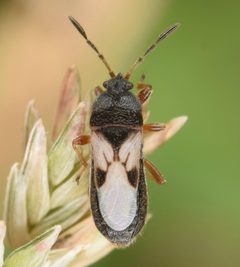
, commonly known as the true , is a small hemipteran native to North America and the most frequently encountered in the Blissus. measure approximately 4 mm in length with distinctive black bodies, white wings bearing black triangular spots, and reddish legs. The species is a significant agricultural pest of turfgrass and grain crops, particularly corn, wheat, and sorghum, causing damage by sucking sap from stems and leaves. thrive under hot, dry, sunny conditions, while heavy rainfall and high humidity promote fungal that suppress .
Pronunciation
How to pronounce Blissus leucopterus: //ˈblɪsəs luːˈkɒptərəs//
These audio files are automatically generated. While they are not always 100% accurate, they are a good starting point.
Identification
distinguished from similar Blissus by combination of black body, white wings with black triangular spot at outer margin, and reddish legs. Young nymphs identifiable by bright red coloration with white abdominal band (later turning black). Distinguished from false chinch bug (Nysius raphanus) by body shape: B. leucopterus has broader, more robust body; false chinch bug is narrow and dull yellowish-gray with transparent wing tips extending beyond . Distinguished from (B. insularis) by geographic range and subtle morphological differences in wing markings. In sorghum fields, examine lower leaf and stalk base; pull back sheaths to reveal on stalk or surrounding soil.
Images
Habitat
Sunny, open patches of turfgrass and agricultural fields. Overwinters in sheltered locations including hedgerows, roadside vegetation, bushy fence rows, woodland edges, soybean stubble, beneath tree bark, within bunch grass, and inside field mice nests. Hot, dry, sunny conditions favor growth; moist, warm, humid conditions are detrimental due to fungal activity.
Distribution
Native to the Americas. Found throughout the United States, southern Canada, Mexico, and Central America. Introduced established in South America including Argentina, Colombia, French Guiana, Guyana, Peru, Suriname, and Venezuela. Potential for further spread to Europe identified as phytosanitary concern, with modeling indicating high probability of establishment in Southern Russia and other regions with suitable climate.
Seasonality
overwinter December through March. from hibernation occurs March to April when daytime temperatures exceed 20°C for several hours. First : laid April through May, nymphs develop through June, adults present by July. Second generation: eggs laid July through October, adults mature by November. Adults from second generation seek shelters in November. Two generations per year typical.
Diet
Phloem feeder on plants in the grass (Poaceae). Documented include wheat, corn (Zea mays), sorghum, barley, oats, rye, millet, rice, and many wild and cultivated grasses. Feeds on stems, leaves, and underground plant parts. Moves to new growing plants when current hosts ripen or dry.
Host Associations
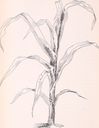
- Zea mays - pestCauses 'goose-necking' in seedlings; induces osmotic, oxidative, and acid stress responses
- Triticum aestivum - pestMajor historical pest of wheat in Midwestern United States
- Sorghum bicolor - pestSignificant pest; threshold of 2+ per 20% of seedlings under 6 inches tall warrants treatment
- Echinochloa colonum - Laboratory studies indicate one of the best for development
Life Cycle
stage: mean duration 8.4 days under laboratory conditions. Nymphal stage: five instars, mean duration 26.0 days. Total development from egg to : approximately 32 days (males) to 36 days (females). Pre-oviposition period: approximately 7.7 days. Adult longevity: females average 98 days, males 91 days. : females average 153 eggs with 92% . time: approximately 11 weeks. Two generations per year in temperate regions.
Behavior
Aggregates in sunny, open areas. Migrates from sites to crop fields in spring when temperatures reach approximately 70°F (21°C). Moves from maturing or drying plants to actively growing plants. Feeding involves insertion of stylets with labial tip playing chemosensory role in host location and probing. Heavy rain can trap developing nymphs in soil, causing mortality. seek shelter for overwintering in autumn.
Ecological Role
Herbivore and agricultural pest. Natural agents include big-eye bug (Geocoris bullatus) as and tiny (Eumicrosoma beneficum) as . Fungal provide natural suppression under humid conditions. Serves as prey for predators in agricultural .
Human Relevance
Major historical pest of grain crops in Midwestern United States during 19th and 20th centuries; contributed to widespread crop failures in wheat and corn. Crop to soybeans (non-) significantly reduced in some regions. Currently primarily a lawn and turfgrass pest in residential settings, commonly treated with and pest- grass varieties. Listed as pest in Eurasian Economic Union due to invasion potential. established for management: 2+ chinch bugs on 20% of seedlings under 6 inches tall, or 75% on taller plants.
Similar Taxa
- Blissus insularis; closely related with overlapping but distinct geographic range (primarily southeastern United States). Historically confused with B. leucopterus in some regions.
- Nysius raphanusFalse chinch bug; similar and agricultural pest status, but narrower, dull yellowish-gray body with transparent wing tips extending beyond , and different preferences including mustard plants.
- Blissus leucopterus hirtusHairy ; or closely related primarily associated with turfgrass damage in residential lawns; morphologically similar with subtle differences in .
Misconceptions
More Details
Sensory Biology
Labial tip include 11 uniporous peg sensilla and one sensillum chaeticum per field, innervated by 4-5 and 3 bipolar respectively. These structures function in chemoreception during location and feeding probing .
Climate Sensitivity
strongly influenced by moisture conditions. Hot, dry, sunny weather promotes increase; heavy rainfall causes nymphal mortality through soil trapping; humid conditions favor fungi that can be fatal to populations.
Taxonomic Complexity
boundaries within the complex (including B. l. leucopterus, B. l. hirtus, and B. insularis) remain subject to taxonomic debate, with some authorities treating these as distinct species and others as or geographic variants.
Sources and further reading
- BugGuide
- Wikipedia
- GBIF taxonomy match
- iNaturalist taxon
- NCBI Taxonomy
- Catalogue of Life
- Occasional Pests - AgriLife Extension Entomology
- Stem- and Leaf- Feeding Insects - AgriLife Extension Entomology
- Residential Pest Management: What Do Homeowners Know, and What Do They Do?
- Blissus leucopterus . [Distribution map].
- Labial tip sensilla of Blissus leucopterus leucopterus (Hemiptera: Blissidae): Ultrastructure and behavior
- Analysis of Proteins Associated with Chinch Bug (Blissus leucopterus leucopterus Say)-Infested Corn (Zea mays L.) Seedlings
- К вопросу о таксономическом статусе и фитосанитарном значении пшеничного клопа Blissus leucopterus (Say, 1832)
- Studies on the Seasonal Biology, Influence of Temperature on Immature Stages, and Damage to Field Corn by the Chinch Bug, Blissus Leucopterus Leucopterus (Say).
- Studies of certain phases of the biology of the chinch bug, Blissus leucopterus (Say), under conditions of constant temperature and constant relative humidity
- Biologia, Habitos Y Huespedes de la Chinche de Las Raices Blissus Leucopterus (Say) (Hemiptera: Lygaeidae)