
Blissidae
Stål, 1862
Chinch Bugs and Allies
Genus Guides
4- Blissus(chinch bugs)
- Ischnodemus(Wheat Chinch-bugs)
- Toonglasa
- Wheelerodemus
Blissidae is a of true bugs (Hemiptera) comprising over 400 in nearly 50 . Members are elongate insects, typically four to seven times as long as broad, with many species exhibiting short-winged forms. All species feed on plant sap, primarily from grasses (Poaceae) and sedges (Cyperaceae), with most living between leaf . The family was elevated from status within Lygaeidae by Thomas Henry in 1997. Several species are significant agricultural pests, notably Blissus leucopterus (true chinch bug), which damages corn and other cereal crops.
Pronunciation
How to pronounce Blissidae: //ˈblɪsɪdiː//
These audio files are automatically generated. While they are not always 100% accurate, they are a good starting point.
Identification
Distinguished from related by the combination of elongate body (4–7× longer than wide), association with monocot (grasses and sedges), and between leaf . Previously treated as Blissinae of Lygaeidae; separation confirmed by phylogenetic and morphological studies (Henry 1997). Short-winged forms common in many . Labial tip bears 11 uniporous peg and one sensillum chaeticum, with chemosensory function confirmed in .
Images
Appearance
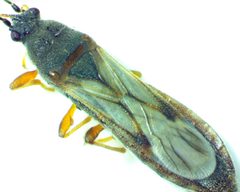
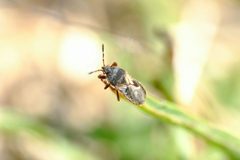
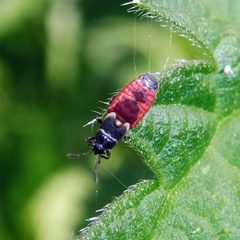
are distinctly elongate, slender true bugs with body length typically four times the width, and up to six or seven times in some . Short-winged (brachypterous) forms are common in many species, though fully winged forms also occur. The body is generally parallel-sided and adapted for living in tight spaces between leaf .
Habitat
Primarily associated with monocot plants, especially grasses (Poaceae) and sedges (Cyperaceae). Most inhabit the spaces between leaf of their plants. include grasslands, agricultural fields, pastures, and wetlands. Some species specifically develop in loose outer leaf sheaths of galls formed by other insects, such as Dimorphopterus blissoides in galls of Lipara lucens on Phragmites australis.
Distribution
Worldwide distribution with strong representation in the Neotropical region. Records from North America, South America (Argentina, Brazil, Peru), Europe (Pannonian Basin, Slovakia, Bulgaria, Croatia, Greece, Hungary, Romania, Denmark, Sweden), Iran, and Mexico. Specific show expanding ranges: Ischnodemus variegatus introduced to Florida; Dimorphopterus blissoides spreading in the Pannonian Basin; Praetorblissus mexicanus representing northern range expansion in Mexico.
Diet
All feed on plant sap, specifically phloem, from monocot . Primary host are Poaceae (grasses) and Cyperaceae (sedges). Documented hosts include: Zea mays (maize), Triticum aestivum (wheat), Sorghum bicolor (sorghum), various turfgrasses, St. Augustinegrass, forage grasses (Urochloa spp., Panicum maximum, Andropogon gayanus), Phragmites australis, Hymenachne amplexicaulis (West Indian marsh grass), Cyperus erythrorhizos, Scirpus cyperinus, and bamboo (Chusquea repens).
Host Associations
- Zea mays - maize; major pest for Blissus leucopterus
- Triticum aestivum - wheat
- Sorghum bicolor - sorghum
- Urochloa ruziziensis - forage grass
- Urochloa humidicola - forage grass; antixenosis resistance documented
- Urochloa brizantha - forage grass; multiple cultivars including 'Piatã', 'Paiaguás', 'Marandu'
- Panicum maximum - forage grass; cultivars 'Mombaça' and 'Zuri' show antixenosis resistance
- Andropogon gayanus - forage grass; antixenosis resistance documented
- Phragmites australis - common reed; for Dimorphopterus blissoides in galls of Lipara lucens
- Hymenachne amplexicaulis - West Indian marsh grass; for introduced Ischnodemus variegatus in Florida
- Cyperus erythrorhizos - sedge; for Ischnodemus rufipes in unpredictable wetlands
- Scirpus cyperinus - sedge; for Ischnodemus rufipes in permanent wetlands
- Chusquea repens - bamboo; for Praetorblissus mexicanus
- Stenotaphrum secundatum - St. Augustinegrass; for Blissus insularis
Life Cycle
Development includes , nymph, and stages. Eggs are laid on plant bases, , and leaves. Nymphs develop through multiple instars, with temperature-dependent development rates. In laboratory conditions, Blissus pulchellus reared at 27±5°C, 60±10% relative humidity, and 12-hour . Multiple per year occur in suitable climates. occurs in leaf sheaths, as documented for Dimorphopterus blissoides hibernating in galls of Lipara lucens.
Behavior
Feeding involves stylet penetration to phloem with labial playing critical chemosensory roles in location and acceptance; 11 uniporous peg sensilla and one sensillum chaeticum on labial apex confirmed in . Host-seeking shows discrimination between attractive and non-attractive hosts within hours (4 hours documented in choice tests for Blissus pulchellus). Differential probing behavior occurs on versus susceptible host plants. behavior documented in Blissus insularis. Most live concealed between leaf .
Ecological Role
Herbivores specialized on monocot plants, capable of reducing plant and growth through feeding damage. Some may serve as potential agents for plants (Ischnodemus variegatus on Hymenachne amplexicaulis). Agricultural pests causing significant economic damage to cereal crops, forage grasses, and turf. mechanisms include antixenosis (non-preference) and physical barriers (compaction and lignification of parenchyma and sclerenchyma in leaf ).
Human Relevance
Several are major agricultural and horticultural pests. Blissus leucopterus (true chinch bug) is a destructive pest of corn, wheat, and other cereals in the United States. Blissus insularis () damages St. Augustinegrass and other turfgrasses. Blissus pulchellus threatens forage grass production and cattle ranching in Brazil. Control efforts include breeding, application, and investigation of via gut manipulation (Burkholderia-associated crypts in B. insularis).
Similar Taxa
- LygaeidaeHistorically treated as Blissinae within Lygaeidae; separated by Henry (1997) based on phylogenetic and morphological evidence. Blissidae distinguished by more elongate body form and specialized monocot association.
- Coreidae of phytophagous true bugs with different body form (often broader, leaf-footed) and different associations; distinguished by and feeding patterns.
- MiridaeLarger of plant bugs with generally softer bodies, more diverse associations including dicots, and different morphological features.
More Details
Taxonomic History
Long treated as Blissinae of Lygaeidae; resurrected as full Blissidae by Thomas Henry in 1997 based on morphological and phylogenetic studies. Placement within Lygaeoidea confirmed.
Gut Symbionts
Blissus insularis possesses specialized crypts housing dense of Burkholderia bacteria. These are essential for ; suppression causes retarded development, smaller body size, and increased susceptibility. Symbionts are protected from phage attack by structural blockage between and midgut regions, suggesting programmed ontogeny that creates a sheltered residence.
Sensory Biology
Labial tip in include 11 uniporous peg sensilla (each innervated by 4–5 bipolar ) and one sensillum chaeticum (with 3 neurons). Chemosensory function confirmed through behavioral tests with chemical blockage, demonstrating importance in feeding and acceptance.
Sources and further reading
- BugGuide
- Wikipedia
- GBIF taxonomy match
- iNaturalist taxon
- NCBI Taxonomy
- Catalogue of Life
- Myakka bug, Ischnodemus variegatus (Signoret) (Insecta: Hemiptera: Blissidae)
- Aggregation Behavior of the Southern Chinch Bug (Hemiptera: Blissidae)
- Resistance of forage grasses to Blissus pulchellus Montandon (Hemiptera: Blissidae)
- Electronic Monitoring of the Feeding Behavior of Blissidae, Coreidae, Miridae, and Plataspidae
- First record of <i>Praetorblissus</i> from Mexico (Hemiptera: Heteroptera: Lygaeoidea: Blissidae), with the description of a new species associated with bamboo
- Impacts of Antibiotic and Bacteriophage Treatments on the Gut-Symbiont-Associated Blissus insularis (Hemiptera: Blissidae)
- Host Plants (Cyperaceae) of Ischnodemus rufipes Van Duzee (Hemiptera: Blissidae): Cyperus erythrorhizos in Unpredictable Wetland Communities, Scirpus cyperinus in More Permanent Wetlands
- Dimorphopterus blissoides (Hemiptera: Heteroptera: Blissidae): recent spreading of a neonative species in the Pannonian Basin
- Labial tip sensilla of Blissus leucopterus leucopterus (Hemiptera: Blissidae): Ultrastructure and behavior
- Differential Probing Behavior of Blissus insularis (Hemiptera: Blissidae) on Resistant and Susceptible St. Augustinegrasses
- Wheelerodemus muhlenbergiae Henry and Sweet (Hemiptera: Lygaeoidea: Blissidae): Distribution, Host Plants, and Seasonality
- Distribution ofEumicrosoma benefica(Hymenoptera: Scelionidae) in Southern Chinch Bug (Hemiptera: Blissidae) Populations
- Four new species of Ischnodemus (Hemiptera, Heteroptera, Blissidae) and additional records from Argentina