
Blissus
Burmeister, 1835
chinch bugs
Species Guides
8- Blissus arenarius
- Blissus barberi
- Blissus canadensis
- Blissus insularis(Southern Chinch Bug)
- Blissus leucopterus(true chinch bug)
- Blissus minutus
- Blissus occiduus(Western Chinch Bug)
- Blissus sweeti
Blissus is a of true bugs (Hemiptera: Blissidae) comprising approximately 27 , commonly known as in North America. Several species are significant agricultural pests: B. leucopterus (true chinch bug) attacks cereal crops including wheat, corn, and sorghum; B. occiduus (western chinch bug) damages warm-season turfgrasses, particularly buffalograss and zoysiagrass; and B. insularis () is a major pest of St. Augustine grass. These species exhibit strong preferences for grasses and can cause substantial economic damage through phloem feeding.
Pronunciation
How to pronounce Blissus: /ˈblɪsəs/
These audio files are automatically generated. While they are not always 100% accurate, they are a good starting point.
Identification
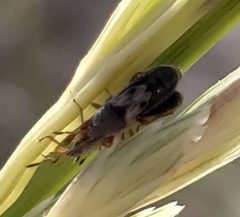
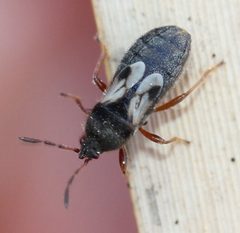
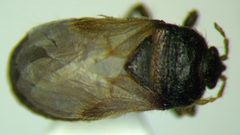
are small, approximately 3–4 mm in length, with black bodies and distinctive white wings marked with black triangular spots that form an X or hourglass pattern when viewed dorsally. stages lack wings; young nymphs are yellowish-orange with a white band across the , becoming darker with successive . The bears specialized sensory structures including 11 uniporous peg and one sensillum chaeticum at the apex, which function in chemoreception during location and feeding. -level identification requires examination of genitalia and wing venation patterns.
Images
Habitat
Associated with grass-dominated environments including agricultural fields, turfgrass systems, and natural grasslands. occupy distinct : B. leucopterus in cereal crop fields and adjacent grassy areas; B. occiduus in warm-season turfgrass systems and rangelands; B. insularis in lawn and recreational turf settings. thrive under hot, dry conditions and are often most damaging during drought periods when plants are moisture-stressed.
Distribution
Native to the Americas with documented occurrence in North America (United States, Canada, Mexico), Central America and West Indies, and South America (Argentina, Colombia, French Guiana, Guyana, Peru, Suriname, Venezuela). Within the United States, show regional partitioning: B. leucopterus in eastern and central states; B. occiduus in western states (California, Colorado, Kansas, Montana, Nebraska, New Mexico) and Canadian prairies (Alberta, British Columbia, Manitoba, Saskatchewan); B. insularis in southeastern states. Recent modeling indicates potential for range expansion into southern Russia and Eurasian regions.
Seasonality
Activity patterns vary by and latitude. In temperate regions, overwinter in bunch grasses and become active when soil temperatures exceed 21°C (70°F), typically spring through early summer. Multiple occur annually in warmer climates; B. insularis completes 6–7 generations per year in Florida. Peak damaging typically coincide with hot, dry summer conditions. completion ranges from 30–40 days under favorable temperatures.
Diet
Phloem-feeding on Poaceae (grasses). All pest feed on developing plant vascular tissues, extracting sap from stems, crowns, and leaf . B. leucopterus feeds on wheat, sorghum, corn, barley, and millets; B. occiduus prefers buffalograss and zoysiagrass but feeds on 17+ grass species including bermudagrass, St. Augustine grass, and various crop and weed grasses; B. insularis specializes on St. Augustine grass. Feeding injects toxic saliva that disrupts water and nutrient transport, causing characteristic reddening, stunting, and plant death.
Host Associations
- Triticum aestivum - pesttrue chinch bug
- Zea mays - pesttrue and western
- Sorghum bicolor - pesttrue chinch bug
- Buchloë dactyloides - preferred western chinch bug
- Zoysia japonica - preferred western chinch bug
- Stenotaphrum secundatum - primary
- Cynodon dactylon - western chinch bug
- Hordeum vulgare - true chinch bug
- Panicum maximum - Blissus pulchellus study
- Urochloa humidicola - Blissus pulchellus study
Life Cycle
Hemimetabolous development with , five nymphal instars, and stages. Eggs are deposited behind leaf , on roots, or in soil near plants. Nymphal development requires 2–3 weeks under optimal conditions (28°C). Adults are long-lived and reproduce continuously during favorable periods. occurs as adults in protected grass clumps or field debris. Multiple overlapping occur annually in subtropical and tropical regions; fewer generations in temperate zones.
Behavior
Strong -seeking mediated by chemosensory input from labial . Initial host selection is influenced by plant architecture and morphological cues, with stoloniferous growth habit potentially attracting initial . Gradual redistribution to preferred hosts occurs over 24–72 hours if initial host is suboptimal. Aggregative feeding behavior behind leaf and at soil line provides protection from desiccation and natural enemies. occurs by crawling and , with mass from maturing small grain fields or drying grasses to succulent hosts.
Ecological Role
Herbivore and agricultural pest. Functions as a regulator of grass in natural systems; in managed systems, economic damage occurs when populations exceed action thresholds. Serves as prey for including lady beetles, ground beetles, and spiders. Gut (Burkholderia spp.) in specialized crypts contribute to nutritional and potentially confer .
Human Relevance
Major economic pest of turfgrass and cereal production. B. leucopterus caused historic crop losses exceeding $100 million annually in the United States prior to modern management. Current management relies on crop varieties, cultural practices (early planting, crop ), with neonicotinoids (clothianidin, imidacloprid, thiamethoxam), and foliar . Insecticide resistance has developed in some . Subject to regulations in Eurasian Economic Union due to invasion potential.
Similar Taxa
- Nysius raphanusFalse chinch bug is smaller (2–3 mm), uniformly gray-brown without distinctive wing pattern, and lacks the black body with white-marked wings of Blissus . Occurs in overlapping but shows different patterns and less damaging feeding.
- Cicadulina spp.Leafhoppers share grass-feeding habit and cause similar yellowing , but are more mobile, smaller, and have hind legs modified for jumping; different wing posture and body shape.
- Schizaphis graminumGreenbug causes similar reddening and stunting of cereals, but is soft-bodied with cornicles, sedentary colony-forming , and produces honeydew; Blissus are active runners with hardened forewings.
Sources and further reading
- BugGuide
- Wikipedia
- GBIF taxonomy match
- iNaturalist taxon
- NCBI Taxonomy
- Catalogue of Life
- Occasional Pests - AgriLife Extension Entomology
- Stem- and Leaf- Feeding Insects - AgriLife Extension Entomology
- Forage Sorghum Insects - AgriLife Extension Entomology
- Seedling to tassel stage insect control - AgriLife Extension Entomology
- Insects that feed on developing grain in the head - AgriLife Extension Entomology
- Managing Insect and Mite Pests of Texas Corn - AgriLife Extension Entomology
- Blissus insularis Barber
- Host preference of the chinch bug, Blissus occiduus
- Blissus leucopterus . [Distribution map].
- Southern Chinch Bug, Blissus insularis Barber (Insecta: Hemiptera: Lygaeidae)
- К вопросу о таксономическом статусе и фитосанитарном значении пшеничного клопа Blissus leucopterus (Say, 1832)
- Biology of the Lawn Chinch Bug, Blissus insularis
- Studies of certain phases of the biology of the chinch bug, Blissus leucopterus (Say), under conditions of constant temperature and constant relative humidity
- Resistance of forage grasses to Blissus pulchellus Montandon (Hemiptera: Blissidae)
- Studies on the Seasonal Biology, Influence of Temperature on Immature Stages, and Damage to Field Corn by the Chinch Bug, Blissus Leucopterus Leucopterus (Say).
- Impacts of Antibiotic and Bacteriophage Treatments on the Gut-Symbiont-Associated Blissus insularis (Hemiptera: Blissidae)
- Labial tip sensilla of Blissus leucopterus leucopterus (Hemiptera: Blissidae): Ultrastructure and behavior
- Analysis of Proteins Associated with Chinch Bug (Blissus leucopterus leucopterus Say)-Infested Corn (Zea mays L.) Seedlings