
Ischnodemus
Fieber, 1837
Wheat Chinch-bugs
Species Guides
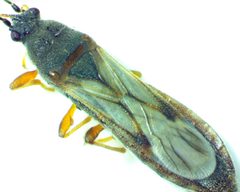
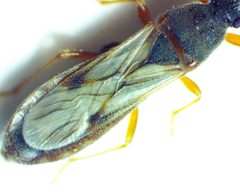
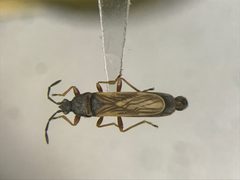
8Ischnodemus is a of true bugs in the Blissidae containing approximately 95 . are characterized by moderately to very elongated bodies, reflected in the genus name derived from Greek for 'feeble body.' The genus has a distribution across all major zoogeographic regions and shows strong associations with grasses (Poaceae), with some species utilizing sedges (Cyperaceae). Several species are economically significant, including I. variegatus (Myakka ), an introduced species in North America being evaluated as a agent for West Indian marsh grass.
Pronunciation
How to pronounce Ischnodemus: //ˌɪsknoʊˈdiːməs//
These audio files are automatically generated. While they are not always 100% accurate, they are a good starting point.
Identification
-level identification relies on the elongated, slender body form characteristic of Blissidae. -level identification requires examination of male genitalia (pygophore and paramere) and habitus patterns. Regional keys are available for some areas (e.g., Argentina).
Images
Appearance
have moderately to very elongated, slender bodies. The name directly references this physical characteristic of slenderness.
Habitat
Primarily associated with grasses (Poaceae), occurring in grasslands, wetlands, and marsh . Some occupy predictable permanent wetlands while others inhabit unpredictable seasonal wetland .
Distribution
across all major zoogeographic regions. Native range includes Neotropical, Palearctic, and other regions. I. variegatus introduced to North America (Florida) as an .
Diet
Herbivorous; phloem-feeding on grasses (Poaceae). Documented include various Gramineae, with some specializing on sedges (Cyperaceae: Cyperus erythrorhizos, Scirpus cyperinus). I. variegatus feeds specifically on West Indian marsh grass (Hymenachne amplexicaulis).
Host Associations
- Poaceae (grasses) - primary plantsMost abundant on various Gramineae
- Cyperus erythrorhizos - In unpredictable wetland ; I. rufipes
- Scirpus cyperinus - In more permanent wetlands; I. rufipes
- Hymenachne amplexicaulis - West Indian marsh grass; I. variegatus
- Glyceria spp. - I. sabuleti
Life Cycle
stages described for some (I. oblongus, I. fulvipes). Development is temperature-dependent in at least some species (I. variegatus).
Behavior
Some exhibit . I. sabuleti induces plant through phloem feeding and shows aggregation behavior that may facilitate intraspecific facilitation through host plant quality improvement. Drought-stressed host plants appear to improve performance and facilitate in this species.
Ecological Role
Phloem-feeding herbivores on grasses and sedges. Some may function as agents for grasses. Natural enemies present in native ranges.
Human Relevance
Several have economic significance. I. variegatus (Myakka ) is being evaluated as a agent for the West Indian marsh grass in Florida. Some species may impact agricultural grasses.
Similar Taxa
- PatritiodemusFormerly included now transferred to this (I. brusai moved to Patritiodemus); separation based on morphological characters
- Other Blissidae generaDistinguished by the characteristic elongated, slender body form of Ischnodemus
More Details
Etymology
The name Ischnodemus is derived from Greek ἰσχνόσ (ischnos) 'feeble' and δέμασ (demas) 'body', referring to the slender, elongated body form.
Taxonomic History
Review by Slater (1979) listed 95 . Ongoing taxonomic work continues to describe new species (e.g., four new species from Argentina in 2022) and clarify generic boundaries.
Research Gaps
and stages remain unknown for most . associations documented for relatively few of the approximately 95 described species.
Sources and further reading
- BugGuide
- Wikipedia
- GBIF taxonomy match
- iNaturalist taxon
- NCBI Taxonomy
- Catalogue of Life
- Myakka bug, Ischnodemus variegatus (Signoret) (Insecta: Hemiptera: Blissidae)
- Four new species of Ischnodemus (Hemiptera, Heteroptera, Blissidae) and additional records from Argentina
- Host specificity of Ischnodemus variegatus, an herbivore of West Indian marsh grass (Hymenachne amplexicaulis)
- Host specificity of Ischnodemus variegatus, an herbivore of West Indian marsh grass (Hymenachne amplexicaulis)
- Characterizing the host specificity of Ischnodemus variegatus (Signoret) (Hemiptera: Blissidae) on two congeneric grass species
- Intraspecific Facilitation Through Host Plant Quality Improvement? Observations on the Aggregation Behaviour and Population Biology of the Senescence Inducing Phloem Feeder (Ischnodemus Sabuleti) Intraspecifikus facilitáció a tápnövényminőség feljavítása útján? Megfigyelések a szeneszcencia indukáló karcsú nádibodobács Ischnodemus sabuleti aggregációiról és populációbiológiájáról
- Notes on the Biology of Ischnodemus oblongus and I. fulvipes with Descriptions of the Immature Stages (Hemiptera: Lygaeidae)1
- Host Plants (Cyperaceae) of Ischnodemus rufipes Van Duzee (Hemiptera: Blissidae): Cyperus erythrorhizos in Unpredictable Wetland Communities, Scirpus cyperinus in More Permanent Wetlands
- Temperature-Dependent Development, Survival, and Potential Distribution of <I>Ischnodemus variegatus</I> (Hemiptera: Blissidae), a Herbivore of West Indian Marsh Grass