
Lipara lucens
Meigen, 1830
Cigar Gall
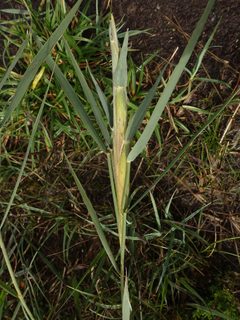
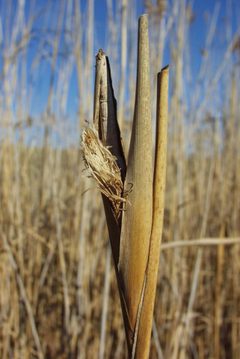
Lipara lucens is a gall-forming frit fly (Diptera: Chloropidae) that induces characteristic cigar-shaped galls on common reed (Phragmites australis). The is monophagous, completing its entire larval development within reed stems. Males produce species-specific acoustic signals through wing vibration and abdominal movement to locate females, who respond with answering vibrations. This substrate-borne communication reduces mate-searching time by allowing males to rapidly assess reed stems for receptive females.
Pronunciation
How to pronounce Lipara lucens: /lɪˈpɑːrə ˈluːsɛnz/
These audio files are automatically generated. While they are not always 100% accurate, they are a good starting point.
Identification
Distinguished from other Lipara by gall and species-specific acoustic signals. The cigar-shaped gall on Phragmites australis stems is diagnostic; other Lipara species form different gall types on the same . signals differ between species and function in reproductive isolation. Males produce calling songs; females produce answering songs—both detectable as substrate vibrations on reed stems.
Images
Appearance
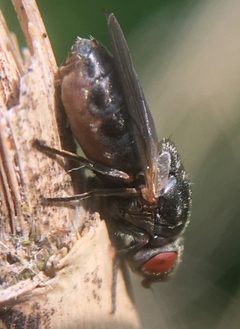
is a small frit fly typical of Chloropidae. Gall is cigar-shaped, formed on Phragmites australis stems. Gall structure includes a central nutritive tissue cylinder surrounded by inner longitudinal and outer radial parenchymatous layers, with vascular strands oriented perpendicular to the stem axis. Mature galls undergo sclerenchymatization, becoming extremely hardened.
Habitat
Wetland and marsh environments dominated by common reed (Phragmites australis) stands. Larvae develop inside living reed stems. occur on reed stems where mating and oviposition take place.
Distribution
Europe: recorded from Belgium, Denmark, Netherlands, and Norway.
Diet
Larvae feed internally on nutritive tissue within galls formed on Phragmites australis stems. Gall contents provide proteins, , , and lipids; no starch detected in nutritive tissue.
Host Associations
- Phragmites australis - obligate Monophagous gall-former; induces cigar-shaped galls on stems. Formerly listed as Phragmites communis.
Life Cycle
deposited into reed stems. Larvae feed outside the developing gall initially, then gnaw through the growing point to enter the gall chamber where they consume nutritive tissue. Gall growth coincides with larval feeding; internode elongation is reduced. occurs within the hardened gall. emerge from galls.
Behavior
Males produce acoustic signals through wing vibration and abdominal movement, perceived by females as substrate vibrations on the same reed stem. Virgin females respond with vibrations, eliciting male searching . This communication system allows rapid assessment of reed stems for mates, reducing search time. Females selectively oviposit into specific internodes based on diameter and physical characteristics that optimize offspring survival.
Ecological Role
Gall-former that modifies Phragmites australis stem structure. Galls may influence reed stand architecture and serve as for associated and . Subject to parasitoid and attack; gall may represent adaptive trade-offs between plant resistance and parasitoid defense.
Similar Taxa
- Other Lipara speciesCo-occur on Phragmites australis but form different gall morphologies (e.g., round or irregular galls). Distinguished by -specific acoustic signals and gall structure.
More Details
Acoustic communication mechanism
Sound production involves wing vibration combined with abdominal movement. Signals are simpler in structure than those of many other Diptera, consisting of pulse trains with characteristic frequency patterns. Communication is substrate-borne via reed stems rather than airborne.
Gall development histology
Gall formation involves proliferation rather than degeneration of pith parenchyma. Tissue cylinder around the gall chamber widens up to three times normal size; pith parenchyma doubles in width. Vascular strands connect to plant vascular tissue, running perpendicular to the stem axis.
Sources and further reading
- BugGuide
- Wikipedia
- GBIF taxonomy match
- iNaturalist taxon
- NCBI Taxonomy
- Catalogue of Life
- ACOUSTICAL COMMUNICATION BY LIPARA LUCENS (DIPTERA, CHLOROPIDAE)
- Habitat Selection By Lipara Lucens Mg. (Diptera, Chloropidae) and Its Survival Value
- Plant resistance versus parasitoid attack in the evolution of the gall-forming fly Lipara lucens
- Morphological and histochemical analysis of galls of Lipara lucens (Diptera, Chloropidae) on Phragmites australis (Poaceae)