
Eustala
Simon, 1895
humpbacked orb-weavers
Species Guides
6- Eustala anastera(Humpbacked Orbweaver)
- Eustala californiensis
- Eustala cepina(Riparian Duncecap Orbweaver)
- Eustala conchlea
- Eustala emertoni
- Eustala rosae
Eustala is a of orb-weaver spiders in the Araneidae, first described by Eugène Simon in 1895. As of November 2024, the genus contains 87 distributed primarily across the Americas, from the United States through Central America to South America, with highest diversity in Brazil, Uruguay, and Argentina. Several species have been documented exhibiting specialized ecological relationships, including myrmecophily (living among ants) in Central American species that inhabit -defended acacia plants. The genus includes the well-known humpbacked orb-weaver, Eustala anastera, found across North and Central America.
Pronunciation
How to pronounce Eustala: /juːˈstɑːlə/
These audio files are automatically generated. While they are not always 100% accurate, they are a good starting point.
Identification
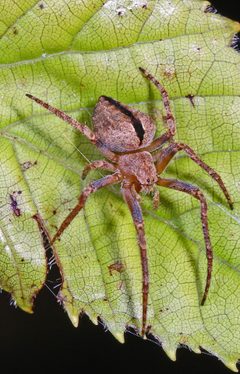
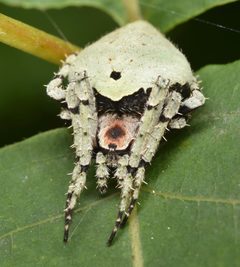
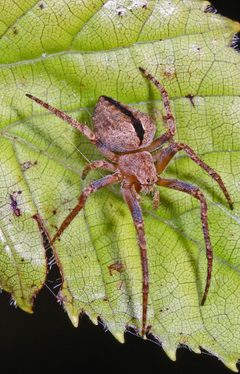
in this are characterized by a pronounced hump on the surface of the , giving rise to the "humpbacked orb-weavers." The abdomen is typically rounded and elevated, distinguishing Eustala from other Araneidae genera. Many species exhibit cryptic coloration and patterning that aids in concealment during daylight hours. Precise species identification often requires examination of genitalic structures under microscopy.
Images
Habitat
occupy diverse including forests, woodlands, grasslands, and scrub vegetation. Several Central American species (E. oblonga and E. illicita) are specialized inhabitants of -defended acacia plants in lowland tropical moist forest and dry forest . These myrmecophilic species hide among leaves, stems, and thorns during the day and construct orb webs among foliage at night.
Distribution
Widespread across the Americas. North American records include the United States (eastern and central regions), Mexico, and the Caribbean. Central American distribution includes Panama, Rica, Guatemala, and Honduras. South American records encompass Brazil (highest with numerous ), Uruguay, Argentina, Paraguay, Venezuela, Colombia, Peru, Ecuador (including Galápagos Islands with three endemic species), French Guiana, Guyana, and Trinidad. Some species (e.g., E. fuscovittata) have extensive ranges spanning Mexico to Paraguay.
Diet
Orb-weaving spiders in this construct typical spiral orb webs to intercept flying insects. Documented prey includes various insects captured in webs. Two Panamanian (E. oblonga and E. illicita) have been observed capturing (winged reproductive ants) during mating , comprising up to 50% of prey in E. illicita webs, though this does not appear to significantly impact ant colony health.
Life Cycle
As with other orb-weaver spiders, Eustala likely follow the typical araneid developmental pattern: deposited in silken egg sacs, spiderlings emerging and dispersing (often by ballooning on silk threads), progressing through multiple instars, with web-building developing through ontogenetic changes. specimens have been observed active during winter months in temperate regions.
Behavior
Several exhibit myrmecophilic , living commensally within -defended acacia mutualisms in Central America. These spiders hide from ants during daylight hours, pressing against leaves, stems, and thorns, then construct orb webs among foliage at night. The ant colony defense and acacia thorns provide protection from including , assassin bugs, stink bugs, anoles, and birds. Some species are known to overwinter as juveniles in temperate regions.
Ecological Role
As orb-weaving , Eustala contribute to through on flying insects. The myrmecophilic species E. oblonga and E. illicita represent a documented case of a third-party exploiter of an -plant mutualism that appears to extract benefits without imposing measurable costs on the mutualist partners. These spiders may provide incidental benefit to acacias through capture of potential herbivorous pests.
Human Relevance
Eustala anastera, the humpbacked orb-weaver, is a familiar to naturalists across eastern North America and has been documented in entomological and arachnological surveys. The serves as a research subject for studies of spider-, web-building ontogeny, and tropical biodiversity. No significant economic impacts (positive or negative) have been documented.
Similar Taxa
- AcanthepeiraBoth include orb-weavers with rounded, somewhat elevated ; Eustala is distinguished by the more pronounced hump and different abdominal profile.
- LarinoidesFurrow spiders in this construct orb webs in similar and have been recorded as prey for spider wasps that also prey on Eustala; Larinoides typically shows more angular shape and different patterning.
- NeosconaSpotted orb-weavers share general orb-weaver and use; Neoscona typically lack the pronounced hump and often show more distinct patterning.
- AraneusMarbled orb-weavers and relatives overlap in distribution and web architecture; Araneus generally have more globose without the characteristic hump of Eustala.
More Details
Taxonomic History
The has undergone significant taxonomic revision, with multiple described from southern Brazil in 2010 and 2014, and three new species described from the Galápagos Islands in 2014. Seven species names have been declared nomina dubia due to lost .
Research Significance
Eustala have contributed to understanding of third-party exploitation of mutualisms, with E. oblonga and E. illicita serving as model organisms for studying how organisms can 'hack' established mutualistic relationships without destabilizing them.
Predation Records
Eustala anastera has been documented as prey for the spider wasp Caliadurgus hyalinatus (Pompilidae), with the capturing spiders to provision nests.
Sources and further reading
- BugGuide
- Wikipedia
- GBIF taxonomy match
- iNaturalist taxon
- NCBI Taxonomy
- Catalogue of Life
- Eustala illicita Archives - Entomology Today
- The Curious Case of the Spiders in the Ant-Acacia Mutualisms
- Bug Eric: Wasp Wednesday: Caliadurgus hyalinatus
- Bug Eric: New Year’s Insects and Spiders
- Bug Eric: 2026
- Three new Eustala (Araneae, Araneidae) species from the Galápagos Islands (Ecuador)
- Population ecology of the orb-weaver spider Eustala taquara (Keyserling) (Araneidae)
- Description of the male of the spider Eustala vellardi Mello-Leitão, 1924,<br />the female of E. delasmata Bryant, 1945 and seven species of Eustala Simon, 1895 declared as nomina dubia (Araneae, Araneidae)
- Spatial distribution and substrate selection by the orb-weaver spiderEustala perfidaMello-Leitão, 1947 (Araneae: Araneidae)
- The orb-weaving spider genus Eustala Simon, 1895 (Araneae, Araneidae): <br />eight new species, redescriptions, and new records
- The “Sawtoothed” Orb Web of Eustala Sp. (Araneae, Araneidae) with a Discussion of Ontogenetic Changes in Spiders′ Web‐Building Behavior