
Acanthepeira
Marx, 1883
Star-bellied Orb-web Spiders, Starbellied Orbweavers
Species Guides
4- Acanthepeira cherokee(Cherokee Orbweaver)
- Acanthepeira marion
- Acanthepeira stellata(starbellied orbweaver)
- Acanthepeira venusta
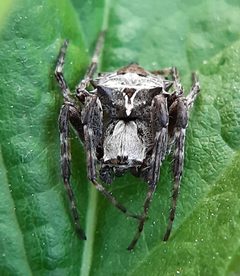
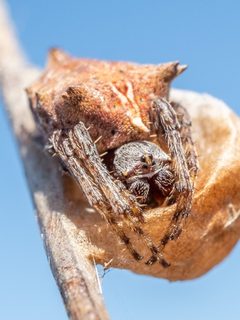
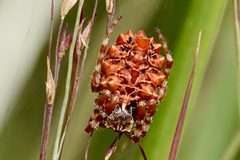
Acanthepeira is a of orb-weaver spiders in the Araneidae, first described by George Marx in 1883. The genus comprises five North American , most notably Acanthepeira stellata, known for its distinctive star-shaped abdominal . These spiders are recognized for their unusual spiked that function as camouflage against . The genus ranges from southeastern Canada through the eastern and central United States to southern California.
Pronunciation
How to pronounce Acanthepeira: //əˌkæn.θəˈpaɪ.rə//
These audio files are automatically generated. While they are not always 100% accurate, they are a good starting point.
Identification
The star-shaped array of pointed on the is diagnostic for this . Acanthepeira stellata, the most widespread , can be distinguished from by the specific arrangement and number of abdominal spines. The rigid, spiked abdomen separates these spiders from all other North American orb-weavers. When disturbed, individuals drop to the ground and feign death with legs tucked tightly against the body, becoming nearly invisible in leaf litter.
Images
Appearance
Spiders in this possess a highly distinctive covered with pointed or spikes arranged in a star-like pattern, giving the appearance of a bur, seed pod, or dried vegetation. The abdomen is notably hard and rigid compared to many other spiders. Mature females measure 7–15 mm in body length; males are smaller at 5–8 mm. The body is typically brown or tan, enhancing cryptic resemblance to plant debris.
Habitat
Prairies, meadows, fields, and forest openings with tall grasses and herbaceous vegetation. Webs are constructed less than three feet above ground, lashed to flimsy stalks and leaves. Also found in agricultural settings including cotton fields in the southern Great Plains. The spiders require vegetation structure that supports their low orb webs and provides cover for their strategy.
Distribution
North America: southeastern Canada south to Florida, west to Kansas, Arizona, and southern California. The shows its greatest diversity in the central and eastern United States.
Seasonality
females active from May to October; mature males from May to September. Spiderlings emerge from sacs in summer and overwinter as or individuals. activity predominates, with spiders occupying web hubs after dark.
Diet
Primarily grasshoppers (nymphs) and other medium-sized insects. One documented instance of on an American Green Tree Frog (Hyla cinerea), though this is considered exceptional. In Chiapas, México, has been observed preying on beetles (Phyllophaga spp.).
Life Cycle
laid in silken sacs during summer; spiderlings emerge and disperse via ballooning—climbing to elevated positions, releasing silk threads, and being carried by wind currents. One individual was documented at 1,000 feet altitude over Louisiana. Spiderlings overwinter as or instars, reaching maturity the following spring.
Behavior
hunters that occupy the hub of their orb webs after dark. When disturbed, individuals drop from the web and feign death (), drawing legs tightly against the body to enhance in ground vegetation. Ballooning is used by spiderlings for . Webs are small (6–10 inches diameter) and positioned low in vegetation.
Ecological Role
of herbivorous insects, particularly nymphs; contributes to natural in agricultural and grassland . Prey for spider wasps including Caliadurgus hyalinatus and Sceliphron caementarium, which paralyze and provision nests for their larvae.
Human Relevance
Beneficial in agricultural contexts due to on pest grasshoppers and beetles. The distinctive appearance makes it a subject of interest for naturalists and photographers. Not medically significant to humans.
Similar Taxa
More Details
Etymology note
The 'star-bellied' is anatomically misleading—the star-shaped are on the (opisthosoma), not the surface. The name likely originated from early descriptions based on ventral views or colloquial usage.
Predator avoidance
The hardened, spiked may function in deterrence beyond camouflage, though this has not been experimentally verified. The combination of physical armor and behavioral represents a dual defense strategy.
Sources and further reading
- BugGuide
- Wikipedia
- GBIF taxonomy match
- iNaturalist taxon
- NCBI Taxonomy
- Catalogue of Life
- Bug Eric: Spider Sunday: Star-bellied Orbweaver, Acanthepeira stellata
- Bug Eric: Spider Sunday: Starbellied Orbweaver
- Bug Eric: Wasp Wednesday: Caliadurgus hyalinatus
- Mydidae | Beetles In The Bush
- August | 2022 | Beetles In The Bush
- Acanthepeira Stellata (Walckenaer, 1805) (Araneae: Araneidae), enemigo natural de especies de Phyllophaga (Coleoptera: Melolonthidae) en Chiapas, México