
Acanthepeira stellata
(Walckenaer, 1805)
starbellied orbweaver, starbellied spider
Acanthepeira stellata is a distinctive orb-weaving spider known for its hard, spiked covered in prominent that give it a star-like appearance. The ranges from Canada to Mexico and is commonly found in grasslands, prairies, meadows, and agricultural areas. It is , constructing vertical orb webs close to the ground to capture prey. The spider exhibits effective , resembling plant debris such as burs or seed pods when at rest.
Pronunciation
How to pronounce Acanthepeira stellata: /əˌkænˈθɛpaɪrə stɛˈlɑtə/
These audio files are automatically generated. While they are not always 100% accurate, they are a good starting point.
Identification
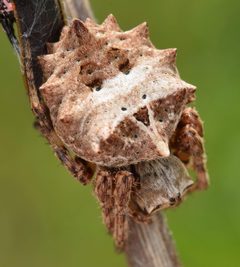
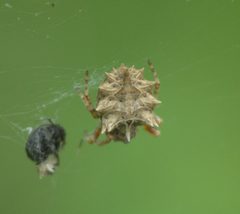
The star-shaped, spiked is diagnostic and distinguishes this from all other North American orbweavers. The hard, tuberculate abdomen contrasts with the soft abdomens of most araneids. Some Araneus species have abdominal humps, but none possess the dense, radiating spines characteristic of Acanthepeira stellata. The small size and ground-level web placement in grassy further aid identification. When approached, individuals characteristically drop to the ground and feign death, disappearing into leaf litter.
Images
Appearance
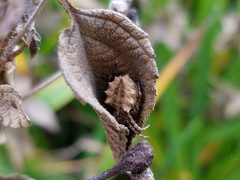
females measure 7–15 mm in body length; males are smaller at 5–8 mm. The is hard and covered with numerous pointed or spikes that create a star-shaped silhouette, inspiring both the common and . These projections are visible from multiple angles and serve a defensive function. The overall coloration is cryptic, typically brown or tan, enhancing its resemblance to dried vegetation or plant debris. When disturbed, the spider tucks its legs tightly against the body, further enhancing its disguise as inanimate matter.
Habitat
Prairies, meadows, fields, forest openings, and agricultural areas with tall grasses and herbaceous vegetation. Webs are typically constructed less than three feet above ground, lashed to flimsy stalks and leaves. The is also documented in cotton fields and other crops in the southern Great Plains. In Mexico, it has been observed in agricultural parcels.
Distribution
North America from southeast Canada to Florida, west to Kansas and Arizona. Also recorded in Mexico (Chiapas). Most commonly found along the Eastern and Western coastlines of North America, with scattered inland .
Seasonality
females occur from May to October; mature males from May to September. Spiderlings emerge from sacs in summer and overwinter as or individuals, reaching maturity the following spring.
Diet
Primarily grasshoppers and other medium-sized flying insects captured in orb webs. One documented instance of on an American Green Tree Frog (Hyla cinerea), though this appears exceptional. In Chiapas, Mexico, has been observed preying on beetles (Phyllophaga ) in agricultural settings.
Life Cycle
Females produce clutches containing approximately 574 eggs, each about 1.04 mm in diameter. Spiderlings emerge in summer and disperse by ballooning—climbing to elevated points, releasing silk threads, and being carried by wind. One individual was documented at 1000 feet altitude over Louisiana. Juveniles overwinter and mature the following spring. The has one per year in temperate regions.
Behavior
; constructs vertical orb webs at night and typically occupies the hub (center) -down to await prey. When disturbed, drops to ground and feigns death with legs tucked tightly against the body, effectively disappearing into vegetation. Ballooning is used by spiderlings for . may be more easily located at night when they occupy web hubs. The hard, spiked likely serves as defense.
Ecological Role
of insect pests including nymphs and beetles, with potential value as a agent in agricultural systems. Serves as prey for spider wasps including the Black and Yellow Mud Dauber (Sceliphron caementarium), which paralyzes and provisions nests with this . The spider wasp Caliadurgus hyalinatus has also been documented using A. stellata as for its larvae.
Human Relevance
Potential natural enemy of agricultural pests including Phyllophaga beetles. Generally harmless to humans; not medically significant. Its cryptic appearance may lead to misidentification as plant debris.
Similar Taxa
- Araneus species (e.g., A. gemmoides, cat-faced orbweaver)Some Araneus have abdominal humps or projections, but lack the dense, radiating spines and hard, star-shaped of A. stellata.
- Neoscona crucifera (spotted orbweaver)Shares habits and ground-level web placement in some , but has smooth, rounded with pattern of spots rather than spines.
More Details
Ballooning altitude record
A spiderling was captured at 1000 feet (305 m) over Tallulah, Louisiana on December 13, 1930, demonstrating the ' capacity for long-distance aerial .
Egg clutch characteristics
Average clutch size of 574 with individual egg mass of approximately 0.55 mg; average female body mass is 596.0 mg.
Sources and further reading
- BugGuide
- Wikipedia
- GBIF taxonomy match
- iNaturalist taxon
- NCBI Taxonomy
- Catalogue of Life
- Bug Eric: Spider Sunday: Star-bellied Orbweaver, Acanthepeira stellata
- Bug Eric: Spider Sunday: Starbellied Orbweaver
- Limacodidae | Beetles In The Bush
- August | 2022 | Beetles In The Bush
- Bug Eric: Wasp Wednesday: Caliadurgus hyalinatus
- Acanthepeira Stellata (Walckenaer, 1805) (Araneae: Araneidae), enemigo natural de especies de Phyllophaga (Coleoptera: Melolonthidae) en Chiapas, México