Common Green Lacewings
Chrysoperla is a genus of green lacewings in the family Chrysopidae, tribe Chrysopini, containing approximately 67 described species with a cosmopolitan distribution. Adults are characterized by a pale yellowish stripe down the middle of the body and delicate, transparent wings. The genus is notable for its use in biological pest control, as larvae are predatory and feed on aphids, mites, and other soft-bodied insects. Species identification is complicated by morphological similarity; many species are distinguished primarily by male genitalia features and species-specific vibrational courtship songs rather than external appearance.
Chrysoperla downesi is a species of green lacewing in the family Chrysopidae, first described by Smith in 1932. Like other members of the genus Chrysoperla, it is a predatory insect whose larvae feed on soft-bodied arthropod pests. The species is part of the taxonomically complex Chrysoperla carnea-group, in which species are often difficult to distinguish by morphology alone and may require acoustic or molecular methods for identification. It is native to North America and has been documented in museum collections.
Harris's Green Lacewing
Chrysoperla harrisii is a green lacewing species in the family Chrysopidae, native to North America. Adults are predatory and feed on soft-bodied insects and honeydew. The species belongs to the Chrysoperla carnea-group, a complex of morphologically similar species that are difficult to distinguish without specialized techniques such as vibrational song analysis. Larvae are aggressive predators of aphids, mites, and other small arthropods, making this species valuable for biological pest control.
Red-lipped Green Lacewing
Chrysoperla rufilabris, the red-lipped green lacewing, is a predatory insect in the family Chrysopidae native to eastern North America. Larvae are voracious predators of soft-bodied insects, particularly aphids, and are widely used as biological control agents in agricultural and ornamental systems. Adults are primarily nocturnal and are commonly attracted to artificial lights. The species has been extensively studied for its potential in integrated pest management, with research demonstrating its effectiveness against diverse prey including aphids, scale insects, and lepidopteran eggs.
Green lacewings, lacewings, stinkflies, aphid lions, aphid wolves, junk bugs, trash bugs
Chrysopidae, commonly known as green lacewings, is a large family of neuropteran insects comprising approximately 85 genera and 1,300–2,000 species worldwide. Adults are delicate, often bright green insects with conspicuous golden compound eyes and translucent, iridescent wings with characteristic wide costal fields in the venation. Larvae are voracious predators nicknamed "aphid lions" or "trash bugs," known for carrying debris on their backs for camouflage while hunting soft-bodied prey. The family is economically significant as biological control agents, with millions reared annually for agricultural pest management.
green lacewings
Chrysopini is a tribe of green lacewings within the family Chrysopidae, comprising approximately 17-32 genera and 300-926 described species. Members are recognized by their delicate, net-veined wings and often green or yellow-green bodies. The tribe represents one of the most species-rich and commonly encountered groups of lacewings in temperate and tropical regions worldwide.
Laurentian Tiger Beetle
Cicindela denikei, the Laurentian Tiger Beetle, is a small tiger beetle species found in the upper Midwest of North America. Adults measure 13–15 mm in length and possess metallic green elytra. The species inhabits gravel and sand substrates in coniferous forest environments, where it preys on other insects using active pursuit or ambush tactics. Larvae construct burrows in soil from which they ambush passing prey.
Mescalero Sand Tiger Beetle
Cicindela formosa rutilovirescens is a sand dune endemic subspecies of tiger beetle restricted to the Mescalero Sands region of southeastern New Mexico and adjacent Texas. First described by Rumpp in 1986, it is distinguished from other C. formosa subspecies by its distinctive greenish-red to coppery coloration. The subspecies is active in late summer and fall, with adults running on open sandy surfaces. It is considered uncommon and patchily distributed within its restricted habitat range.
Pacific Hairy-necked Tiger Beetle
Cicindela hirticollis gravida is a subspecies of tiger beetle in the family Carabidae, first described by LeConte in 1851. As part of the C. hirticollis species complex, it shares the characteristic hairy neck and preference for wet sandy habitats near water bodies. The subspecies is distributed along Pacific coastal regions and associated river systems. Adults are active predators that hunt small arthropods, with larvae constructing burrows in sandy substrates.
Western Beach Tiger Beetle, Angel's Tear
Cicindela latesignata is a tiger beetle species known by the common names Western Beach Tiger Beetle and Angel's Tear. It belongs to the subfamily Cicindelinae within the ground beetle family Carabidae. The species is native to coastal regions of western North America and Mexico, where it inhabits sandy beach habitats. Like other tiger beetles, it is a fast-running, visually acute predator with distinctive elytral markings.
Western Tiger Beetle
Cicindela oregona, commonly known as the Western Tiger Beetle, is a North American tiger beetle species found from the Rocky Mountains to the Pacific Coast and north into Alaska. It is closely related to C. duodecimguttata (Twelve-spotted Tiger Beetle), with which it forms a hybrid zone along the Front Range of the Rockies. The species exhibits distinctive microhabitat segregation with co-occurring tiger beetles, preferring moist stream edge habitats and showing physiological adaptations for foraging in wet conditions at temperatures between 25-38°C.
Dappled Tiger Beetle
Cicindela oregona guttifera is a subspecies of the Western Tiger Beetle, a ground-dwelling predatory beetle in the family Carabidae. The subspecies occurs in western North America, where adults are active hunters in sandy riparian and coastal habitats. Like other tiger beetles, it is characterized by large eyes, long legs, and prominent mandibles adapted for capturing small prey. The species exhibits the typical tiger beetle behavior of fast running, intermittent stopping to refocus vision, and rapid flight when disturbed.
Maricopa Tiger Beetle
Cicindela oregona maricopa is a subspecies of the Western Tiger Beetle, first described by Leng in 1902. This tiger beetle inhabits sandy shoreline and riparian habitats, particularly along beaches and muddy banks of lakes and rivers. The subspecies is part of the broader C. oregona complex, which replaces the closely related C. duodecimguttata west of the Rocky Mountains. Adults are active predators with excellent vision, though they can become difficult to approach during warm conditions.
Purple Tiger Beetle, Cow Path Tiger Beetle
Cicindela purpurea is a North American tiger beetle commonly known as the purple tiger beetle or cow path tiger beetle. Adults measure 12-16 millimeters and display remarkable color polymorphism, appearing in matte green, metallic green, bluish, black, or bronze-purple forms. The species exhibits a spring-fall emergence pattern, with adults active in April-May and September, spending summer as subterranean larvae. It is widespread across northern North America but notably absent from the mid-Atlantic states, Texas, and coastal Pacific regions. Five subspecies are recognized, including the distinctive C. p. audubonii with its reduced elytral markings and occasional all-black morphs.
Cow Path Tiger Beetle, Purple Tiger Beetle
The nominate subspecies of the Cow Path Tiger Beetle, Cicindela purpurea purpurea is a small (12-16 mm), predatory beetle with highly variable coloration ranging from matte green and metallic green to bluish, black, or bronze-purple. It exhibits a spring-fall life cycle, with adults emerging in autumn as sexually immature individuals, overwintering in burrows, and re-emerging in spring to mate and reproduce. The subspecies is distinguished from other C. purpurea subspecies by its reduced elytral markings and absence of the distinct purple marginal border characteristic of C. p. audubonii. Populations in the eastern United States have declined significantly, with some feared extirpated in parts of their historical range.
Six-spotted Tiger Beetle, Six-spotted Green Tiger Beetle
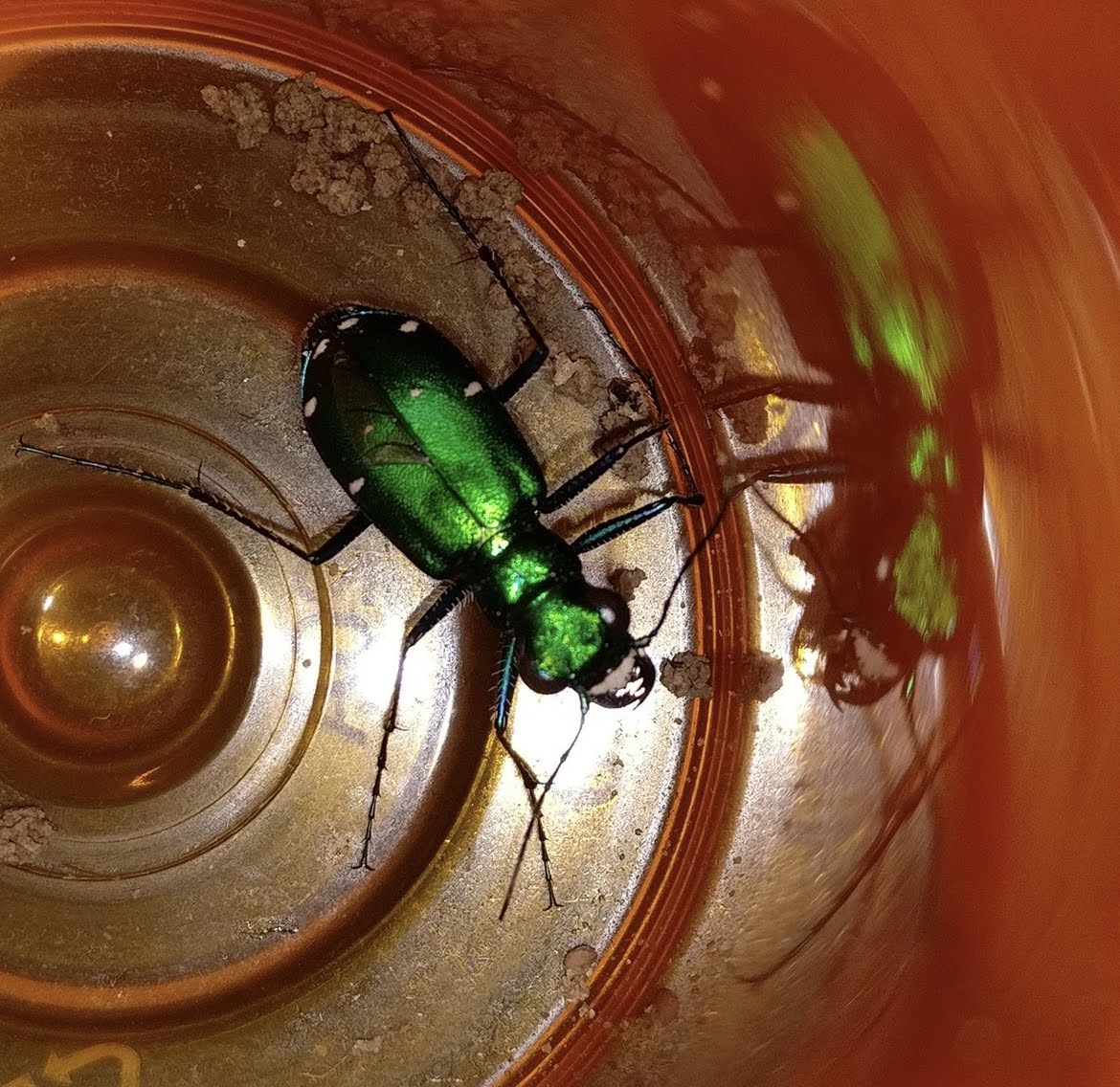
Cicindela sexguttata is a common North American tiger beetle recognized by its bright metallic-green to blue-green elytra, often bearing six small white spots. Adults are active predators of small arthropods in deciduous forest habitats, where they hunt in sunlit patches on the forest floor. The species exhibits specialized thermal ecology, basking to elevate body temperature and foraging optimally at approximately 32.8°C. Larvae are subterranean ambush predators that construct burrows in sandy soils. The species has been reported to live up to five years total, with approximately one year spent in larval development.
Diffracted Tiger Beetle
Cicindela tranquebarica diffracta is a subspecies of the oblique-lined tiger beetle, distinguished from the nominate form by more diffused and broken elytral maculations. It occurs in sandy and clay soils across the Great Plains and western North America. Like other members of the C. tranquebarica complex, it is a spring-fall active species with larvae that construct typical tiger beetle burrows in appropriate substrates.
Inyo Tiger Beetle, Oblique-lined Tiger Beetle (Inyo subspecies)
Cicindela tranquebarica inyo is a subspecies of tiger beetle in the family Carabidae (subfamily Cicindelinae). It belongs to the widespread Oblique-lined Tiger Beetle species complex, which occurs across North America in sandy and open habitats. This subspecies was described by Fall in 1917 and is associated with the Inyo region of eastern California. Tiger beetles in this group are fast-running, visually oriented predators that hunt small invertebrates. The subspecies status indicates geographic differentiation within the broader C. tranquebarica distribution, though like many tiger beetle subspecies, its taxonomic validity may require further study.
Kirby's Oblique-lined Tiger Beetle, Kirby's Tiger Beetle
Cicindela tranquebarica kirbyi is a subspecies of the oblique-lined tiger beetle found in the Great Plains and Rocky Mountain regions of North America. It is a spring-fall species that emerges in fall as sexually immature adults, overwinters in burrows, and becomes active again in spring for mating and oviposition. The subspecies is distinguished from the nominate eastern form by broader white maculations on the elytra. It occurs in both saline and dry sandy habitats, showing greater habitat flexibility than many tiger beetle species.
Opal Tiger Beetle
Cicindela tranquebarica parallelonota is a subspecies of the oblique-lined tiger beetle, commonly known as the Opal Tiger Beetle. It belongs to the tiger beetle subfamily Cicindelinae within the ground beetle family Carabidae. The species exhibits spring-fall adult activity, with larvae developing in burrows during summer months. Adults are known for their fast running speed and predatory habits, though specific distinguishing features of this subspecies relative to other C. tranquebarica subspecies require careful examination of elytral maculation patterns.
Wealed Tiger Beetle
Cicindela tranquebarica vibex is a subspecies of oblique-lined tiger beetle in the family Carabidae. It is a spring-fall species active during cooler months, spending summer as larvae in soil burrows. Adults are ground-dwelling predators that hunt small invertebrates using rapid pursuit and visual tracking. The subspecies occurs in western North America, where it has been observed in sandy and clay habitats including saline flats and dry creek beds.
Wetsalts Tiger Beetle
Cicindelidia haemorrhagica is a tiger beetle species notable for its ability to inhabit extreme thermal environments. In Yellowstone National Park, it is exclusively associated with hot springs ranging from pH 2.7 to 9.0 and temperatures from 29.1 to 75.0°C, where it functions as the apex invertebrate predator. The species exhibits remarkable thermal tolerance, with adults observed on substrates exceeding 50°C and showing minimal behavioral thermoregulation compared to populations in milder habitats. Outside Yellowstone, it occurs in wet salt lakes, ponds, rivers, and tidal flats across the western United States.
Mudflat Tiger Beetle
Cicindelidia trifasciata sigmoidea is a subspecies of the Mudflat Tiger Beetle, a member of the tiger beetle family (Cicindelidae). The species Cicindelidia trifasciata is broadly distributed across North America with multiple recognized subspecies occupying distinct geographic and habitat zones. The nominate subspecies and related forms are associated with moist, open substrates including mudflats, salt marshes, and coastal wetlands. These beetles are active predators with excellent vision and rapid running ability, characteristic of the genus.
ladybird, ladybug, lady beetle
Coccinella is a genus of lady beetles recognized by their convex, hemispherical bodies and typically red or orange elytra marked with black spots or bands. The genus contains approximately 94 species and occurs throughout the Northern Hemisphere, with greater diversity in Eurasia than North America. Several species, particularly C. septempunctata, are valued as biological control agents due to their predatory habits.
California Lady Beetle
Coccinella californica is a ladybird beetle endemic to coastal California. Adults measure 5.10–6.80 mm and are distinguished by predominantly red, usually spotless elytra and a mostly black thorax. The species plays a documented role in biological pest control in vineyard ecosystems.
Stink Fly
Coenomyia ferruginea, commonly known as the stink fly, is a species of fly in the family Xylophagidae. The family name derives from Greek roots meaning "wood-eating," referring to the larval habit of developing in dead and decaying wood. Adults are large, brown, and slow-moving flies that can be mistaken for beetles at first glance. The species occurs across Europe and North America. Formerly classified as a subfamily of Rhagionidae (snipe flies), Xylophagidae is now recognized as a distinct family closely related to Tabanidae (horse and deer flies).
Tiger Flies
Coenosia is a large genus of predatory muscid flies comprising more than 350 species. Members are commonly known as tiger flies due to their active hunting behavior. They are documented from multiple continents including Europe, Asia, and North America. Some species serve as hosts for entomopathogenic fungi in the genus Strongwellsea, which exhibit unusual extended-host survival during infection.
tiger fly
Coenosia humilis is a predatory muscid fly commonly known as the tiger fly. It is an active predator of small flying insects, particularly agromyzid leafminers, and has been studied as a biological control agent in agricultural systems. The species is native to Europe but has been recorded in multiple regions including Indonesia and the North Atlantic islands. It exhibits distinct daily activity patterns with peak hunting during morning and afternoon hours.
soft-winged flower beetles
Collops is a genus of soft-winged flower beetles in the family Melyridae, containing at least 20 described species. These beetles are recognized as beneficial predators in agricultural systems, where they feed on pest insects including aphids and plant bug eggs. The genus has been studied extensively for its role in biological control, particularly in cotton and alfalfa systems in the southwestern United States. Collops beetles are frequently found on flowering plants where they hunt prey and may also utilize extrafloral nectaries.
Collops beetle
Collops cribrosus is a soft-winged flower beetle in the family Melyridae, first described by LeConte in 1852. The species belongs to the genus Collops, which comprises predatory beetles frequently associated with flowering plants where they hunt small arthropod prey. Like other members of its genus, C. cribrosus is recognized as a beneficial insect in agricultural contexts, serving as a natural enemy of pest insects. The species has been documented in western North America, with confirmed records from British Columbia.
Collops flavicinctus is a species of soft-winged flower beetle in the family Melyridae, subfamily Malachiinae. Members of the genus Collops are recognized as beneficial predators in agricultural systems, particularly in cotton production. The species is documented from the southwestern United States with iNaturalist records from Utah. Like other Collops species, it likely contributes to biological control of pest insects through predation on eggs and small arthropods.
Collops granellus is a species of soft-winged flower beetle in the family Melyridae. Like other members of the genus Collops, it is a predatory beetle associated with flowering plants, where it feeds on small insects and other arthropods. The genus is well-known in agricultural contexts as a beneficial predator in cotton and other crop systems.
Hairy Soft-winged Flower Beetle
Collops hirtellus is a species of soft-winged flower beetle in the family Melyridae, first described by LeConte in 1876. It is one of several Collops species recognized as beneficial predators in agricultural systems, particularly in cotton production. The species has been documented in western Canada and is part of a genus known for predatory feeding habits on pest insects.
Collops insulatus is a species of soft-winged flower beetle in the family Melyridae. The genus Collops comprises predatory beetles commonly found on flowers, where they feed on small insects and other arthropods. Like other members of the genus, C. insulatus likely serves as a beneficial insect in agricultural and natural ecosystems by helping control pest populations. The species epithet "insulatus" (meaning "island" in Latin) may refer to an island-like distribution pattern or type locality, though specific etymological details are not documented in available sources.
Collops marginellus is a species of soft-winged flower beetle in the family Melyridae. The genus Collops comprises predatory beetles commonly found on flowers, where they feed on other small insects. These beetles are recognized as beneficial insects in agricultural systems, particularly in cotton production, where they contribute to biological control of pest populations. The species is part of a genus whose members are frequently encountered on flowering plants in arid and semi-arid regions of western North America.
Collops necopinus is a soft-winged flower beetle in the family Melyridae. Like other members of the genus Collops, it is a predatory beetle that feeds on small arthropods. The species has been documented in the southwestern United States, including New Mexico, and is associated with flowering plants where it hunts prey. Collops beetles are recognized as beneficial natural enemies in agricultural systems, particularly in cotton production.
Eastern Coastal Collops
Collops nigriceps is a soft-winged flower beetle (family Melyridae) with a documented preference for flowers of Gutierrezia sarothrae (broom snakeweed) in the southwestern United States. The species has been collected in northeastern New Mexico and has been observed in association with other flower-visiting beetles including cerambycids and cantharids. As a member of the genus Collops, it likely functions as a generalist predator in flower-based arthropod communities.
Collops nigritus is a species of soft-winged flower beetle in the family Melyridae, subfamily Malachiinae. The genus Collops comprises predatory beetles commonly found on flowers where they feed on other small insects. Members of this genus are recognized as important natural enemies in agricultural systems, particularly in cotton and other crops, where they contribute to biological control of pest populations. Collops nigritus specifically has been documented as occurring in the southwestern United States and is associated with flowering plants in arid and semi-arid habitats.
Collops parvus is a species of soft-winged flower beetle in the family Melyridae. The genus Collops comprises predatory beetles frequently found on flowers, where they feed on other insects. C. parvus is one of numerous small, often brightly colored species in this genus that serve as important natural enemies of pest insects in agricultural and natural ecosystems.
four-spotted collops
Collops quadrimaculatus is a species of soft-winged flower beetle in the family Melyridae, commonly known as the four-spotted collops. It is recognized as a beneficial predator in agricultural systems, particularly in cotton production. The species occurs across Central and North America, with documented populations in Canada (Ontario, Québec), the United States, and Mexico. Adults are active during the growing season and are frequently recorded in field observations.
Collops reflexus is a species of soft-winged flower beetle in the family Melyridae. Like other members of the genus Collops, it is a predatory beetle found in association with flowering plants. The genus is recognized for its ecological role as a predator of pest insects in agricultural systems, including cotton. Collops reflexus has been documented in field observations on flowers of Gutierrezia sarothrae (broom snakeweed) in northeastern New Mexico, where it occurs alongside other flower-visiting beetles.
Collops simplex is a species of soft-winged flower beetle in the family Melyridae. Members of this genus are known as predatory beetles commonly found on vegetation. The species is documented in entomological records but detailed biological information remains limited.
Collops subtropicus is a species of soft-winged flower beetle in the family Melyridae. The genus Collops comprises small, predatory beetles commonly found on flowers, where they feed on pollen and prey on other small insects. Members of this genus are recognized as beneficial predators in agricultural systems, particularly in cotton and other crops.
Collops versatilis is a soft-winged flower beetle in the family Melyridae, first described by Fall in 1912. The genus Collops comprises predatory beetles commonly found on flowers, where they feed on other insects. C. versatilis has been documented from British Columbia, Canada, with 75 iNaturalist observations recorded. Like other members of the genus, it likely serves as a beneficial predator in agricultural and natural ecosystems, though specific ecological details for this species remain limited.
Collops vicarius is a species of soft-winged flower beetle in the family Melyridae. The genus Collops comprises predatory beetles commonly found on flowers, where they feed on other insects. C. vicarius is part of a group of beneficial predatory insects utilized in biological control programs in agricultural systems, particularly in cotton production. Species in this genus are recognized as important natural enemies of pest insects.
Striped Collops, melyrid beetle
Collops vittatus is a small predatory soft-winged flower beetle in the family Melyridae, measuring approximately 5 mm in length. The species exhibits considerable geographic variation in coloration and morphology across its North American range. It has been documented as a predator of agricultural pests, particularly the spotted alfalfa aphid. The species is found from Canada through the United States to Central America, with notable morphological differences between northeastern and southwestern populations.
Comantella fallei is a small to medium-sized robber fly (10-15 mm) found in California and Colorado. Adults are active in early spring and late fall, an unusual seasonal pattern for Asilidae. The species is distinguished by a humpbacked profile, a slender spur on the front tibia, and a distinctive "Mohawk" mane of hairs on the thorax. One observation documents predation on a small wolf spider (Pardosa).
long-legged fly
Condylostylus calcaratus is a species of long-legged fly in the family Dolichopodidae, first described by Loew in 1861. Members of this genus are commonly encountered in gardens and along forest edges, where they are active predators on small insects. The family Dolichopodidae is among the most diverse families of Diptera, with nearly 60 genera and approximately 1,300 species in North America north of Mexico alone.
Condylostylus caudatus is a species of long-legged fly in the family Dolichopodidae. It is a small, metallic-colored predatory fly commonly observed darting over vegetation in sunny habitats. As a member of this diverse family, it preys on other small insects. The species was first described by Wiedemann in 1830.
Condylostylus comatus is a species of long-legged fly in the family Dolichopodidae, primarily found in the Eastern United States. Males can be distinguished from similar species by a row of hairs on the mid metatarsus and pale genital appendages. The species belongs to a diverse Neotropical genus and exhibits typical dolichopodid characteristics including predatory behavior on small insects.