
Cicindela oregona guttifera
LeConte, 1856
Dappled Tiger Beetle
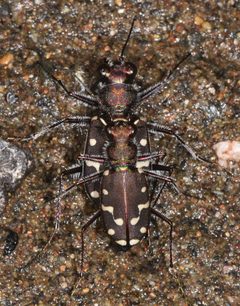
Cicindela oregona guttifera is a of the Western Tiger Beetle, a ground-dwelling predatory in the Carabidae. The subspecies occurs in western North America, where are active hunters in sandy riparian and coastal . Like other tiger beetles, it is characterized by large , long legs, and prominent adapted for capturing small prey. The exhibits the typical tiger beetle of fast running, intermittent stopping to refocus vision, and rapid when disturbed.
Pronunciation
How to pronounce Cicindela oregona guttifera: //sɪˈsɪndələ ˌɔːrɪˈɡoʊnə ˌɡʊtəˈfɪrə//
These audio files are automatically generated. While they are not always 100% accurate, they are a good starting point.
Identification
Distinguished from the nominate C. o. oregona and other western tiger beetles primarily by details of elytral maculation pattern. C. oregona as a is separated from the similar C. duodecimguttata by the absence of a distinct marginal white band at the middle of the perpendicular to the middle band; this band is present in C. duodecimguttata. Where the two species overlap on the eastern slope of the Rocky Mountains, they may hybridize. C. oregona subspecies can be difficult to separate without examination of specific maculation details and geographic provenance.
Images
Appearance
are small to medium-sized tiger beetles, averaging 11–14 mm in body length. The are marked with bold white or ivory maculations (spots or bands) against a darker background coloration. The body is covered with white setae (hairs) on the sides and undersurface, which serve to insulate against heat. Large, bulging provide acute vision. Long, slender legs are adapted for rapid running. The are enlarged and prominent, characteristic of predatory tiger beetles.
Habitat
Sandy riparian including beaches, lake shores, riverbanks, and mudflats. Occurs in open, sparsely vegetated sandy areas where prey is abundant and burrowing substrate is suitable. At Lake Topaz, California, observed on muddy southwestern banks in shallowly pitched mudflat areas.
Distribution
Western North America. Records indicate presence in Alaska, Canada, Mexico, and the United States. Within the western U.S., found in California, Nevada, and northward into southern British Columbia. The occurs in coastal and interior western localities.
Seasonality
are active in spring and fall, with peak activity during cooler periods. This seasonal pattern reflects an adult-active, larva-summer typical of many temperate tiger beetles. Activity is reduced during midday heat, with beetles seeking shade or burrowing into sand.
Diet
Active of small , including ants and other arthropods. Hunts by sight, pursuing prey with rapid running interrupted by brief stops to refocus before continuing pursuit. Prey is captured and dismembered with enlarged .
Life Cycle
Typical of tiger beetles in the Cicindela: are laid in burrows excavated in sandy substrate. Larvae are , constructing vertical burrows in which they ambush prey from the entrance. Larvae pass through three instars, with the summer months spent as larvae and pupae in soil tunnels. emerge in spring and fall, with some overlap in timing. Adults may dig shallow burrows for shelter during periods of extreme temperature or overnight.
Behavior
with characteristic stop-and-go running pattern necessitated by visual processing limitations at high speed. Extremely wary and agile, with rapid escape when approached. When disturbed, may fly short distances and alight facing the threat to reduce profile, or hunker down in sand depressions for concealment. Uses long legs to elevate body above hot substrate surfaces (stilting ). dig burrows for overnight shelter and temperature ; burrows are typically placed in troughs between sand ripples and have characteristic flattened, horizontally angled tunnels before descending.
Ecological Role
in sandy riparian , controlling of small arthropods. Larvae serve as prey for specialized including in the Tiphiidae (Methocha). The ' presence indicates intact sandy with minimal disturbance.
Human Relevance
Subject of interest to entomologists and naturalists; serves as for healthy sandy riparian . vulnerable to degradation from plants, off-road vehicle use, and shoreline development. can be impacted by trampling and habitat destruction.
Similar Taxa
- Cicindela duodecimguttataOverlaps in range on eastern slope of Rocky Mountains; distinguished by presence of distinct marginal white band at middle of perpendicular to middle band, which is absent in C. oregona; hybrids occur in zone of overlap
- Cicindela oregona oregonaNominate ; differences in elytral maculation pattern details and geographic distribution (C. o. oregona more coastal, C. o. guttifera more interior and northern)
- Cicindela repandaSympatric in some sandy ; differs in elytral maculation pattern and typically more brownish coloration with different spot arrangement
More Details
Nomenclature
The was described by LeConte in 1856. The epithet 'guttifera' refers to the spotted or maculate appearance of the .
Conservation Notes
While not formally listed as endangered, tiger beetles dependent on specific sandy are vulnerable to habitat loss and degradation. The has been considered for conservation attention due to the imperiled nature of limited dune and sand prairie habitats in parts of its range.
Sources and further reading
- BugGuide
- GBIF taxonomy match
- iNaturalist taxon
- NCBI Taxonomy
- Catalogue of Life
- Bug Eric: Springtime Tiger Beetles
- Big, Bold and Beautiful—Redux | Beetles In The Bush
- Just another ‘bug on white’ | Beetles In The Bush
- GBCT Beetle #5: Crossidius coralinus monoensis | Beetles In The Bush
- St. Anthony Dune Tiger Beetle | Beetles In The Bush
- The World’s Largest Tiger Beetle | Beetles In The Bush