
Cicindela oregona
LeConte, 1856
Western Tiger Beetle
Species Guides
3- Cicindela oregona guttifera(Dappled Tiger Beetle)
- Cicindela oregona maricopa(Maricopa Tiger Beetle)
- Cicindela oregona oregona(Oregon Tiger Beetle)
Cicindela oregona, commonly known as the Western Tiger , is a North American tiger beetle found from the Rocky Mountains to the Pacific Coast and north into Alaska. It is closely related to C. duodecimguttata (Twelve-spotted Tiger Beetle), with which it forms a hybrid zone along the Front Range of the Rockies. The species exhibits distinctive microhabitat segregation with co-occurring tiger beetles, preferring moist stream edge and showing physiological adaptations for foraging in wet conditions at temperatures between 25-38°C.
Pronunciation
How to pronounce Cicindela oregona: /sɪˈsɪndɛlə ɔˈrɛɡənə/
These audio files are automatically generated. While they are not always 100% accurate, they are a good starting point.
Identification
Distinguished from similar tiger beetles by preference for moist, wet stream edges rather than drier upper beaches. Where sympatric with C. duodecimguttata, C. oregona occupies wetter microhabitats; the two form a hybrid zone along the Front Range of the Rocky Mountains. Separated from C. tranquebarica by physiological differences: C. oregona shows higher activity at body temperatures below 30°C and has lower lethal temperatures under dry conditions (39-43°C vs. 46-47°C).
Images
Appearance
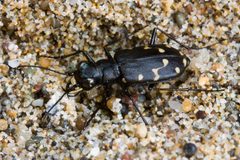
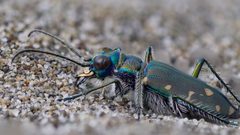
Medium-sized tiger averaging 11-14 mm in body length. Typically brown with ivory markings on the . Decorated with white hairs that help insulate from hot sun. Possesses large , long legs, and enlarged characteristic of tiger beetles. Some may show metallic coloration due to structural properties of the .
Habitat
Moist stream edge and wet portions of stream beaches. Progressively moves from dry upper beach to wet stream edge as temperatures increase and humidity decreases. Found in sandy riparian habitats including beaches, dunes, and barren paths through prairies and forests. In the Southwest, occurs in riparian corridors and near water sources.
Distribution
Western North America from the Rocky Mountains to the Pacific Coast, extending north deep into Alaska. Occurs in Canada, USA (western states), and Mexico. Northeastern limit of distribution approaches but may not reach southwestern corner of Arkansas; hybrid zone with C. duodecimguttata along Front Range of Colorado Rockies.
Seasonality
active in spring and fall; summer spent as larvae and pupae in soil tunnels. Active foraging throughout the day in suitable temperature ranges (25-38°C air temperature).
Diet
Pursues small including ants. Prey captured using rapid pursuit with intermittent stopping to re-focus vision, then dispatched with enlarged .
Life Cycle
present spring and fall; larvae and pupae in soil tunnels during summer. Larvae are ambush hunters living in vertical burrows, presenting flat at burrow entrances to seize passing small .
Behavior
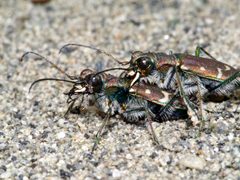
Exhibits characteristic tiger hunting : runs so fast it outruns its ability to focus, requiring intermittent stops to re-focus before dashing again. When disturbed, flies then alights facing the threat to reduce profile, or hunkers down in sand depressions. Uses long legs to elevate body high off hot ground (stilting behavior) to avoid overheating. Males grip females using toothed that fit -specific notches on female pronotum.
Ecological Role
of small in sandy riparian . Larval burrowing may contribute to soil aeration in beach and dune .
Human Relevance
Subject of ecological and behavioral research due to distinctive microhabitat segregation and physiological adaptations. Popular among naturalists and entomologists; some tiger threatened by human development.
Similar Taxa
- Cicindela duodecimguttataClosely related forming hybrid zone where ranges meet along Front Range of Rockies; distinguished by darker coloration and preference for somewhat drier, darker creek banks with more clay content
- Cicindela tranquebaricaCo-occurs on stream beaches; C. oregona occupies wetter microhabitats and shows higher water loss rates and lower lethal temperatures under dry conditions
- Cicindela repandaSimilar brown coloration with ivory markings but prefers near-water throughout eastern U.S.; C. oregona restricted to western North America
More Details
Physiological Adaptations
Study in Northeast Arizona demonstrated C. oregona has higher active metabolism between 25-40°C compared to C. tranquebarica, but lower to desiccation. Both share similar high lethal temperatures (47-48°C) in saturated air, indicating thermal limits are similar when water stress is absent.
Taxonomic Note
Tiger beetles formerly placed in , now treated as Cicindelinae within Carabidae. The close relationship between C. oregona and C. duodecimguttata has led some to suggest they may be subspecifically distinct.
Sources and further reading
- BugGuide
- Wikipedia
- GBIF taxonomy match
- iNaturalist taxon
- NCBI Taxonomy
- Catalogue of Life
- Bug Eric: Springtime Tiger Beetles
- Bug Eric: April 2015
- Just repanda… er, wait a minute… | Beetles In The Bush
- Bug Eric: New Mexico Dragonfly Blitz - Day 2
- Big, Bold and Beautiful—Redux | Beetles In The Bush
- GBCT Beetle #5: Crossidius coralinus monoensis | Beetles In The Bush
- Microhabitat segregation and physiological differences in co-occurring tiger beetle species, Cicindela oregona and Cicindela tranquebarica