
Cicindela tranquebarica
Herbst, 1806
Oblique-lined Tiger Beetle
Species Guides
10- Cicindela tranquebarica arida(Death Valley Tiger Beetle)
- Cicindela tranquebarica diffracta(Diffracted Tiger Beetle)
- Cicindela tranquebarica inyo(Inyo Tiger Beetle)
- Cicindela tranquebarica joaquinensis(San Joaquin Tiger Beetle)
- Cicindela tranquebarica kirbyi(Kirby's Oblique-lined Tiger Beetle)
- Cicindela tranquebarica parallelonota(Opal Tiger Beetle)
- Cicindela tranquebarica sierra(Sierra Tiger Beetle)
- Cicindela tranquebarica tranquebarica(Oblique-lined Tiger Beetle)
- Cicindela tranquebarica vibex(Wealed Tiger Beetle)
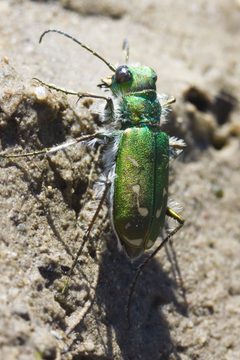
Cicindela tranquebarica, commonly known as the oblique-lined tiger , is a North American tiger beetle distinguished by its variable coloration ranging from reddish-brown to black to green, with distinct white maculations. measure 11–16 mm in length, with females typically larger than males. The species exhibits notable physiological adaptations including stilting for and for high temperatures in dry conditions. It has a two-year with adults active in spring and fall, in burrows.

Pronunciation
How to pronounce Cicindela tranquebarica: //sɪˈsɪndələ træŋkwɪˈbærɪkə//
These audio files are automatically generated. While they are not always 100% accurate, they are a good starting point.
Identification
Distinguished from similar by oblique-lined maculations (light markings running down midline), slightly larger body size compared to some co-occurring Cicindela species, and preference for drier microhabitats. In co-occurrence with C. oregona, C. tranquebarica occupies dry upper beach portions while C. oregona occupies moist stream edges. Larger and body size distinguish it from smaller saline like Eunota togata and C. fulgida where they co-occur.
Images
Appearance
Variable coloration including reddish-brown, black, and green forms. typically purple or black, or dark red, red or purple. Hairy forehead with erect setae. Short upper lip and with three teeth. in Montana typically exhibit distinct maculations—light blemishes running down the midline of the body. Females slightly larger than males on average.
Habitat
Highly diverse: banks and mud flats of creeks and rivers, dry lake beds, tidal flats, roadside ditches, packed gravelly-sandy roads near water, open ground, old fields, stubble fields, saline and alkali flats, blowouts, sand pits, prairie grasslands, forest trails, and roads. In Montana specifically: sedge-grass sand flats, hard-packed gravelly-sandy roads near water, saline/alkali flats, riparian dunes, sandy blowouts, sand pits, river sandbars, and old river crossings. Shows highest in dry upper portions of beaches and can tolerate high-saline environments.
Distribution
North America: most of the United States from Atlantic Coast to western Sierra Nevada and Cascades; Canada. Highest relative in southwest Montana; abundant in southern California San Joaquin Valley. Northeast Arizona (detailed study site).
Seasonality
Spring-fall : appear in late spring, lay in June; first and second instar larvae found early September; larvae overwinter, emerge May or early June for final stage. Adults active in spring and fall, in burrows. Two-year .
Diet
Small including ants; prey size correlates with size, allowing resource partitioning with co-occurring .
Life Cycle
Two-year cycle: emerge in late spring, oviposit in June in moist areas; larvae develop through three instars, with first and second instars present by early September; larvae overwinter in burrows 22–50 cm deep; occurs in burrow; adults emerge in fall as sexually , re-enter burrows to overwinter, then re-emerge in spring for mating and oviposition.
Behavior
Thermoregulatory stilting: raises body away from hot ground to reduce body temperature. Shuttles between sun and shade at air temperatures above 35°C. Strong flier; attracted to lights at night; exhibits side-to-side wobbling before landing during escape . Social ranges from solitary to gregarious. Sensitive to temperature changes; seeks shade or burrows during excessive heat.
Ecological Role
of small ; contributes to control of ants and other ground-dwelling arthropods. Resource partitioning through microhabitat segregation and prey size differentiation reduces competition with co-occurring tiger in diverse .
Human Relevance
Not considered rare; no special conservation management required. Benefits from human-created including agricultural fields, pastures, clay roads, sand/gravel pits, and rangelands. Livestock grazing can maintain open vegetation cover beneficial to the , though overgrazing negatively impacts colonies. Used in physiological and ecological studies of and habitat partitioning.
Similar Taxa
- Cicindela oregonaCo-occurs along streams but occupies moist stream edge subhabitat; C. tranquebarica restricted to dry upper beach portions with higher temperature and lower water loss rates
- Cicindela purpureaSimilar timing and breadth; distinguished by coloration and maculation patterns
- Cicindela lengiConvergent in sand ; C. lengi has longer, obliquely straight humeral lunule and more cylindrical, parallel-sided body
- Eunota togataCo-occurs in saline flats but smaller body size and different seasonal activity; C. tranquebarica has larger allowing larger prey
- Cicindela fulgidaCo-occurs in saline but prefers sparsely vegetated zones at edge of flats; C. tranquebarica more generalized in microhabitat use
Misconceptions
The specific epithet 'tranquebarica' refers to Tranquebar (Tharangambadi), a Danish colony in southern India, based on an incorrect label on the indicating this as the place of origin; the is actually North American, not Indian.
More Details
Thermoregulatory Physiology
Exhibits higher for high temperatures in dry air (46–47°C lethal temperature at 0% RH) compared to co-occurring C. oregona. High wax and larger amount of saturated hydrocarbons on surface reduce water loss at 30–40°C body temperatures. Stilting height increases from 3.7 to 8.5 mm as body temperature rises, reducing thermal stress.
Subspecies Diversity
Eleven recognized including C. t. arida, C. t. cibecuei, C. t. diffracta, C. t. inyo, C. t. joaquinensis, C. t. kirbyi, C. t. parallelonota, C. t. sierra, C. t. tranquebarica, C. t. vibex, and C. t. viridissima. Subspecies vary in maculation patterns and geographic distribution.
Vision
contain with fully developed crystal cones and a subcorneal layer between corneal lens and crystalline cone. Each contains 260 pegs functioning as interfacetal mechanoreceptors between corneal lenses. Dioptric apparatus includes corneal lens, subcorneal layer, and crystalline cone, enabling detection of polarized light.
Sources and further reading
- BugGuide
- Wikipedia
- GBIF taxonomy match
- iNaturalist taxon
- NCBI Taxonomy
- Catalogue of Life
- Bug Eric: Springtime Tiger Beetles
- Diversity in Tiger Beetle Larval Burrows | Beetles In The Bush
- Alkali Tiger Beetle | Beetles In The Bush
- Kirby’s Tiger Beetle | Beetles In The Bush
- Rattled in the Black Hills | Beetles In The Bush
- Monroe Canyon – A Tiger Beetle “Hot Spot” | Beetles In The Bush
- Microhabitat segregation and physiological differences in co-occurring tiger beetle species, Cicindela oregona and Cicindela tranquebarica