
Cicindela oregona maricopa
Leng, 1902
Maricopa Tiger Beetle
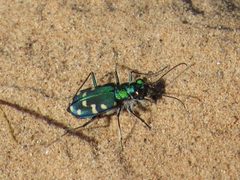
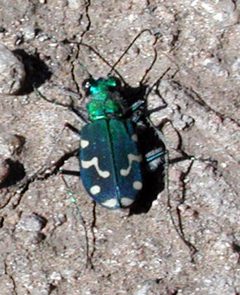
Cicindela oregona maricopa is a of the Western Tiger Beetle, first described by Leng in 1902. This tiger inhabits sandy shoreline and riparian , particularly along beaches and muddy banks of lakes and rivers. The subspecies is part of the broader C. oregona complex, which replaces the closely related C. duodecimguttata west of the Rocky Mountains. are active with excellent vision, though they can become difficult to approach during warm conditions.

Pronunciation
How to pronounce Cicindela oregona maricopa: /sɪˈsɪndələ ˌɔːrɛˈɡoʊnə ˌmærɪˈkoʊpə/
These audio files are automatically generated. While they are not always 100% accurate, they are a good starting point.
Identification
Best identified by and geographic location combined with elytral pattern. Distinguished from the closely related C. duodecimguttata by the absence of a distinct marginal white band at the middle of the perpendicular to the middle band—this band is characteristic of C. duodecimguttata. In the zone of overlap along the eastern Rocky Mountains, separation may require careful examination due to hybridization. The C. o. maricopa is distinguished from the nominate subspecies C. o. oregona by subtle differences in markings and distribution.
Images
Habitat
Sandy beaches, lake and river shorelines, riparian mudflats, and other open sandy or muddy near water. Occurs on gently sloping to flat terrain where substrate is loose enough for burrowing but stable enough to maintain burrow integrity. In dune systems, tends to occupy sloping south-facing dune above flatter sand plains.
Distribution
Western North America. Records from Alaska, western Canada, western United States, and Mexico. The C. o. maricopa occurs in the southwestern United States and adjacent Mexico, with the broader ranging throughout western North America.
Seasonality
active in spring and fall, spending summer as larvae in soil burrows. Activity patterns tied to temperature; adults become scarce and dig into burrows during midday heat, becoming more active again as temperatures cool in late afternoon and evening. In late season, adults may dig burrows in preparation for .
Diet
Active of small including ants and other arthropods. Pursues prey visually, running in short bursts interspersed with stops to refocus due to speed exceeding visual processing capacity. Prey captured and dismembered with enlarged .
Life Cycle
Spring-fall activity pattern with summer spent as larvae in vertical burrows in soil or sand. Larvae are ambush that position flat at burrow entrance to seize passing prey. occurs in burrow. Adults dig burrows for shelter during temperature extremes and overnight; burrows typically placed in troughs between sand ripples or in swales, with flat tunnel angling horizontally back into substrate before descending.
Behavior
with rapid running and capabilities. Extremely wary and difficult to approach, exhibiting swift escape flights that end with characteristic bounce and tumble landing. When pursued, may alight facing threat to reduce visible profile or hunker down in sand depressions for concealment. Uses long legs to elevate body above hot substrate surface ('stilting' ). dig burrows for overnight shelter and temperature ; burrowing activity increases as temperatures rise. Mating involves male grasping female pronotum with toothed ; males may remain coupled for extended mate-guarding periods.
Ecological Role
in sandy shoreline and riparian . Larval burrows may provide microhabitat structure in sand dune . As part of the C. oregona complex, contributes to predator diversity in western North American riparian and lacustrine .
Human Relevance
Subject of interest to entomologists and naturalists; sometimes difficult to observe closely due to wariness. vulnerable to disturbance from recreational activities, plants, and shoreline development. No significant economic importance.
Similar Taxa
- Cicindela duodecimguttataClosely related that C. oregona replaces west of the Rocky Mountains; distinguished by presence of distinct marginal white band at middle of perpendicular to middle band, which is absent in C. oregona. Hybrids occur in overlap zone.
- Cicindela oregona oregonaNominate with slightly different elytral markings and more northerly/westerly distribution; the two subspecies meet and intergrade in some areas.
More Details
Nomenclatural Note
Cicindela oregona has undergone taxonomic revision; some authorities recognize the oregona group as distinct from C. duodecimguttata, with which it was formerly confused. The maricopa was described by Leng in 1902 and is accepted in current classifications.
Conservation Context
Like many sand-dune and shoreline tiger beetles, are vulnerable to loss and degradation. Related in the maritima group (C. arenicola, C. waynei, C. albissima, C. theatina) are of significant conservation concern due to restricted ranges; C. o. maricopa has broader distribution but shares habitat vulnerabilities.
Sources and further reading
- BugGuide
- GBIF taxonomy match
- iNaturalist taxon
- NCBI Taxonomy
- Catalogue of Life
- Bug Eric: Springtime Tiger Beetles
- Big, Bold and Beautiful—Redux | Beetles In The Bush
- Just another ‘bug on white’ | Beetles In The Bush
- GBCT Beetle #5: Crossidius coralinus monoensis | Beetles In The Bush
- The World’s Largest Tiger Beetle | Beetles In The Bush
- St. Anthony Dune Tiger Beetle | Beetles In The Bush