
Cicindela duodecimguttata
Dejean, 1825
Twelve-spotted Tiger Beetle
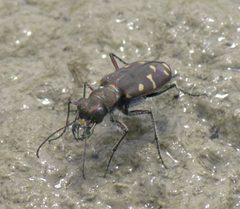
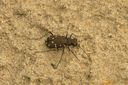
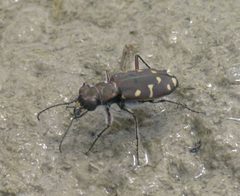
Cicindela duodecimguttata, the twelve-spotted tiger , is a small dark-colored tiger beetle measuring 12–15 mm in length. The is distinguished by twelve pale spots on the , though spot patterns can vary. It occurs throughout eastern North America, primarily in moist along rivers and streams. are active during spring and fall, spending summer as larvae in soil burrows. The species is closely related to the western C. oregona, with which it forms a hybrid zone along the Rocky Mountain front range.
Pronunciation
How to pronounce Cicindela duodecimguttata: /sɪsɪnˈdiːlə duːəˌdɛksɪmˈɡʌtɑːtə/
These audio files are automatically generated. While they are not always 100% accurate, they are a good starting point.
Identification
Most readily distinguished from the similar and frequently co-occurring Cicindela repanda (Bronzed Tiger Beetle) by its darker coloration—C. repanda is bronze to coppery-brown while C. duodecimguttata is dark brown to black. The twelve pale elytral spots (usually six per side, reduced and broken rather than forming continuous bands) confirm identification once the darker coloration draws attention. In the hybrid zone with C. oregona along the Rocky Mountain front range, identification becomes difficult; pure C. duodecimguttata possesses a distinct marginal white band at the middle of the at right angles to the middle band, which is lacking in C. oregona.
Images
Appearance
measure 12–15 mm in body length. The coloration is dark brown to black, distinctly darker than the sympatric C. repanda. The bear twelve pale spots arranged as six spots per side, though spot patterns may be reduced or interrupted. The marginal white band at the middle of the elytra is distinct and positioned at right angles to the middle band—this feature distinguishes eastern from the western C. oregona. The body is covered with white setae that provide insulation. Large , long slender legs, and prominent are characteristic of the .
Habitat
Moist along rivers, streams, and creeks; also found on moist trails, roads, and paths. In the central United States, often associated with stream banks composed of sand mixed with dark clay. Records from sand prairies suggest some may occur in drier sandy habitats, though these may represent dispersing individuals rather than established populations.
Distribution
Widespread throughout eastern North America from the Atlantic coast west to the Rocky Mountains. Absent from the extreme southeastern coastal plain and most of Florida. Replaced by the closely related C. oregona west of the Rocky Mountains, with a hybrid zone occurring along the eastern slope of the Rockies.
Seasonality
active during spring and fall (spring-fall ); summer is spent as larvae and pupae in soil burrows. In Missouri and Arkansas, adults have been observed in June.
Diet
are visual of small , including ants and other insects. Specific prey items have not been systematically documented for this .
Life Cycle
are laid in soil. Larvae are ambush that construct vertical burrows in sandy or clay soils, positioning their flattened at the entrance to seize passing prey. The larva progresses through three instars before pupating in a soil chamber. emerge in spring, with the exhibiting a spring-fall pattern typical of many temperate tiger beetles.
Behavior
are fast-running visual that may temporarily stop while pursuing prey to re-focus their , as their running speed can exceed their visual processing capacity. When disturbed, adults fly short distances and typically alight facing the threat, reducing their visible profile. They may also seek shade under vegetation or stand on tiptoe using their long legs to minimize thermal exposure. Males grasp females by the pronotum with their during mating; the female pronotum has grooves that accommodate male mandibles.
Ecological Role
of small in riparian and moist edge . Larvae function as sit-and-wait predators in soil . The contributes to nutrient cycling through and serves as potential prey for larger invertebrates and vertebrates.
Similar Taxa
- Cicindela repandaCo-occurs in near-water ; distinguished by bronze to coppery coloration versus dark brown to black in C. duodecimguttata, and by continuous elytral bands rather than broken spots.
- Cicindela oregonaWestern counterpart with which C. duodecimguttata forms a hybrid zone along the Rocky Mountain front range; distinguished by lack of the distinct marginal white band at the middle of the .