
Cicindela repanda
Dejean, 1825
Bronzed Tiger Beetle, Common Shore Tiger Beetle
Species Guides
3- Cicindela repanda novascotiae(Nova Scotia Shore Tiger Beetle)
- Cicindela repanda repanda(Bronze Tiger Beetle)
- Cicindela repanda tanneri(Tanner's Tiger Beetle)
Cicindela repanda, known as the bronzed tiger or common shore tiger beetle, is a widespread North American tiger beetle measuring 10–13 mm. exhibit a bronze-brown surface with metallic green or blue surfaces. The is notable for its two-year spring-fall , with adults active primarily in spring and fall, and for its opportunistic feeding habits that include both and . It is among the most common tiger beetles in eastern North America, frequently found in dense along waterways.
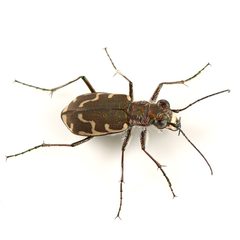
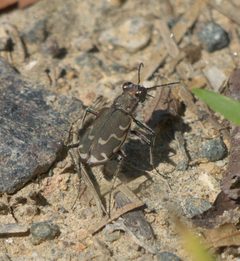
Pronunciation
How to pronounce Cicindela repanda: //kɪˈkɪndələ ˈripænda//
These audio files are automatically generated. While they are not always 100% accurate, they are a good starting point.
Identification
Distinguished from similar by the C-shaped humeral lunule on the that does not curl forward on its inner edge (contrasting with the G-shaped marking of C. hirticollis). The shoulder marking touches or nearly touches the middle band. Compared to C. duodecimguttata, C. repanda has a lighter, more bronze coloration rather than dark coloration, and more extensive rather than reduced elytral maculae. The pronotum is coppery and hairy, versus the hairy-necked condition of C. hirticollis. The elytra are less coarsely punctate than those of Ellipsoptera cuprascens.
Images
Appearance
measure 10–13 mm in length. The surface is bronze-brown, while surfaces are metallic green or blue. The pronotum is coppery and hairy. The is small with one tooth. display deep alveoli and acute ridges, with a gradual increase in reflectance toward near-infrared wavelengths producing a flat brown overall appearance; microscopic examination reveals subtle iridescence with mainly red reflected colors. The shoulder marking (humeral lunule) is C-shaped and touches or nearly touches the middle band. The proepisternum is bronze-brown with reddish reflections.
Habitat
Primarily inhabits fluvial including edges of lakes, ponds, and streams. Found on sand, gravel, or clay soil substrates, often directly along shorelines rather than inland. Occurs on sand dunes around the Great Lakes, particularly the Indiana Sand Dunes. Frequently found with C. duodecimguttata in clay silt stream beds or with C. hirticollis in sand substrate streams. Remarkably tolerant of substrate variation, observed on sand, mud, mixed substrates, and even concrete boat ramps (though larval burrows have not been confirmed in the latter).
Distribution
Widely distributed across most of North America, including the United States and Canada. Common throughout eastern North America. Particularly abundant in the Great Lakes region. Three recognized: C. repanda repanda, C. repanda novascotiae, and C. repanda tanneri.
Seasonality
are active primarily in spring and fall (spring-fall ), with peak in June and September. Adults emerge from hibernation in April, with numbers declining by early July. A new emerges from pupae in late August through September. occurs as adults, with mating following in spring. The species has a predominantly two-year .
Diet
Opportunistic feeder, primarily predatory but also frugivorous. feed on small arthropods including , ants, and other insects; dead insects are readily accepted. Prey detection relies heavily on movement, though beetles have been observed capturing over 90% of prey in complete darkness, indicating multimodal sensory capabilities. has been documented on fallen fruits of Sassafras albidum and Phytolacca americana (pokeweed), with no significant preference between high-fat and high-sugar fruits. Fruit feeding likely provides important nutrients during periods of low prey availability or high energy demands prior to .
Life Cycle
Two-year typical. are spring-fall : larvae pupate and emerge in fall, overwinter as adults, and mate in spring. Some individuals may follow a summer pattern with adult only in summer and as larvae. Overwintering requires cold temperature-induced before mating. Larvae are found in sandy areas, digging vertical tunnels and lying in wait with modified near the surface to ambush passing prey.
Behavior
are that capture prey through high-speed chases rather than stealth. Pursuit involves intermittent stopping and running due to visual constraints at high angular velocities—when relative motion exceeds receptor acceptance limits, prey images blur, requiring pauses to re-focus. Adults exhibit thermoregulatory including stilting (elevating body on long legs), sun-facing, and shade-seeking. Less aggressive predatory behavior compared to , with frequent retreat rather than capture in encounters; this may reflect to scavenging dead prey at water edges. Adults have been observed at ultraviolet lights at night, likely attracted by abundant prey. When feeding, adults hold back against the and pronotum, possibly to prevent damage from struggling prey.
Ecological Role
of small in shoreline and riparian . Larval and stages occupy different feeding , reducing . High densities and reliance on both living and dead prey may influence prey structure in fluvial . Serves as prey for various predators including such as Cerceris fumipennis.
Human Relevance
Subject of ecological and behavioral research, particularly regarding visual physiology, , and -prey dynamics. Popular among naturalists and photographers for its accessibility and charismatic . Occasionally attracted to UV lights used for insect surveys. Not considered a pest .
Similar Taxa
- Cicindela hirticollisSimilar size and preference, but distinguished by G-shaped (not C-shaped) humeral lunule, more coppery body cast, and hairier neck region
- Cicindela duodecimguttataCo-occurs in similar but has darker coloration, reduced elytral maculae broken into spots, and is less common in central North America
- Ellipsoptera cuprascensShares wet sand but has more coarsely and densely punctate, shinier with more distinctly coppery color; also readily attracted to UV lights at night
Misconceptions
Long assumed to be an obligate , but research has demonstrated significant . Prior experimental results suggesting strict may have been biased by using satiated individuals that had already undergone post-hibernation feeding and rapid weight gain.
More Details
Subspecies
Three recognized: C. repanda repanda (nominate), C. repanda novascotiae, and C. repanda tanneri.
Structural coloration
The flat brown appearance of the results from complex interplay of structural elements: deep alveoli, acute ridges, and epicuticular laminations create poor reflectance of any single visible wavelength, though microscopic iridescence reveals wide range of reflected colors.
Population dynamics
Exhibits two-humped curve with peaks following spring from hibernation and fall emergence of new . High population densities common along waterways.
Sources and further reading
- BugGuide
- Wikipedia
- GBIF taxonomy match
- iNaturalist taxon
- NCBI Taxonomy
- Catalogue of Life
- Just repanda… er, wait a minute… | Beetles In The Bush
- Cicindela cursitans in Missouri | Beetles In The Bush
- Bug Eric: Springtime Tiger Beetles
- Cicindelidae | Beetles In The Bush | Page 7
- Unexpected visitors | Beetles In The Bush
- Very cozy tigers! | Beetles In The Bush