
Cicindela hirticollis
Say, 1817
hairy-necked tiger beetle, moustached tiger beetle
Species Guides
4- Cicindela hirticollis gravida(Pacific Hairy-necked Tiger Beetle)
- Cicindela hirticollis rhodensis(Rhode Island Tiger Beetle)
- Cicindela hirticollis shelfordi(Shelford's Hairy-necked Tiger Beetle)
- Cicindela hirticollis siuslawensis(Siuslaw Hairy-necked Tiger Beetle)
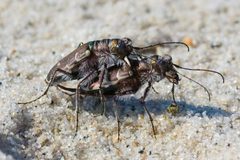
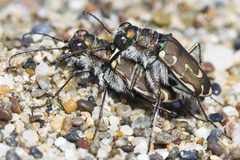
Cicindela hirticollis is a medium-sized tiger (2–14 mm) found on sand bars and sandy beaches across North America. It is distinguished by dark brown surfaces with very light cream or white elytral markings. The is active in summer and exhibits distinctive thermoregulatory . are currently in decline.
Pronunciation
How to pronounce Cicindela hirticollis: /sɪˈsɪndɛlə hɜːrtɪˈkɒlɪs/
These audio files are automatically generated. While they are not always 100% accurate, they are a good starting point.
Identification
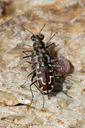
The surest distinguishing character is the 'G'-shaped humeral lunule on the , where the portion is nearly transverse and angles sharply anteriorly on its inner edge. This contrasts with Cicindela repanda, which has a 'C'-shaped humeral lunule that never curls forward on its inner edge. C. hirticollis is also slightly stockier with bolder white markings and a more coppery cast than C. repanda.
Images
Appearance
Medium-sized , 2–14 mm in length. surfaces of , prothorax, and are dark brown. Elytral markings are very light-colored cream or white. Slightly stockier build than similar , with somewhat bolder white markings and a slightly more coppery cast to the body.
Habitat
Sandy beaches and sand bars along rivers and lakes. In Missouri, restricted to wet sand along large rivers (Mississippi and Missouri Rivers). Not found in interior areas away from water. Larvae construct burrows in sandy beach substrate.
Distribution
Widespread in North America. Found along Atlantic and Pacific coasts, Great Lakes shores, and major river systems. Specific records from Canada, USA, and Mexico. Study sites include Lake Michigan (Emmet County, Michigan), Mississippi River in Missouri, and Cape Girardeau County, Missouri.
Seasonality
Active in summer. observed in late July and early August in Missouri. High larval densities observed in August.
Life Cycle
Larval stage occurs in burrows constructed in sandy beach substrate. active in summer.
Behavior
exhibit 'stilting' and 'sun-facing' —thermoregulatory postures employed when sun heats soil surface to potentially lethal temperatures. Extremely wary and active in hot conditions, making close approach difficult. Adults run rapidly and fly readily when disturbed. In Missouri, always found in association with Cicindela repanda though in much lower numbers.
Human Relevance
Subject of ecological study and nature photography. decline noted, though not currently listed as endangered. One of eleven recognized (C. h. shelfordi) documented in Missouri.
Similar Taxa
- Cicindela repandaVery similar appearance and ; distinguished by 'C'-shaped (not 'G'-shaped) humeral lunule, less stocky build, and less bold white markings
- Ellipsoptera cuprascensShares wet sand river beach ; distinguished by coppery coloration and different elytral markings
More Details
Subspecies diversity
Eleven recognized, including C. h. shelfordi (Shelford's Hairy-necked Tiger Beetle) in Missouri, C. h. abrupta, C. h. athabascensis, C. h. coloradula, C. h. corpuscula, C. h. couleensis, C. h. gravida, C. h. hirticollis, C. h. ponderosa, C. h. rhodensis, and C. h. siuslawensis
Sources and further reading
- BugGuide
- Wikipedia
- GBIF taxonomy match
- iNaturalist taxon
- NCBI Taxonomy
- Catalogue of Life
- Cicindela cursitans in Missouri | Beetles In The Bush
- Very wary tigers! | Beetles In The Bush
- be | Beetles In The Bush
- Bruneau Sand Dune tiger beetles caught in the act! | Beetles In The Bush
- Very cozy tigers! | Beetles In The Bush
- Distribution, Abundance, and Some Habits of Larvae of Cicindela Hirticollis (Coleoptera: Cicindelidae) on a Lake Michigan Beach