
Cicindela hirticollis rhodensis
Calder, 1916
Rhode Island Tiger Beetle
Cicindela hirticollis rhodensis is a of hairy-necked tiger beetle in the Carabidae. It is one of several subspecies within the C. hirticollis complex, a group of tiger beetles associated with wet sandy along rivers and streams. are active that hunt visually for small prey. The subspecies name "rhodensis" refers to its type locality in Rhode Island, though the full distribution extends more broadly in eastern North America.
Pronunciation
How to pronounce Cicindela hirticollis rhodensis: /sɪˈsɪndələ hɜːrtɪˈkɒlɪs roʊˈdɛnsɪs/
These audio files are automatically generated. While they are not always 100% accurate, they are a good starting point.
Identification
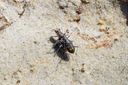
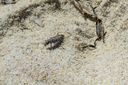
Distinguished from the sympatric Cicindela repanda by the "G"-shaped (versus "C"-shaped) humeral lunule on the , stockier build, and more distinct white markings. The coppery body coloration and association with wet sand along large rivers further separate it from most . Compared to C. hirticollis shelfordi, C. h. rhodensis typically shows less extensive maculations and somewhat different body proportions, though boundaries can be subtle and require geographic context for confident assignment.
Images
Habitat
Specialized to wet sand along rivers, streams, and lakeshores. Found on open, barren sandbars and sandy beaches with proximity to water. Requires substrates that allow for burrowing by larvae and running by . Vegetation is typically sparse in occupied microhabitats, though adults often position themselves near vegetated edges where prey is more abundant.
Distribution
Eastern North America, with records from Canada, the United States, and Mexico. The subspecific epithet reflects the type locality in Rhode Island, but the occurs more broadly in the northeastern and north-central United States and adjacent Canada.
Seasonality
Active primarily during warmer months. As a "summer " within its , are most active during the hottest part of the season, typically from late spring through early fall depending on latitude.
Diet
are visual that actively hunt small on open ground. Specific prey records for this are not documented, but related tiger beetles capture small arthropods including flies, ants, and other ground-dwelling insects.
Life Cycle
Develops through complete with , larva, pupa, and stages. Larvae construct burrows in sandy substrates, where they lie in wait at the burrow entrance to ambush passing prey. Third instar larvae seal their burrows for . Specific developmental timing for this is not documented.
Behavior
are and highly active, employing rapid running and to escape threats. Exhibits thermoregulatory including "stilting" (elevating body on long legs to reduce ground contact) and "sun-facing" (orienting body to minimize solar exposure) during extreme heat. Adults are wary and difficult to approach closely during hot, sunny conditions. Some may be attracted to ultraviolet lights at night, though this behavior appears more pronounced in related such as Ellipsoptera cuprascens.
Ecological Role
Functions as a mid-level in riparian and lacustrine sand , controlling of small . Larval burrowing may contribute to soil aeration and nutrient cycling in sandy substrates.
Human Relevance
Serves as an for healthy, undisturbed sandy shoreline . are vulnerable to habitat loss from riverbank stabilization, recreational development, and water level management. The has been studied for its ecological and evolutionary significance, including diversification and habitat specialization.
Similar Taxa
- Cicindela repandaSympatric and co-occurring on wet sand ; distinguished by "C"-shaped (versus "G"-shaped) humeral lunule, less stocky build, and less distinct maculations.
- Cicindela hirticollis shelfordiAnother of C. hirticollis; differs in geographic distribution (primarily central North America) and subtle differences in body proportions and maculation extent.
- Ellipsoptera cuprascensShares wet sand riverine and similar body form; distinguished by more uniformly coppery coloration, denser and coarser elytral punctation, and activity at lights.
More Details
Taxonomic Note
The Cicindela hirticollis complex includes multiple described with overlapping ranges and intergrading . The validity and boundaries of these subspecies have been debated, with some authorities suggesting -level recognition for certain . C. h. rhodensis represents the nominate subspecies described from the northeastern United States.
Conservation Context
While not currently listed as threatened, tiger beetles of the C. hirticollis complex are vulnerable to shoreline development and hydrological alteration. The restricted microhabitat requirements of both larvae (burrow sites) and (open running surfaces) make sensitive to disturbance.
Sources and further reading
- BugGuide
- GBIF taxonomy match
- iNaturalist taxon
- NCBI Taxonomy
- Catalogue of Life
- Desmiphora hirticollis: Crypsis or Mimicry? | Beetles In The Bush
- Very wary tigers! | Beetles In The Bush
- Very cozy tigers! | Beetles In The Bush
- Cylindera celeripes Larva Revealed | Beetles In The Bush
- Cosmetid harvestman with parasitic/phoretic mites in Argentina | Beetles In The Bush