
Collops cribrosus
LeConte, 1852
Collops beetle
Collops cribrosus is a soft-winged flower beetle in the Melyridae, first described by LeConte in 1852. The belongs to the Collops, which comprises predatory beetles frequently associated with flowering plants where they hunt small prey. Like other members of its genus, C. cribrosus is recognized as a beneficial insect in agricultural contexts, serving as a natural enemy of pest insects. The species has been documented in western North America, with confirmed records from British Columbia.
Pronunciation
How to pronounce Collops cribrosus: //ˈkɒl.ɒps krɪˈbroʊ.səs//
These audio files are automatically generated. While they are not always 100% accurate, they are a good starting point.
Identification
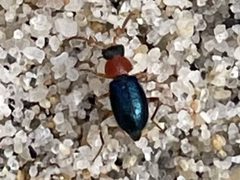
Collops cribrosus can be distinguished from other Collops by the specific arrangement and of punctures on the (the species epithet "cribrosus" refers to this sieve-like punctation pattern). Members of the Collops are generally characterized by soft, flexible elytra, a somewhat flattened body form, and often striking coloration with red or orange and black markings. Accurate species-level identification typically requires examination of genitalic structures and detailed punctation patterns, best confirmed by comparison with or expert determination.
Images
Habitat
Flowering plants in open , including agricultural fields, grasslands, and disturbed areas with abundant herbaceous vegetation. The is strongly associated with plants that support of small prey.
Distribution
Western North America. Confirmed records exist from British Columbia, Canada. The likely occurs more broadly across western regions of the United States and Canada, though precise distribution requires further documentation.
Diet
Predatory, feeding on small arthropods including aphids, , and other soft-bodied insects. The has been observed hunting on flowers where such prey aggregate.
Behavior
active on flowers and vegetation surfaces. Individuals patrol inflorescences and leaf surfaces in search of prey. The is capable of and readily disperses among flowering plants.
Ecological Role
of agricultural and horticultural pests, contributing to of aphids and . As a member of the native predator , it helps regulate herbivorous populations in both natural and managed .
Human Relevance
Recognized as a beneficial natural enemy in programs for cotton and other crops. The Collops, including C. cribrosus, is explicitly mentioned in agricultural extension literature as part of the natural enemy complex that helps suppress pest . Conservation of these through reduced use is encouraged in protocols.
Similar Taxa
- Collops vittatusSympatric with similar flower-visiting and preferences; distinguished by elytral color pattern and punctation
- Collops quadrimaculatusAnother western North American Collops with overlapping range; requires examination of punctation and pattern for separation
- Hippodamia convergensConvergent lady beetle shares flower-visiting predatory and similar ecological role, but belongs to Coccinellidae with hardened, convex and different body form