
Collops vittatus
(Say, 1823)
Striped Collops, melyrid beetle
Collops vittatus is a small predatory soft-winged flower beetle in the Melyridae, measuring approximately 5 mm in length. The exhibits considerable geographic variation in coloration and across its North American range. It has been documented as a of agricultural pests, particularly the spotted alfalfa aphid. The species is found from Canada through the United States to Central America, with notable morphological differences between northeastern and southwestern .
Pronunciation
How to pronounce Collops vittatus: /ˈkɒl.ɒps vɪˈteɪ.təs/
These audio files are automatically generated. While they are not always 100% accurate, they are a good starting point.
Identification
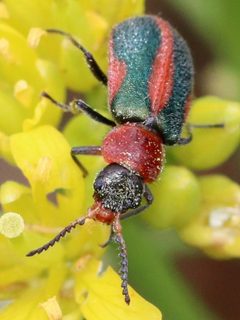
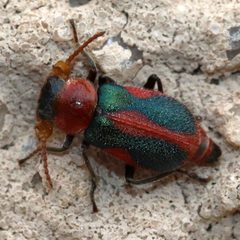
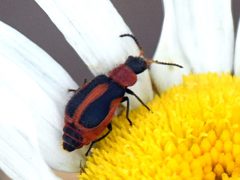
Distinguished from similar Collops by the continuous pale margins on the (, margins, and tips), which remain fairly consistent across geographic variants. The central thoracic spot, formed from two merged spots that do not reach the front margin, is a key feature, though this spot varies in size and may be divided or absent. Males can be identified by the enlarged, irregular second antennal segment. Northeastern specimens tend to be smaller, shinier, with coarser punctuation, darker , and almost entirely black legs; southwestern specimens are larger, duller, more finely punctured, with pale antennae and mostly pale legs.
Images
Appearance
measure approximately 5 mm in length. The is black with and antennal base. The is rufous with a central black spot formed from two merged spots that do not reach the front margin; this spot is variable in size and may be divided or absent. The are greenish-blue with pale rufous , margins, and tips that remain continuous. The underside features a rufous , black postpectus, black with testaceous edging at segmental lines, and mostly black legs with brownish frontal tibiae. Males have an enlarged, irregular second antennal segment; the first antennal segment is somewhat triangular, about one-third longer than wide, not indented at the back, and flattened in front.
Habitat
Agricultural , specifically alfalfa fields in studied regions; broader preferences include areas supporting soft-winged flower beetle . The occupies diverse environments across its wide geographic range, from Canadian prairies to southwestern United States.
Distribution
North and Central America. In North America: southwestern United States, northeastern United States, and Canada from Saskatchewan to Quebec. Canadian distribution includes Alberta, Manitoba, New Brunswick, Northwest Territories, and Ontario. Distribution is not always continuous throughout this range.
Diet
Predatory; has been observed feeding on the spotted alfalfa aphid (Therioaphis maculata). Specific broader dietary range not documented in available sources.
Host Associations
- spotted alfalfa aphid - preyPrimary prey documented in Arizona agricultural study
Behavior
Predatory targeting agricultural pest aphids. Specific behavioral details beyond feeding habits not documented in available sources.
Ecological Role
agent of agricultural pests; contributes to in alfalfa .
Human Relevance
Studied as a agent for the spotted alfalfa aphid in agricultural settings. Potential value in programs.
Similar Taxa
- Other Collops speciesSimilar general as soft-winged flower beetles; distinguished by the continuous pale elytral margins and specific thoracic spot pattern of C. vittatus
More Details
Geographic variation
The exhibits extensive morphological variation across its range, with northeastern and southwestern differing in size, shininess, punctuation , and leg coloration. Intermediate forms occur in the Dakotas, Montana, Colorado, Texas, and Arizona, making clear-cut geographic varieties difficult to define.