
Collops reflexus
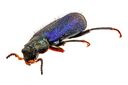
Collops reflexus is a of soft-winged flower beetle in the Melyridae. Like other members of the Collops, it is a predatory found in association with flowering plants. The genus is recognized for its ecological role as a of pest insects in agricultural systems, including cotton. Collops reflexus has been documented in field observations on flowers of Gutierrezia sarothrae (broom snakeweed) in northeastern New Mexico, where it occurs alongside other flower-visiting beetles.
Pronunciation
How to pronounce Collops reflexus: //ˈkɒl.ɒps rɪˈflɛks.us//
These audio files are automatically generated. While they are not always 100% accurate, they are a good starting point.
Identification
Collops reflexus can be distinguished from similar Collops by specific elytral markings and body proportions, though detailed diagnostic features require examination of and original descriptions. The Collops is characterized by soft , relatively long legs, and often bright coloration with red or orange markings contrasting against darker backgrounds. Species-level identification within Collops typically requires close examination of antennal structure, pronotal shape, and the pattern of maculation on the elytra.
Images
Habitat
Documented from juniper/pine/oak woodland edge in the Great Plains, specifically in canyon environments at the interface between grasslands and Rocky Mountain foothill vegetation. Associated with flowering plants in disturbed or semi-arid environments.
Distribution
Recorded from Mills Rim Campground in Harding County, northeastern New Mexico, at the western edge of the Great Plains. The broader distribution of the likely encompasses the southwestern United States, though specific range boundaries remain poorly documented.
Seasonality
Observed in mid-September in northeastern New Mexico, suggesting activity in late summer to early fall. This timing coincides with the blooming period of Gutierrezia sarothrae, its documented plant association.
Diet
Predatory. As a member of the Collops, it preys on small insects and other arthropods. Documented occurrence on flowers of Gutierrezia sarothrae suggests hunting of other flower-visiting insects. Related such as Collops vittatus are known of pest insect , including those of Lygus hesperus (western tarnished plant bug).
Host Associations
- Gutierrezia sarothrae - foraging_habitat observed on flowers, presumably hunting prey
Behavior
are active on flowers during daylight hours, where they likely hunt other insects attracted to floral resources. unknown.
Ecological Role
in flower-associated . Contributes to of pest insects in natural and agricultural systems. The Collops is explicitly recognized as a component of natural enemy in cotton agroecosystems.
Human Relevance
Member of a recognized as beneficial for in programs, particularly in cotton production. Potential value as a natural enemy of plant bug pests and other agricultural pests, though specific economic impact of C. reflexus unstudied.
Similar Taxa
- Collops vittatusCongeneric with similar and appearance; both are soft-winged flower beetles in the same , though C. vittatus has been more extensively studied as a of Lygus hesperus
- Collops sp.Other undetermined in the share the general habitus of soft , flower association, and predatory , requiring careful examination for species-level identification