
Lygus hesperus
Knight, 1917
Western Tarnished Plant Bug
Lygus hesperus is a significant agricultural pest in western North America, causing extensive damage to cotton, strawberries, alfalfa seed, and other crops. In California alone, losses exceed $30 million in cotton and $40 million in strawberries. overwinter in reproductive triggered by short day lengths, resuming activity when conditions improve. The has been the subject of extensive research on sampling methods, , and resistance.
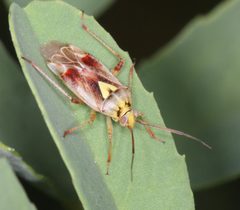
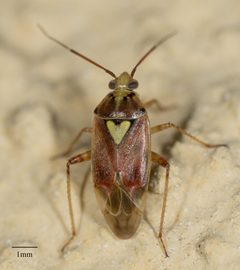
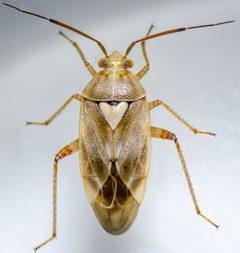
Pronunciation
How to pronounce Lygus hesperus: //ˈlaɪɡəs ˈhɛspərəs//
These audio files are automatically generated. While they are not always 100% accurate, they are a good starting point.
Identification
are approximately 6 mm (¼ inch) long with a conspicuous dark-colored triangle (scutellum) in the center of the back. Coloration varies from pale green to yellowish-brown with reddish-brown to black markings. Nymphs are uniformly pale green with red-tipped ; late instars display four conspicuous black spots on the and one large black spot near the base of the . Nymphs lack developed wings but move rapidly through foliage. Distinguished from Lygus lineolaris () by geographic range—L. hesperus predominates in the western half of Texas and western states, while L. lineolaris dominates the eastern half.
Images
Habitat
Agricultural fields and adjacent non-crop areas including pastures, rangeland, and weedy field margins. Strongly associated with succulent plant growth. In cotton, occurs from presquaring through open-boll stages. Found in alfalfa fields, potato fields, and strawberry plantings. Non-crop hosts include clovers, dock, mustard, pigweed, Russian thistle, vetches, and wild sunflower.
Distribution
Western North America: documented from California, Arizona, Nevada, Washington, and western Texas. Present in Mexico. Most abundant and economically significant in California's Central Valley and Central Coast agricultural regions.
Seasonality
Overwinters as diapausing in response to short . termination occurs when environmental conditions become favorable, with postdiapause females resuming . Activity patterns follow plant ; build in spring on wild hosts and legumes before moving to cotton and other crops during fruiting periods. In California strawberries, monitored throughout the growing season with immigration from surrounding weeds and alfalfa.
Diet
Phytophagous; feeds on developing reproductive structures of plants. In cotton, feeds on terminals, squares, flowers, and small bolls. Feeding causes deformed bolls, dirty bloom (damaged anthers), puckered petals, square and small boll shedding, stunted growth, and dark sunken on boll surfaces that can penetrate carpel walls and damage seeds or lint. Prefers legumes to cotton when available.
Host Associations
- Gossypium hirsutum - pestCotton; major economic in California and Texas
- Fragaria × ananassa - pestStrawberry; key pest in California organic production
- Medicago sativa - Alfalfa; preferred , source of that move to other crops
- Solanum tuberosum - Potato
- Lens culinaris - pestLentil
- Various clovers (Trifolium spp.) - wild
- Rumex spp. (dock) - wild
- Brassica spp. (mustard) - wild
- Amaranthus spp. (pigweed) - wild
- Salsola tragus (Russian thistle) - wild
- Vicia spp. (vetches) - wild
- Helianthus spp. (wild sunflower) - wild
Life Cycle
, nymph (five instars), . Eggs laid beneath plant tissue surface, concealed from . Nymphs develop through five instars before becoming winged adults. In laboratory rearing, completes development and on artificial diets; one study documented 15 on a modified diet. Adults enter reproductive under short day lengths.
Behavior
Strongly attracted to succulent plant growth. Nymphs move rapidly and are difficult to detect in foliage. capable of and between patches. Feeding involves stylet-probing with saliva secretion containing polygalacturonases, , and other for extraoral digestion. adults are reproductively inactive; postdiapause females resume and oviposition when conditions improve. Research indicates short-term does not reduce lifetime and may enhance early reproductive rate and longevity.
Ecological Role
Major agricultural pest causing direct feeding damage to crop reproductive structures. Serves as for introduced agent Peristenus relictus, a European nymphal established in California. Preyed upon by including convergent lady beetles (Hippodamia convergens) and Collops vittatus; molecular studies confirm by these . Mockingbirds and other birds consume L. hesperus in strawberry systems, contributing to biological control. May bacterial plant Pantoea ananatis and Serratia spp. based on detection in salivary secretions.
Human Relevance
Causes substantial economic losses in multiple cropping systems. In California, estimated damage of $30 million to cotton and $40 million to strawberries. In organic strawberry production, establishment of Peristenus relictus has averted estimated losses of $1,901 per acre through suppression exceeding 95% in weeds and alfalfa and 70% in strawberry after 10 years. Subject to intensive including sampling with sweep nets and drop cloths, applications (noted to be more difficult to control than related , requiring higher labeled rates), and . Research has developed drone-based sampling methods (iDrone ) for population monitoring. Used as model organism in mark-release-recapture studies with fluorescent dyes.
Similar Taxa
- Lygus lineolaris; nearly identical in appearance, , and damage . Distinguished primarily by geographic distribution—L. lineolaris predominates in eastern North America and eastern Texas, L. hesperus in western regions. The two overlap in central Texas.
- Lygus elisusPale legume bug; third predominant Lygus in Texas cotton. Similar appearance and damage. Less commonly encountered than L. hesperus in western regions.
- Aphids, cotton fleahoppers, and leafhopper nymphsSmall L. hesperus nymphs can be mistaken for these . Distinguished by broader body shape, rapid movement, larger size, red-tipped , and characteristic black spot patterns on late instars.
Sources and further reading
- BugGuide
- Wikipedia
- GBIF taxonomy match
- iNaturalist taxon
- NCBI Taxonomy
- Catalogue of Life
- Occasional Pests - AgriLife Extension Entomology
- From Burglars to Bugs: Anti-Theft Dye Useful in Insect-Tracking Studies
- Researchers Share New Method for Detecting Insect Egg Predators
- How One Entomologist is Breaking Barriers in Crop Protection
- Birds, Bugs, and Agriculture: Is It a Sin to Kill a Mockingbird?
- Sweep Net in the Sky: Team Designs Drone for Insect Scouting
- Reproductive biology ofLygus hesperusKnight: III. Modification of reproduction inLygus hesperus
- Lygus hesperus Distribution and Sampling Procedures in Lentils
- Salivary Proteins ofLygus hesperus(Hemiptera: Miridae)
- Potassium chloride deters Lygus hesperus feeding behavior
- No effect of a fluorophore taggant on western tarnished plant bug, Lygus hesperus roaming and flight behavior
- Reproductive biology ofLygus hesperusKnight: I. Laboratory studies on lygus reproduction
- Diapause Termination and Postdiapause in Lygus hesperus (Heteroptera: Miridae)
- Reproductive biology ofLygus hesperusKnight: II. Biology of the lygus bug sex pheromone
- New Oligidic Production Diet for Lygus hesperus Knight and L. lineolaris (Palisot de Beauvois)2,3
- Quantifying the economic impact of Peristenus relictus establishment on host Lygus hesperus populations in California organic strawberry
- Abundance and Distribution of Lygus hesperus (Heteroptera: Miridae) in Two Conifer Nurseries in Western Oregon