
Lygus elisus
Van Duzee, 1914
pale legume bug, lucerne plant bug
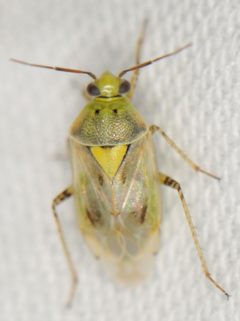
Lygus elisus is a plant bug in the Miridae, commonly known as the pale legume or lucerne plant bug. It is a significant agricultural pest of forage, fiber, and fruit crops, particularly alfalfa, cotton, and strawberries. The species is distributed across western North America from Alaska to northern Mexico, with established also reported in Oceania. and nymphs feed on developing plant tissues using , causing economic damage including cat-faced berries in strawberry production. Female-produced have been identified and developed for monitoring and potential management applications.
Pronunciation
How to pronounce Lygus elisus: /ˈlaɪɡəs ɛˈliːsəs/
These audio files are automatically generated. While they are not always 100% accurate, they are a good starting point.
Identification
are small plant bugs approximately 5-6 mm in length. The can be distinguished from other Lygus species by male genitalia characteristics; adult males are illustrated in taxonomic keys. General Lygus includes a conspicuous dark-colored triangle in the center of the back (the scutellum), with body coloration varying from pale green to yellowish brown with reddish brown to black markings. Nymphs are uniformly pale green with red-tipped ; late instars have four conspicuous black spots on the and one large black spot near the base of the . Accurate species-level identification requires examination of male genitalia or molecular methods.
Images
Habitat
Agricultural crop systems including alfalfa fields, cotton fields, and strawberry production systems. Also found in native vegetation adjacent to agricultural areas. The thrives in environments with abundant plants providing succulent growth.
Distribution
Western North America: Alaska, western Canada (British Columbia, Alberta), western United States (California, Arizona, Idaho, Nevada, Washington), and northern Mexico. Also established in Oceania. GBIF records confirm presence in these regions.
Diet
Both nymphal and stages feed on plants using . Documented crop hosts include alfalfa (forage), cotton (fiber), and strawberries (fruit). In laboratory colonies, reared on green bean pods (Phaseolus vulgaris), of navel orangeworm (Amyelois transitella), and raw sunflower seeds.
Host Associations
- alfalfa - primary crop forage crop
- cotton - primary crop fiber crop
- strawberry - primary crop fruit crop; feeding causes cat-faced berries
- green bean - laboratory Phaseolus vulgaris; used for rearing
- navel orangeworm - laboratory diet component of Amyelois transitella used in colony maintenance
- sunflower - laboratory diet componentraw seeds used in colony maintenance
Life Cycle
Development is temperature-dependent. to development ranges from 37.6 days at 15°C to 11.1 days at 30°C. Five nymphal instars. Lower developmental threshold estimated at 10.6°C, upper threshold at 34.5°C; no survival to adulthood at 35°C. Preoviposition period averages 8.3 days at 25°C. Mean highest at 25°C (128.8 eggs per female). Eggs laid in plant tissues such as green bean pods in laboratory conditions.
Behavior
disperse within and among different plants searching for new nutritional resources. Males are attracted to female-produced . Both nymphs and adults are active feeders, causing characteristic damage to developing plant tissues. Reproductively active under long-day conditions (18:6 h L:D).
Ecological Role
Agricultural pest causing economic damage to forage, fiber, and fruit crops. Feeding damage reduces crop quality and yield, particularly in strawberry production where it causes unmarketable cat-faced fruit. Serves as prey for including Geocoris (bigeyed bugs) in agricultural systems.
Human Relevance
Major economic pest of high-value agricultural crops. Management relies on strategies including monitoring with traps, , and judicious use. Pheromone-based monitoring uses a 100:60 blend of (E)-2-hexenyl butyrate and (E)-4-oxo-2-hexenal. has been reported, complicating chemical control. Subject of simulation modeling for optimizing pest management strategies.
Similar Taxa
- Lygus hesperusWestern tarnished plant bug; co-occurs in western North America, similar appearance, , and damage profile. Distinguished by male genitalia and composition.
- Lygus lineolarisTarnished plant bug; eastern North American counterpart with overlapping and pest status. Geographic separation is primary distinguishing feature.
- Lygus nubilusPreviously confused due to taxonomic synonymies; distinguished by male genitalia characteristics in taxonomic keys.
Sources and further reading
- BugGuide
- Wikipedia
- GBIF taxonomy match
- iNaturalist taxon
- NCBI Taxonomy
- Catalogue of Life
- Occasional Pests - AgriLife Extension Entomology
- What You Should Know about 'Berries Vs. Bugs' | Bug Squad
- High Honor for Emily Bick: ESA Student Certification Award | Bug Squad
- Don't Miss This UC Davis Seminar by Ecology Researcher Andrew Corbett | Bug Squad
- Remembering Vernon Burton: 1924-2015 | Bug Squad
- Insects that feed on developing grain in the head - AgriLife Extension Entomology
- Influence of Constant Temperatures on Life History of Immature <I>Lygus elisus</I> (Hemiptera: Miridae)
- THE LYGUS BUGS (GENUS LYGUS HAHN) OF NORTH AMERICA (HETEROPTERA: MIRIDAE)
- Development of practical pheromone lures for Lygus hesperus and Lygus elisus (Heteroptera: Miridae).