
Coenosia humilis
Meigen, 1826
tiger fly
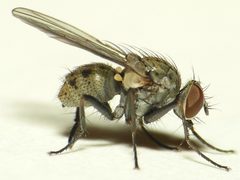
Coenosia humilis is a predatory muscid fly commonly known as the tiger fly. It is an active of small flying insects, particularly agromyzid leafminers, and has been studied as a agent in agricultural systems. The is native to Europe but has been recorded in multiple regions including Indonesia and the North Atlantic islands. It exhibits distinct daily activity patterns with peak hunting during morning and afternoon hours.
Pronunciation
How to pronounce Coenosia humilis: /kɛˈnoʊ.sɪə ˈhjuː.mɪ.lɪs/
These audio files are automatically generated. While they are not always 100% accurate, they are a good starting point.
Images
Habitat
Agricultural , specifically potato fields. The has been documented in cultivated agricultural settings in Indonesia, suggesting adaptability to crop environments. European occur in the native range of the species.
Distribution
Europe (native range); recorded in Belgium, Denmark, and the Azores (São Miguel). Introduced or vagrant documented on Tristan da Cunha in the South Atlantic. Field studies conducted in Pangalengan, Indonesia indicate presence in agricultural regions of Southeast Asia.
Diet
Small flying insects captured in . Approximately 60% of prey consists of agromyzid flies, specifically the leafminer . Laboratory studies indicate individual consumption rates of 23.5 leafminer flies per day. Prey are subdued and body contents extracted through sucking.
Host Associations
- Liriomyza huidobrensis - -preyPrimary prey item comprising ~60% of diet in potato field studies
Behavior
activity pattern with peak activity during morning and afternoon hours. Hunting involves aerial capture of flying prey followed by extraction of body contents through sucking. occurs on small insects, with documented specialization on leafminer flies in agricultural contexts.
Ecological Role
and potential agent of agricultural pests, particularly leafminer flies. suppression of this predator through application has been observed to cause subsequent increases in leafminer pest populations, indicating its functional importance in agroecosystem pest regulation.
Human Relevance
Studied as a agent for leafminer pests in potato . Susceptible to broad-spectrum , which can disrupt its pest suppression services and exacerbate pest . Management recommendations may include insecticide selection or timing to preserve .
More Details
Conservation and management considerations
application in potato fields significantly suppresses C. humilis while simultaneously promoting leafminer pest populations, demonstrating the ecological trade-offs of chemical pest management and the value of conservation in strategies.
Sources and further reading
- BugGuide
- Wikipedia
- GBIF taxonomy match
- iNaturalist taxon
- NCBI Taxonomy
- Catalogue of Life
- Bug Eric: Spider Wasp, Agenioideus humilis, Caught on Video
- Ivy bees and rare carder bees in a warming world - Buglife Blog - Buglife
- Bug Eric: Tiny Wasp Hero Slays Redback Spiders in Australia
- Twig tethered to a twig | Beetles In The Bush
- Researchers Develop Genome Map for Mojave Poppy Bee
- Bare ground experiments to help save rare bees and wasps - Buglife Blog - Buglife
- Lalat predator Coenosia humilis Meigen (Diptera: Muscidae) pada pertanaman kentang: pola aktivitas harian, pemangsaan, dan pengaruh aplikasi insekisida